Robots · Home robots
Zeroth M1 teleoperation: a $2,499 small humanoid, its controller, SDK and limits
The M1 is the cheapest humanoid you can preorder for the home in 2026: 50 cm tall, 2.8 kg, with a gamepad, an open SDK and simulation support. It is a companion and a learning platform, not a chore robot, and the difference matters.
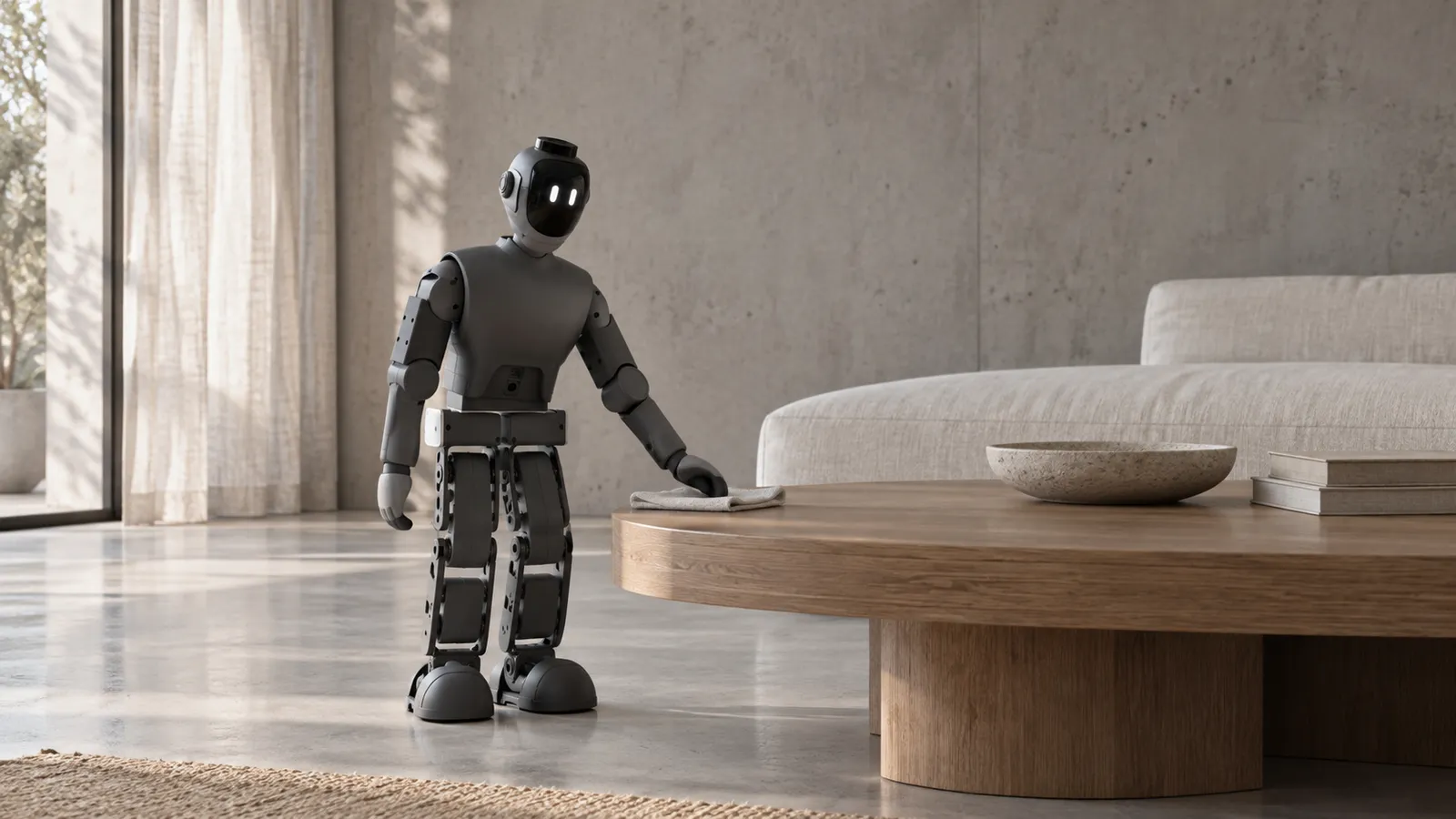
- Size
- 50 cm tall, 2.8 kg, 510 mm arm span
- Legs
- 12 DoF (6 per leg)
- Sensors
- Head LiDAR (LDS), RGB camera, torso iToF depth, 3-mic array
- Compute
- Horizon RDK 5, 10 TOPS NPU
- Battery and speed
- About 2 h; about 0.2 m/s walking, 1.1 m/s on its cart
- Software
- Python SDK, M1 Spine SDK, ROS 2, Isaac Gym, MuJoCo
- Price
- Listed at $2,499 (M1 EDU Combo, preorder) on Zeroth as of October 2026
Updated
Zeroth's M1 is a 50 cm, 2.8 kg two-legged humanoid that its maker pitches as a companion for the home. The M1 EDU Combo is on preorder in the US at $2,499, which makes it the least expensive home humanoid we know of that you can reserve today. It ships with a gamepad, a Python SDK, ROS 2 integration and support for training policies in Isaac Gym and MuJoCo. It does not do housework, and nothing on Zeroth's product page claims it does. This page covers what the M1 is, how you drive it and program it, what it can and cannot do in a home, what Zeroth says about data, and how it compares with the larger humanoids people consider alongside it.
Price, preorder terms and shipping
The M1 EDU Combo page lists $2,499.00, says "Ships Q4 2026", and limits the first batch to 100 units in November. Zeroth ships to the United States only for now, offers a one-year US warranty, and promises a "full refund any time before dispatch". In the box: the M1, a power adapter, a wheeled cart for transport, a remote controller, a USB data and power cable, a manual and an EPP foam case. At its CES 2026 debut, The AI Insider reported pricing "starting at $2,899" with preorders expected in the first quarter and general availability in April. The current listing is lower and later; plan around the product page.
Zeroth is a young company. Its July 6, 2026 funding post says it is based in Suzhou, China, was founded in 2024, closed a Pre-A round of nearly 500 million yuan led by Ant Group for 1 billion yuan raised in total, and has more than 30,000 robot orders across its lineup.
What the M1 is, and what it is not
Zeroth's site calls the M1 "The Companion" and describes it as "one of the world's first embodied intelligence robots designed specifically for home environments." The product page lists six built-in skills: variable-speed walking, walking through obstacles, a one-leg kick, getting up, dancing, and balancing on its cart. It also describes obstacle detection, path planning and waypoint navigation, and real-time face detection and verification from its onboard camera. The AI Insider described intended home uses as reminders and light help for older adults, routine support for families, and a programmable platform for hobbyists.
Can
Cannot
One spec inconsistency is worth knowing: the product page lists 12 degrees of freedom in the legs, six per leg, while its unboxing section describes a "20-DOF" humanoid. The total including arms and head is not broken out. Ask Zeroth for the full joint list if you plan to write control code against it.
How you drive it: the gamepad
The included remote controller is the M1's teleoperation interface. Per the product page, the left stick sets walking direction, the right stick handles turning and speed, the face buttons trigger quick actions, and LB + X is a deployment shortcut. That is locomotion teleop: you steer a walking policy rather than moving individual joints. It is the right design for a small biped, where balance has to be handled on board, and it is the same split larger humanoids use, with the person choosing where to go and the controller deciding how to step.
There is no published arm teleoperation mode, VR interface or leader device, and no remote-operator service. Nobody from Zeroth drives an M1 in your home. If you want to teach it arm motions, you will be writing or training them yourself.
Programming and training policies
The developer side is the more interesting part of the EDU Combo. Zeroth lists a Python SDK, an "M1 Spine SDK" for low-latency motor control, ROS 2 integration at the message-bus level, Linux and over-the-air update workflows, simulation in NVIDIA Isaac Gym and MuJoCo through native Python APIs, and PyTorch or ONNX export for deploying policies through what it calls its Reinforced Imitation Framework. It recommends at least 8 GB of GPU memory for training. A starter kit and a reward-functions repository are marked "Coming Soon".
The page says the deployment code is "fully open source" and links a GitHub repository under the ZerothOpenBridge organization. When we checked on October 16, 2026, that repository returned a 404 and the organization showed no public repositories. That may change before shipping; until it does, treat the open-source claim as pending.
The M1 workflow is simulation-first: train a locomotion or motion policy with reinforcement learning in Isaac Gym or MuJoCo, export it, and deploy it to the robot. That works well for walking and getting up. Manipulation in a home is different: it usually needs demonstrations recorded on the real robot, which is where teleoperation comes in on larger platforms.
Privacy: what Zeroth's policy covers
Zeroth's privacy policy, last updated December 9, 2025, is issued by "joyin-ai", the operator of the store and website, and covers contact, payment, account, transaction, communications, device and usage data. It does not mention the robot's camera, depth sensor or microphones, the face verification feature, or whether any of that data leaves the robot. It does say users "may have a right to request that we delete personal information", that Zeroth does not knowingly collect data about children, and that retention "depends on different factors". For a robot marketed for family homes, with face verification and a microphone array, ask Zeroth whether face templates and audio are processed only on the device, and whether any data is sent to its servers or third parties.
A US regulatory note
On July 28, 2026, the FCC added foreign-produced advanced robotic devices to its Covered List. The definition explicitly includes humanoid robots that move and avoid obstacles, operate on commands or sensor data, weigh over 4.4 lb (the M1 is 2.8 kg, about 6.2 lb) and have sensors, network connectivity and control software, unless granted a Conditional Approval by the Department of War. Covered equipment cannot receive new FCC equipment authorizations. Zeroth has not said where the M1 is produced or whether it has a Conditional Approval, so how the rule applies is unknown. It is worth asking before counting on a Q4 2026 delivery.
M1 against larger humanoids
The next step up for people who want a programmable humanoid is the Unitree G1, which Unitree lists at US $13.5K: 1,320 mm tall, about 35 kg, with 23 degrees of freedom in its base version and about two hours of battery. It is big enough to reach tables and handle objects, and our page on it covers its teleoperation options; it is also more than five times the price and a far more serious machine to have around children. Unitree also makes the smaller R1, covered on its own page. If the goal is to learn manipulation and data collection rather than legged locomotion, a low-cost arm such as the SO-101 teaches more for less. The M1's niche is clear: a walking humanoid that fits on a desk, costs a fraction of a full-size humanoid, and lets you train and deploy locomotion policies at home.
For teams building home humanoids
Small companion humanoids are where many families will first meet a robot, and the larger ones that follow will need to learn real household tasks. That learning runs on demonstrations and on remote takeover when a policy is unsure. RoboPilots staffs both for robot makers, on their hardware and under their privacy rules. For each program we train a dedicated group of operators on your unit and task protocol, and the same group stays on it. A one-week trial sets the clean-episodes-per-operator-hour baseline, shifts run across time zones including US Pacific, and every session is labeled and delivered as LeRobot, RLDS or HDF5. Our home and hospitality page covers how these programs are scoped.
Interfaces, specs and sources
- Gamepad remote (included)
- Python SDK and M1 Spine SDK
- ROS 2 (message bus)
- Isaac Gym and MuJoCo
- PyTorch/ONNX policy deployment
Availability: Preorder. Zeroth lists the M1 EDU Combo at $2,499 with "Ships Q4 2026", a first batch of 100 units in November, US shipping only and a full refund any time before dispatch (zeroth0.com, checked October 16, 2026).
Specs are the maker's published figures, checked on . RoboPilots is not affiliated with Zeroth; product names are trademarks of their owners.
- Zeroth: M1 EDU Combo product page, specs and preorder terms
- Zeroth: homepage and lineup
- Zeroth: Pre-A financing announcement, Jul 6, 2026
- Zeroth: privacy policy (updated Dec 9, 2025)
- The AI Insider: Zeroth enters US market at CES 2026, Jan 5, 2026
- Unitree G1 product page
- FCC: foreign-produced power inverters and robots added to Covered List, Jul 28, 2026
- FCC Public Notice DA 26-786 with National Security Determination (PDF)
Frequently asked questions
- How much is the Zeroth M1?
- Zeroth lists the M1 EDU Combo at $2,499 on preorder as of October 2026. Coverage of its CES 2026 debut quoted pricing starting at $2,899, which the current listing has replaced.
- When does the Zeroth M1 ship?
- Zeroth says it ships in Q4 2026, with a first batch of 100 units in November, to US addresses only. Preorders can be refunded in full any time before dispatch.
- What can a 50 cm humanoid do at home?
- The M1 walks, avoids obstacles, navigates to waypoints, recognizes enrolled faces, dances and gets up on its own, and can run policies you train in simulation. It is too small to do chores such as dishes or laundry.
- Can you program the Zeroth M1?
- Yes. Zeroth lists a Python SDK, a low-latency motor SDK, ROS 2 integration, and Isaac Gym and MuJoCo support, with policies exported from PyTorch or ONNX.
- Is the Zeroth M1 remote controlled?
- It comes with a gamepad that steers its walking and triggers built-in actions. There is no remote-operator service; nobody from Zeroth controls it in your home.