Robots · Humanoids
Unitree R1 teleoperation: what a low-cost humanoid data fleet really takes
The R1 is the cheapest humanoid from a major maker, which makes a fleet of them thinkable. Whether that fleet produces useful data depends on the version you buy, the arm you fit and how you work around the robot's limits.
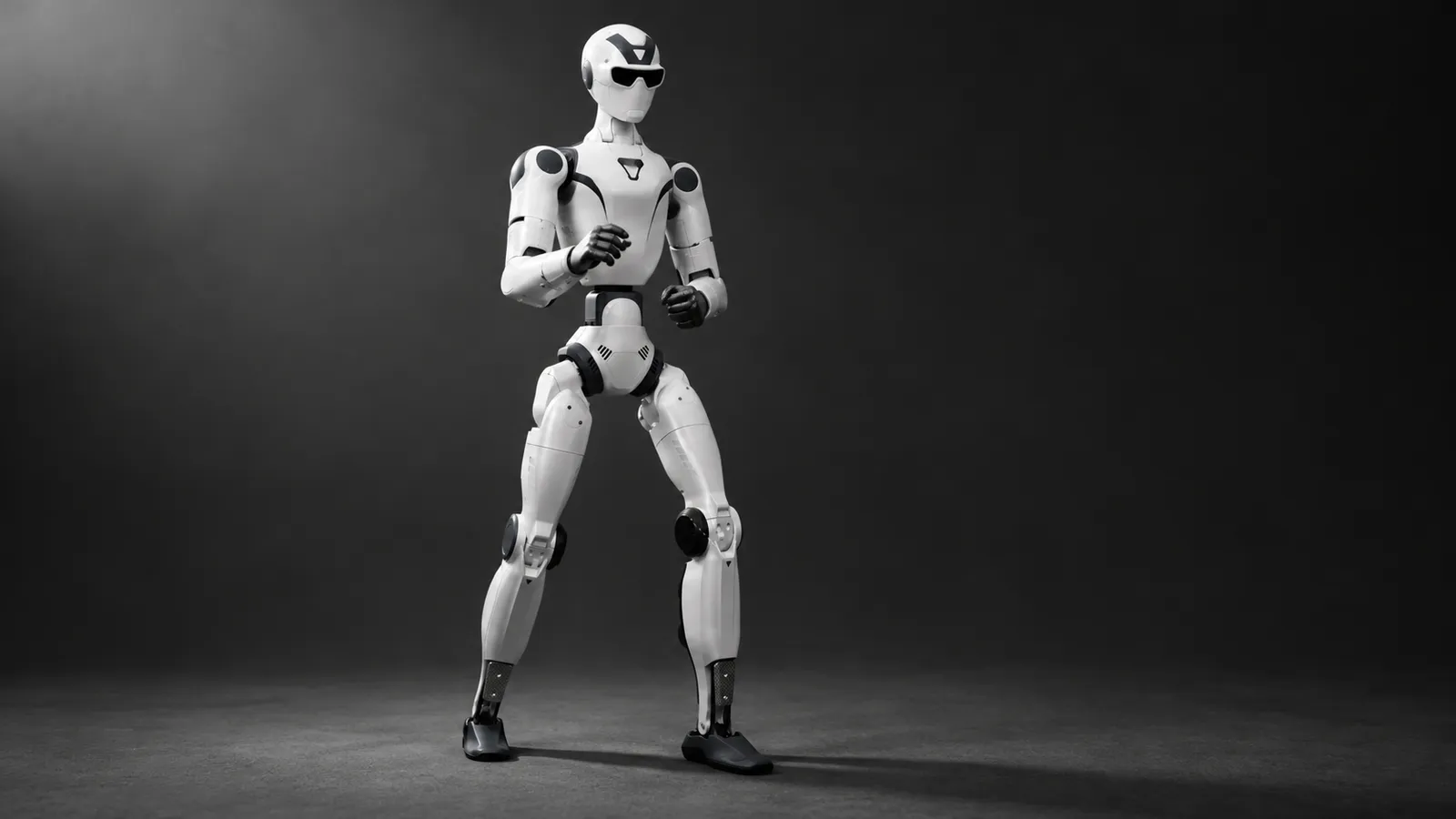
- Height
- 1,230 mm standing (1,230 x 357 x 190 mm)
- Weight
- About 27 kg (AIR); about 29 kg (R1, EDU)
- Degrees of freedom
- 20 (AIR); 26 (R1); 26 to 40 (EDU)
- Arm
- 4 DoF per arm (AIR); 5 DoF (R1, EDU); about 2 kg arm load
- Battery life
- About 1 h
- Cameras
- Monocular (AIR); binocular (R1, EDU)
- Compute
- 8-core processor; EDU option for a high-compute module such as Orin (40 to 100 TOPS)
- Secondary development
- EDU only
Updated
Unitree launched the R1 in July 2025 at $5,900, and the price is the whole story in most coverage. For a robot-learning team the question is narrower: can a group of R1s, driven by remote operators, produce training data you would otherwise need a far more expensive humanoid for? Sometimes, yes. The R1 is a 1.23 m, 29 kg robot with a binocular head camera, a 2-DoF waist and a 2-DoF head, and Unitree has published its own R1 manipulation datasets. It also has an hour of battery, about 2 kg per arm, and a teleoperation stack that only added R1 support in July 2026. This page is about planning around both sides.
AIR, R1 or EDU: the price you actually pay for data
The headline prices are for robots you cannot program. Unitree's shop says it plainly: "Only the EDU version supports secondary development." Every teleop and recording stack below talks to the robot through the SDK, so a data program starts at the EDU.
R1 AIR
R1
R1 EDU
When you model a fleet, use the EDU quote with the hands and compute you need, plus shipping (Unitree lists $300 to $1,200 per order) and import duties. The $5,900 figure is useful for comparison, not for a budget.
As of October 2026, foreign-produced advanced robotic devices are on the FCC Covered List under FCC public notice DA 26-786 (July 28, 2026), unless the Department of War grants them a Conditional Approval. The FCC definition covers mobile robots, including humanoids, quadrupeds and autonomous mobile robots, that weigh over 4.4 lb with any base or dock and have a sensor, network connectivity and control software, when they do not qualify as US-made under the federal Buy American test, whatever the nationality of the maker. Covered models cannot receive new FCC equipment authorizations, which most devices need before they can be imported or sold in the US, while the FCC says models it authorized earlier can still be imported, sold and used; US buyers should confirm the current status with the seller.
How to drive an R1 remotely
Unitree's xr_teleoperate is the official path. Version 1.6 (July 29, 2026) added the R1 with two arm configurations: `R1_A5` for the standard 5-DoF arms and `R1_A7` for robots fitted with 7-DoF arms. The operator wears an Apple Vision Pro, PICO 4 Ultra Enterprise or Meta Quest 3, the arms follow hand or controller tracking, and the `--record` flag saves episodes. Unitree's maintainers described this as "preliminary support for R1" when they closed an R1 EDU support request on July 30, 2026.
The 7-DoF option matters more than it looks. Unitree sells a 7-axis arm, the R1-7a, with a 2 kg payload and 650 mm reach with a dexterous hand, listed from $1,650 by Unitree as of October 2026. A 5-DoF arm cannot reach every position and orientation a human hand can, so operators end up twisting the wrist or the torso to compensate, and the data shows it. Unitree's own R1 towel-folding dataset was recorded on the A7 configuration, which is a hint about where it thinks R1 manipulation data should come from.
Known setup problems, and how to plan around them
Because R1 support is new, the open issues on xr_teleoperate are the best guide to what a team will hit in its first weeks. Three stand out as of October 2026.
Walking during teleop
Head camera detection
Hand configurations
Grippers, hands and the rest of the body
The non-EDU R1 has fixed, fist-style hands; heise described them at launch as able to pinch larger objects but not grip them. For data you need an end effector that opens and closes, which on an EDU means Unitree's Dex1 gripper or an optional dexterous hand. Start with the gripper. It is what Unitree's own R1 data uses, it retargets cleanly from a pinch in hand tracking, and new operators reach a consistent technique on it in days rather than weeks. Move to a dexterous hand when the task needs it, and record that as a separate dataset.
The R1 also has a 2-DoF waist and a 2-DoF head that the published datasets leave out. If the operator turns the head or leans the waist during a demonstration and those joints are not recorded, the camera view changes for reasons the policy cannot see. Either lock them in the protocol or add them to the action vector, and write down which choice you made.
What R1 data looks like
Unitree's Hugging Face organization publishes R1 datasets alongside its G1 sets, including towel folding, pouring popcorn between bowls, putting pens in a drawer and setting plates. The R1_Dex1_Fold_Towel card shows the shape: LeRobot v3.0, Apache-2.0, 29 episodes and 28,850 frames at 30 fps, four 640x480 RGB streams (left and right head, left and right wrist), and a 16-value state and action vector made of 14 arm joints and two Dex1 gripper values.
Upper body only
Grippers, not hands
Short episodes
If you record with xr_teleoperate, the raw episodes are JSON plus images, and Unitree's conversion tooling turns them into LeRobot datasets. Our data collection guide covers quality checks and formats.
Running an R1 fleet
The case for the R1 is breadth: many cheap robots, each doing the same task in a slightly different scene, give a policy variety that one expensive robot cannot. The constraints are operational, and they decide the clean-episode rate more than the hardware does.
Battery rotation
Identical setups
Load limits
One operator, one robot
Latency and the operator link
xr_teleoperate is built for a headset and a host on the same network, with the camera stream served from the robot and the teleop page on port 8012. A remote operator therefore connects to a host at your site, not to the robot directly. Tabletop pick-and-place with a gripper tolerates more delay than fine dexterous work: under about 100 ms round trip feels direct, 100 to 200 ms is workable with slower motions, and beyond that supervision works better than direct control. Our latency guide has the budgets by task.
What a good R1 operator does
R1 or G1?
The Unitree G1 costs more, but xr_teleoperate's joystick walking works on it, it has a larger open ecosystem, and far more of the 205 datasets in Unitree's Hugging Face organization are G1 sets than R1 sets. The R1 wins when you want several robots for the price of one and your task is stationary tabletop manipulation with a gripper. If the task needs walking while working, or dexterous hands from day one, start on a G1.
Takeover and fallback
Once an R1 fleet runs a trained policy, the operators' job shifts to supervision. Design who watches which robots, what triggers a takeover, and how a correction gets labeled before you deploy. Our human-in-the-loop guide covers that design.
How RoboPilots runs R1 teleoperation
Your robots stay at your site. We work through the stack and configuration with you, set up the operator link through a host on your network, and train a dedicated group of operators on your units and your task protocol, including the battery rotation. Several humanoid makers have sent us robots to test our operating protocols, and those protocols are where every new program starts.
One-week trial
Coverage
Data
Interfaces, specs and sources
- unitree_sdk2 (EDU)
- xr_teleoperate v1.6 (R1_A5, R1_A7)
- Vision Pro, PICO, Quest 3
- LeRobot v3.0 datasets
- Dex1 gripper / dexterous hands (EDU)
Availability: Buyable. The R1 AIR is listed at $4,900 and the R1 at $5,900 by Unitree as of October 2026, excluding tax and shipping (Unitree quotes $300 to $1,200 shipping, with duties paid by the buyer). The R1 EDU, the only version that supports secondary development, is sold by quote through Unitree sales. US buyers: see the FCC note on foreign-produced robots (DA 26-786).
Specs are the maker's published figures, checked on . RoboPilots is not affiliated with Unitree; product names are trademarks of their owners.
- Unitree R1 product page and specifications
- Unitree shop: R1
- Unitree R1-7a seven-axis arm
- xr_teleoperate (GitHub)
- xr_teleoperate issue #319: R1 motion mode and SetVelocity
- xr_teleoperate issue #332: R1 EDU head camera
- xr_teleoperate issue #317: R1 EDU five-finger support
- Unitree Robotics datasets (Hugging Face)
- Unitree R1_Dex1_Fold_Towel dataset (Hugging Face)
- heise online: Unitree R1 launch at $5,900
- FCC public notice DA 26-786: foreign-produced robots added to the Covered List (July 28, 2026)
Frequently asked questions
- Is the Unitree R1 programmable without the EDU version?
- No. Unitree's shop states that only the R1 EDU supports secondary development. The AIR and the standard R1 run Unitree's own behaviors.
- How much does the Unitree R1 cost?
- Unitree lists the R1 AIR at $4,900 and the R1 at $5,900 as of October 2026, excluding tax and shipping. The R1 EDU is priced by quote.
- Does xr_teleoperate support the Unitree R1?
- Yes, since version 1.6 in July 2026, with configurations for 5-DoF and 7-DoF arms. Unitree called it preliminary support, and open issues report problems with walking during teleop and with head camera detection.
- Are there public Unitree R1 datasets?
- Yes. Unitree publishes R1 datasets on Hugging Face, such as towel folding and setting plates, in LeRobot v3.0 format with head and wrist cameras and Dex1 grippers.
- How long does the Unitree R1 battery last?
- Unitree lists about one hour of battery life for every R1 version, so a data fleet needs staggered charging.