Robots · Humanoids
Unitree H2 teleoperation: human-height reach, the EDU requirement and the H2 Plus GR00T stack
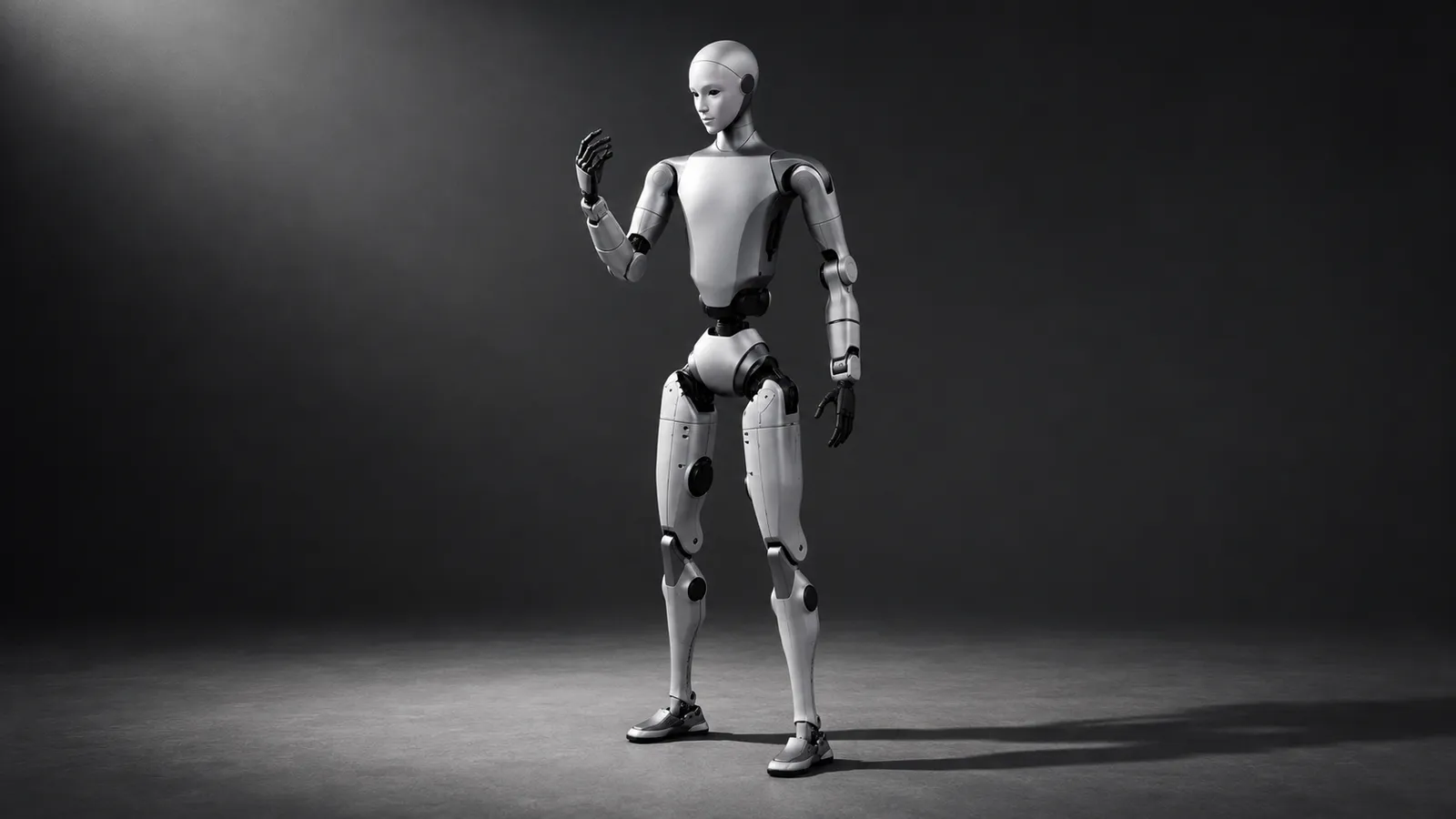
The H2 is a 1.82 m, 31-DoF humanoid at a price research labs can approve. Its teleoperation tooling is newer and thinner than the G1's, so it pays to know what works today and what is still open.
- Height
- 1,820 mm standing (1,820 x 456 x 218 mm)
- Weight
- About 70 kg with battery
- Degrees of freedom
- 31: 6 per leg, 7 per arm, 3 waist, 2 head
- Arm payload
- About 7 kg rated, about 15 kg peak
- Max joint torque
- 120 N·m arm, 360 N·m leg
- Battery
- 15 Ah (0.972 kWh), about 3 h
- Compute
- PC1 Intel Core i5; EDU adds PC2 Intel Core i7 and optional high-compute module; H2 Plus adds Jetson T5000
- Secondary development
- H2 EDU and H2 Plus only
Updated
Unveiled in October 2025, the Unitree H2 is a full-size humanoid with a list price under $30,000. It stands 1.82 m, weighs about 70 kg, and has 31 joints including a 3-DoF waist and a 2-DoF head. Its arms are rated for about 7 kg each. That combination matters for data: a robot at adult height reaches the same shelves, counters and workbenches a person does, so the demonstrations you record are for the environment you actually want to automate. The teleoperation story is younger than the G1's, though, and the gaps are worth knowing before you plan a data program around it.
Three H2s, and only two you can develop on
Unitree sells the H2 in three forms, and the spec table settles which ones you can teleoperate through your own code. Secondary development is marked "YES" for the H2 EDU and for the H2 Plus, and left blank for the standard H2.
H2
H2 EDU
H2 Plus
If a quote or a reseller listing does not say EDU or Plus, assume it is the standard H2 and ask. The difference decides whether your operators can drive the robot through the SDK at all.
As of October 2026, foreign-produced advanced robotic devices are on the FCC Covered List under FCC public notice DA 26-786 (July 28, 2026), unless the Department of War grants them a Conditional Approval. The FCC definition covers mobile robots, including humanoids, quadrupeds and autonomous mobile robots, that weigh over 4.4 lb with any base or dock and have a sensor, network connectivity and control software, when they do not qualify as US-made under the federal Buy American test, whatever the nationality of the maker. Covered models cannot receive new FCC equipment authorizations, which most devices need before they can be imported or sold in the US, while the FCC says models it authorized earlier can still be imported, sold and used; US buyers should confirm the current status with the seller.
How to drive an H2 remotely today
The H2 EDU uses the same unitree_sdk2 and DDS plumbing as the rest of Unitree's humanoids, so most of what works on a G1 carries over in principle. In practice, two stacks are usable right now.
xr_teleoperate (Unitree)
NVIDIA Isaac TeleOp and GR00T (H2 Plus)
One gap to plan around: an open issue on xr_teleoperate, filed on July 26, 2026, asks when H2 head data can be collected in sync with the rest of the stream. It had no maintainer reply when we checked in October 2026. If your policy needs the head joints in the observation, confirm with Unitree or record them through your own SDK node before you start.
What the extra size changes for the operator
Height is the reason to buy an H2, and it changes the operator's job in three ways.
Reach and the waist
Payload
Consequence of a fall
Whole-body versus upper-body data on the H2
Most H2 teleoperation today is upper-body teleop with commanded walking: the arms and hands follow the operator, and the legs follow the joysticks through the robot's own locomotion controller. That is the right default for counter and shelf work. The waist sits in between. If the operator leans the torso through the stack, those three joints belong in the action vector; if the waist stays fixed, leave them out and say so in the dataset card.
True whole-body data, where the legs are part of the demonstration (squatting to lift, stepping while carrying), needs a whole-body controller and a capture device that tracks the operator's body, not just the hands. On the H2 that work is early. Unitree's unitree_rl_gym lists the Go2, H1, H1_2 and G1 but not the H2, while the C++ simulator in unitree_mujoco does include an H2 configuration and uses the same DDS interface as the real robot (domain 1 on loopback for simulation, domain 0 on the real network). That makes MuJoCo the place to rehearse a teleop protocol before an operator touches the real robot.
Hands: Dex3, five-finger options or SharpaWave
On an H2 EDU you choose from Unitree's dexterous-hand options; on the H2 Plus you can fit SharpaWave hands with 22 active DoF, more than 1,000 tactile pixels per fingertip, 150 N grip force and ±1 mm fingertip repeatability. More fingers do not automatically mean better data. Hand tracking from a headset maps the operator's hand onto the robot's, and the more joints the robot hand has, the more the operator's technique and the retargeting decide the result. For pick, place and carry tasks, a simpler hand often yields a higher clean-episode rate. For tool use and in-hand work, the tactile hand is the reason to buy the Plus, and the tactile streams should be recorded from day one even if the first policy ignores them.
Latency for a full-size robot
The control problem is the same as on any Unitree humanoid: a fast local loop (locomotion, IK, safety limits) next to the robot, and a slow loop to the operator over the network. xr_teleoperate is built for a headset and host on the same network, so a remote operator connects to a host on your site rather than to the robot directly. What changes on the H2 is the cost of an overshoot. A heavy arm moving a 7 kg load a few hundred milliseconds behind the operator's hand is harder to stop cleanly than a small arm with a cup. Keep speed limits tighter on a full-size robot once round-trip delay passes about 100 ms, and move fine work from direct control to supervision above about 200 ms. Our latency guide covers the budgets by task.
What a good H2 operator does
H2 versus H1 and G1
Within Unitree's range, the H2 sits between two older robots. The Unitree G1 is smaller and cheaper, with the deepest open ecosystem and hundreds of public datasets; it is the better choice when you want many robots or tabletop tasks. The Unitree H1 is the full-size robot behind many research teleop papers, with more published research code than the H2 but a higher list price. The H2 is the choice when you need adult reach and real payload in a robot you can buy several of, and you accept that some tooling is still catching up.
Takeover and fallback
If you deploy an H2 running a policy, plan the takeover path before the first shift: who watches the robot, what triggers a handover, and which interface the operator uses to finish the task. Using the same stack for takeover as for data collection means each correction is recorded in the same format and can go straight into the next training run. Our human-in-the-loop guide covers the escalation design for humanoids.
How RoboPilots runs H2 teleoperation
The robot stays at your site. We agree the stack with you (xr_teleoperate, Isaac TeleOp on an H2 Plus, or your own), set up the operator link through a host on your network, and train a dedicated group of operators on your unit, your hands and your task protocol, including the fall and stop procedures for a full-size robot. Several humanoid makers have sent us robots to test our operating protocols; those protocols are the starting point, and your H2 program gets its own.
One-week trial
Coverage
Data
Interfaces, specs and sources
- unitree_sdk2 (EDU)
- xr_teleoperate v1.6 (H2, 7-DoF arms)
- NVIDIA Isaac TeleOp + GR00T (H2 Plus)
- unitree_mujoco (C++)
- Vision Pro, PICO, Quest 3
Availability: Buyable. The H2 is listed at $29,900 by Unitree as of October 2026, excluding tax and shipping; the H2 Plus is listed at $100,000 on Unitree's shop as of October 2026. The H2 EDU, which is the version open to secondary development, is sold through Unitree sales by quote. US buyers: see the FCC note on foreign-produced robots (DA 26-786).
Specs are the maker's published figures, checked on . RoboPilots is not affiliated with Unitree; product names are trademarks of their owners.
- Unitree H2 product page and specifications
- Unitree H2 Plus product page
- Unitree shop: humanoid robot prices
- xr_teleoperate (GitHub)
- xr_teleoperate issue #316: H2 head data stream
- unitree_mujoco (GitHub)
- unitree_rl_gym (GitHub)
- KrASIA: Unitree H2 launch coverage
- FCC public notice DA 26-786: foreign-produced robots added to the Covered List (July 28, 2026)
Frequently asked questions
- Do I need the Unitree H2 EDU to develop on it?
- Yes. Unitree's spec table lists secondary development for the H2 EDU and the H2 Plus, not for the standard H2.
- Does xr_teleoperate support the Unitree H2?
- Yes, since version 1.6 of July 29, 2026, for the H2 with 7-DoF arms. An open issue from July 2026 asks when head data can be collected in sync, so check that before relying on head joints in your data.
- How much does the Unitree H2 cost?
- Unitree lists the H2 at $29,900, excluding tax and shipping, and the H2 Plus at $100,000 on its shop, as of October 2026. The H2 EDU is priced by quote.
- What is the difference between the H2 and the H2 Plus?
- The H2 Plus adds a Jetson T5000 compute module, optional SharpaWave tactile hands with 22 DoF each, optional wrist cameras, and a stack built on NVIDIA Isaac TeleOp and GR00T. The body, 31 DoF, payload and battery are the same.
- How much can the Unitree H2 carry?
- Unitree rates the arm payload at about 7 kg, with a peak of about 15 kg.