Robots · Home robots
Labrador Retriever robot: aging in place, and where a carrying robot stops and remote help could start
The Retriever is a self-driving shelf for people who find carrying things hard. It needs no remote operator and has no arm, which makes it a clear example of how far simple, autonomous help goes at home, and what lies beyond it.
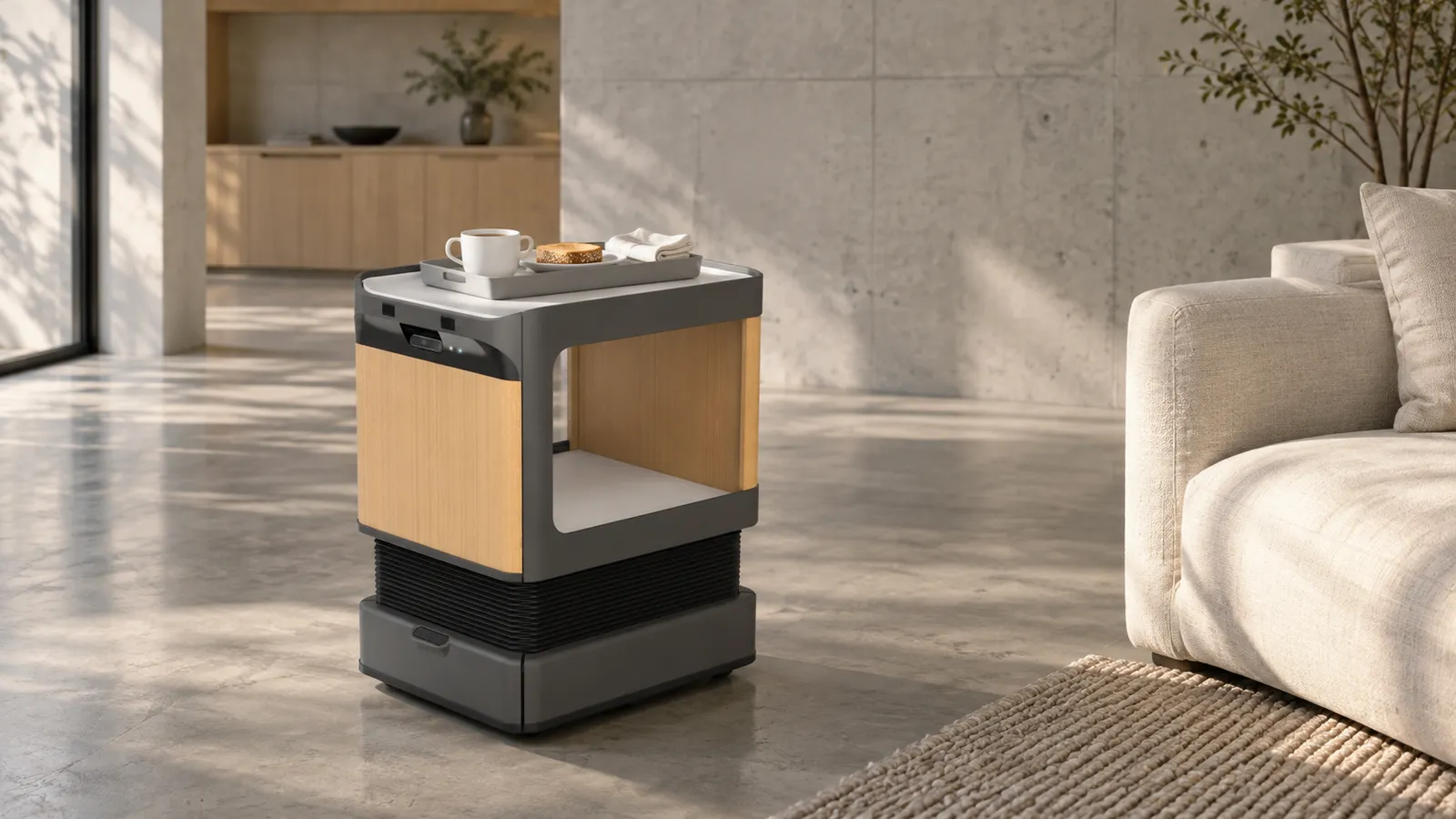
- Models
- Retriever (full-featured) and Caddie (entry level)
- Payload
- Up to 25 lb on two decks; each Retriever tray up to 10 lb
- Deck height (Retriever)
- Upper 25–38 in, lower 11–24 in, self-adjusting
- Footprint
- 18 × 23 in; navigates spaces as narrow as 28 in
- Battery
- A day of normal use per charge; about 4 h to recharge on its dock
- Sensors
- 3D vision, obstacle sensors on all sides, cliff, load and bumper sensors
- Price
- Listed by Labrador from $1,499 up front plus $149/month for 36 months (Retriever, early reservation terms) as of October 2026
Updated
The Labrador Retriever is an assistive home robot from Labrador Systems, built for people with chronic pain, injuries or mobility limits who want to stay independent at home. It is a self-driving, two-deck shelf: it carries meals, laundry and everyday items from room to room, raises its top deck to counter height, and on the Retriever model can pull a tray off a counter or out of a fridge by itself. It has no arm and no remote operator. On a site about the people behind home robots, that is exactly why it is worth a page. The Retriever shows what a carefully scoped, fully autonomous home robot can do for aging in place, and where the next step, hands, would bring humans back into the loop.
Can you get a Retriever?
It is not clear. Labrador's availability page says its updated target for production release of the Retriever Pro, the model for professional care organizations, was Q2 2024, with consumer models to follow based on how quickly it could ramp up for care providers. That date has passed and the page has not been updated. The reserve page says "Our CES 2022 Early Reservation Program has closed", while still offering a $250 refundable deposit for US residents in the contiguous 48 states. The most recent entry on the press page is CEO Mike Dooley speaking at CES in January 2024. We found no announcement of general shipments as of October 2026. If you are considering it for a family member, contact Labrador before you plan around it.
On price, the reserve page lists early-reservation plans: the Caddie from $1,499 up front plus $99 a month for 36 months, and the Retriever from $1,499 up front plus $149 a month for 36 months, with warranty coverage and cloud services while the subscription is active and an option to continue for $49 a month after 36 months. Labrador notes that its dates are estimates, and its product page says specifications are targets that may change before production.
What it does
Carries things
Meets you at the right height
Retrieves trays
Finds its way
How it is controlled, and who is in the loop
Per the product page, you tell it where to go through the Labrador app on a phone or tablet, a voice command through an Alexa-enabled device, a Bluetooth button sold as an accessory, or a pre-set schedule, such as a delivery at the same time every morning. There is no remote operator service and no teleoperation mode. The only people in the loop are the household and, in care settings, the caregivers who set it up. That is a deliberate fit for its users: a robot that must be reliable for someone who cannot easily fix a mistake is better off doing a few things on its own than many things with help.
The Retriever's safety list is longer than its feature list: obstacle sensors in two layers on all four sides, downward depth sensors, cliff sensors for stairs and drops, side bumpers and load sensors that notice when someone leans on it. For a robot that shares a hallway with a person using a walker, detecting bracing is as important as navigating.
Privacy
Labrador's published privacy policy, last updated December 31, 2021, covers its website: contact details and browsing data, with rights to access, update or delete your information. It does not describe what the robot's 3D vision captures, whether maps or images leave the home, or how robot data is used. The reserve page mentions "premium cloud services" as part of the subscription, so some data handling in the cloud is part of the plan. Anyone deploying it, particularly in a care setting, should ask Labrador for the robot's own data terms before installation.
Care providers
Labrador's care providers page is explicit about the role it sees for the robot: "we don't believe robots can replace caregivers", but they can "extend the impact of caregivers by giving them a helping hand." It lists senior living communities, health systems, home health and home care agencies, occupational and physical therapists, post-acute rehab programs and insurers as the organizations it is working with or exploring, and names partners including Nationwide, which ran a pilot announced in March 2022. In November 2022, per the press page, Labrador announced its first business customers planning to deploy robot fleets.
Questions to ask Labrador before you plan around it
These are ordinary questions for any assistive device, and Labrador's public pages answer some of them. The ones about status, data and getting unstuck are the ones to settle in writing.
Where a carrying robot stops
The Retriever solves the transport half of many daily tasks. The other half usually needs hands. A list of what it cannot do maps closely to what assistive manipulation research is working on:
Each of those tasks needs an arm and a manipulation policy, and every home robot doing them today learns from human demonstrations. Several also keep a remote person available to finish what the policy cannot. That changes the privacy and staffing picture for an assistive robot considerably, and it is the main reason simple robots like the Retriever exist: they deliver real help now without those trade-offs.
Retriever against an assistive mobile manipulator
The nearest robot with hands is Hello Robot's Stretch 4, a slim mobile manipulator with a telescoping arm that reaches 55 cm plus a 6 cm wrist and lifts 2.5 kg extended. It is the platform much of assistive home-robot research runs on. The contrast is instructive. Stretch can pick up and hand over objects, but Hello Robot lists it at $29,950 and says on its purchase page that it "is currently only certified for laboratory and research use." The Retriever is built and priced as a consumer and care product, with a much narrower job. For the wider set of home robots, including ones with arms and remote assistance, see our home robots hub.
What remote help could add, done carefully
For companies building the next step, an assistive robot with an arm, remote takeover is a natural fit for the rare, high-value moments: a dropped phone, a jar on a high shelf, a fall-risk situation where the person should not bend down. It is also where privacy matters most, because the people being helped are often older, unwell or both. A responsible program would include:
Our human-in-the-loop guide covers how takeover programs are run on larger robots.
How RoboPilots helps assistive-robot teams
We have no relationship with Labrador Systems, and the Retriever does not use remote operators. For companies building assistive robots that do need people, for demonstration collection or remote takeover, we train a dedicated group of operators on your own unit and task protocol, including the consent and privacy rules your users require. See our home and hospitality page.
One-week trial
Coverage
Data
Interfaces, specs and sources
- Labrador app (phone or tablet)
- Alexa voice commands
- Bluetooth button (accessory)
- Pre-set schedules
- No remote operator
Availability: Announced, status unclear. Labrador's availability page gives a Q2 2024 production target for the Retriever Pro for care providers, with consumer timing to follow; that date has passed. Its reserve page says the CES 2022 early reservation program has closed, and the newest item on its press page is dated January 5, 2024 (labradorsystems.com, checked October 16, 2026).
Specs are the maker's published figures, checked on . RoboPilots is not affiliated with Labrador Systems; product names are trademarks of their owners.
Frequently asked questions
- Is there a robot that can carry things for elderly people at home?
- Yes. The Labrador Retriever is designed for that: a self-driving shelf that carries up to 25 lb between rooms and raises items to counter height. Its availability is unclear as of October 2026, so check with Labrador.
- How much is the Labrador Retriever?
- Labrador's reserve page lists early-reservation terms from $1,499 up front plus $149 a month for 36 months for the Retriever, and $1,499 plus $99 a month for the Caddie. It says that early reservation program has closed.
- Can I control the Labrador Retriever with Alexa?
- Yes. Labrador says you can send it voice commands through an Alexa-enabled device, as well as through its app, a Bluetooth button accessory or a pre-set schedule.
- Is Labrador still shipping?
- We could not confirm it. Labrador's site gives a Q2 2024 production target that has passed, and its newest press item is from January 2024.
- Does the Labrador Retriever have an arm?
- No. The Retriever moves items on two decks and can automatically pick up and set down its own trays, but it cannot grasp objects like a robot arm.