Robots · Home robots
PAL TIAGo Pro teleoperation: the official leader-arm station, and home-assistance data
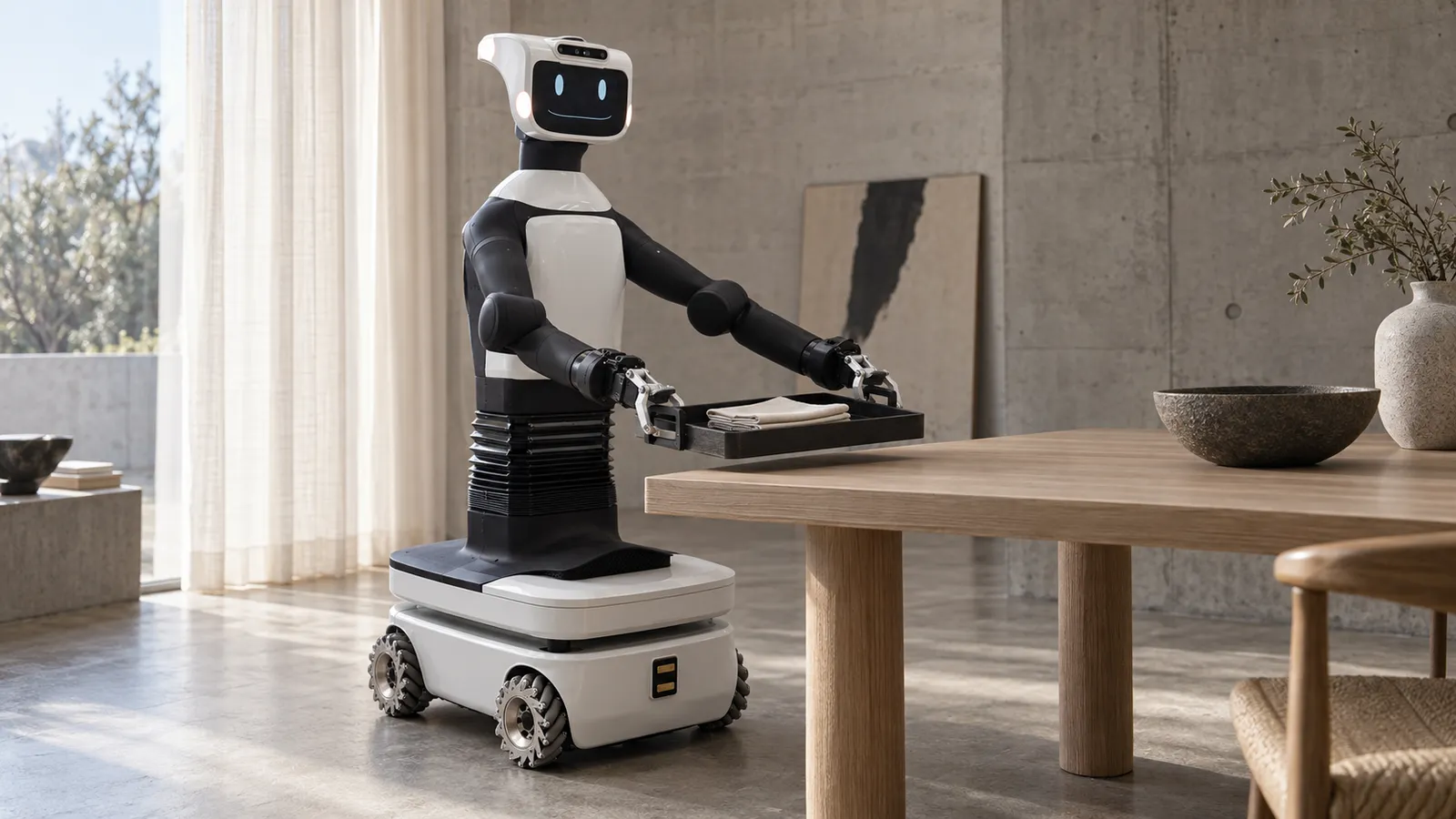
TIAGo Pro is PAL Robotics' two-armed mobile manipulator, sold with an official teleoperation station whose arms mirror the robot's. For labs collecting home and care-setting demonstrations, that matched leader-follower pair is the main reason to choose it.
- Arms
- 2 × 7 DoF, torque sensing on each actuator, 1 kHz EtherCAT (single-arm version available)
- Arm payload
- 3 kg each, excluding end-effector
- Arm workspace
- 92 cm vertical, 236 cm horizontal (as listed by PAL)
- Torso lift
- 35 cm
- Base
- Omnidirectional, 4 mecanum wheels, emergency stop
- Sensors
- Head RGB-D camera, 2 × 360° laser range finders (10 m), optional wrist 6-axis F/T
- Compute
- Intel i5, 16 GB, 512 GB SSD; i7 / 32 GB and NVIDIA Jetson options
- Software
- Ubuntu LTS with PREEMPT-RT, ROS 2, MoveIt 2, Nav2, ros2_control, MuJoCo, Gazebo
Updated
The TIAGo Pro is a research mobile manipulator from Barcelona's PAL Robotics: two 7-DoF arms with torque sensing in every joint, a torso that lifts 35 cm, an omnidirectional base on mecanum wheels, and a head with an RGB-D camera, microphones and a touchscreen. PAL sells it alongside an official Teleoperation Station, a pair of 7-DoF arms with the same 1 kHz EtherCAT bus as the robot. Earlier TIAGo robots have a long record in assistive and care-setting research in Europe. TIAGo Pro brings that platform to bimanual, learning-from-demonstration work, and the station makes it one of the few research robots where the leader arms come from the maker.
Buying a TIAGo Pro
PAL's TIAGo Pro page lists no price or lead time; the only option is "Request a Quote." PAL offers a single-arm version as well as the dual-arm robot, a choice of compute (Intel i5 with 16 GB by default, i7 with 32 GB, and an optional NVIDIA Jetson PC), an additional battery, longer-range laser scanners, a wrist force-torque sensor and a dock charging station. Budget the Teleoperation Station as a separate line item if you plan to collect demonstrations.
US labs have one more check to make. On July 28, 2026 the FCC added "Foreign-produced advanced robotic devices, except advanced robotic devices which have been granted a Conditional Approval by DoW" to its Covered List (FCC public notice DA 26-786), and covered equipment cannot receive new FCC equipment authorizations. The notice defines the category by reference to an attached determination, and we have not seen the FCC or PAL say how it applies to TIAGo Pro. Ask PAL about authorization status before you order for a US site.
The Teleoperation Station
PAL lists the station with two 7-DoF arms, a 3 kg payload, 96 cm vertical and 240 cm horizontal reach, a quick tool changer, and a cabled 1 kHz EtherCAT connection. Its software matches the robot's: PAL's Motion Library, MoveIt 2, ros2_control, a Docker image with the PAL API, RViz integration, and MuJoCo and Gazebo for simulation. What that buys you in practice:
Joint-for-joint mapping
Same stack, same timing
Simulation first
Torque sensing on every joint changes what a demonstration can contain. With joint torques recorded alongside positions, a policy can learn how hard to press when wiping a table or how a drawer resists, not just where the hand went. Decide early whether torques are part of your observation, and record them from the first episode if they might be.
Other ways to drive it
MoveIt 2 and Nav2
PAL Web GUI
Research teleop systems
The TeleMoMa authors also trained imitation-learning policies on the demonstrations they collected, for tasks that need synchronized whole-body motion, which makes their work a useful precedent for TIAGo-family data programs. If your team prefers VR or a vision-based interface to the leader arms, expect to port such a system to TIAGo Pro's 7-DoF arms and new base rather than run it unchanged.
TIAGo in care and home settings
The TIAGo line's strongest record is in care environments. In the SANDRo trial, reported by the International Federation of Robotics in June 2024, a TIAGo with partner integrations worked at the El Carme social and health care centre in Badalona, Spain: patrolling hallways to check call lights and alert nurses, making more frequent room rounds, and running exercise videos in patients' rooms. The IFR describes that robot as an omnidirectional base with a lifting torso and a 7-DoF arm that can pick up fallen objects. The case study adds that PAL ran trials in care centres and test facilities across Europe with partners including the Broca Living Lab in Paris and De Zorggroep in the Netherlands.
Those deployments were largely autonomous tasks with clear rules. The step TIAGo Pro is built for is the harder one: two-handed manipulation learned from people, such as folding a towel, clearing a tray or opening a fridge and taking something out. That is where the Teleoperation Station and operator quality come in.
One arm or two?
PAL sells TIAGo Pro with one arm or two. For data collection the choice shapes the whole program. A single arm halves the station cost and the operator workload, and suits fetch-and-carry or one-handed tasks such as picking up a fallen object, which is what the care deployments above needed. Two arms are what most chores need: holding a container while opening it, folding cloth, steadying a door while reaching in. If the goal is a policy for household manipulation, start with two arms, because demonstrations recorded one-handed cannot be turned into two-handed ones later.
Privacy in care homes and test apartments
PAL sells a research platform, not a service, so privacy rules are set by whoever runs the robot. In a care facility or a volunteer's home, those rules carry more weight than in a lab. The head carries an RGB-D camera and a four-microphone array, and a remote or on-site operator sees whatever the robot sees. A sound protocol covers at least:
Control loop and latency
The station is cabled, so the default setup has the operator in the same room or building as the robot, on a short, deterministic link. That is the right setup for fine, contact-rich demonstrations. Running the station at another site means bridging two EtherCAT systems over a network, adding a camera feed for the operator and a local safety layer on the robot that limits torque and velocity and stops on a lost connection. For a robot working near people in a care home or a test apartment, that safety layer matters more than raw latency. Our latency guide has budgets by task.
Data: getting TIAGo Pro episodes into a training pipeline
Record raw first
Fix the action space
Add a wrist view
Label for the setting
Our data collection guide covers episode structure and quality checks.
What a good TIAGo Pro operator does
TIAGo Pro against other home-research platforms
The closest wheeled bimanual alternative is the Galaxea R1 Lite, which has 6-DoF arms and a 3-DoF torso, a listed price, and a 500-hour open household dataset recorded on the same embodiment. TIAGo Pro's advantages are the seventh joint per arm, torque sensing throughout, PAL's mature ROS 2 stack and a long record in European care research. For a lower-cost leader-follower rig built on the Mobile ALOHA design, see the AgileX Cobot Magic. For a wheeled bimanual humanoid from another European maker, see Pollen Reachy 2.
How RoboPilots staffs a TIAGo Pro program
The robot stays in your lab, test apartment or partner care facility. We train a dedicated group of operators on your unit, the Teleoperation Station and your task protocol, including the privacy and safety rules of the setting, before they record anything. See our home and hospitality page for the wider category.
One-week trial
Coverage
Data
Interfaces, specs and sources
- PAL Teleoperation Station (2 × 7-DoF arms)
- ROS 2 with ros2_control
- MoveIt 2 and Nav2
- PAL Web GUI
- MuJoCo and Gazebo simulation
- Docker image with PAL SDK
Availability: Research, quote only. PAL lists no price or lead time and offers "Request a Quote" on its TIAGo Pro page (checked October 16, 2026). A single-arm version is also available. US buyers should check FCC authorization status after the July 28, 2026 Covered List update for foreign-produced advanced robotic devices.
Specs are the maker's published figures, checked on . RoboPilots is not affiliated with PAL Robotics; product names are trademarks of their owners.
Frequently asked questions
- What is the TIAGo Pro price?
- PAL Robotics does not publish a price. The TIAGo Pro page offers a quote request, and the price depends on configuration, such as one or two arms, compute and accessories.
- Does TIAGo have a teleoperation kit?
- Yes. PAL sells a Teleoperation Station for TIAGo Pro with two 7-DoF arms on a 1 kHz EtherCAT bus, supported in MoveIt 2, ros2_control, MuJoCo and Gazebo.
- Does TIAGo Pro run ROS 2?
- Yes. PAL lists ROS 2 on Ubuntu LTS with a real-time kernel, with MoveIt 2, Nav2 and ros2_control integrated and a Docker image with the PAL SDK.
- Is TIAGo used in healthcare and elder care?
- Yes. TIAGo robots have been trialed in European care centres, including the SANDRo project in Badalona, Spain, where a TIAGo checked call lights, made room rounds and ran exercise sessions.
- TIAGo Pro or Galaxea R1 Lite for home research?
- TIAGo Pro has 7-DoF torque-sensing arms and an official teleoperation station. The R1 Lite has 6-DoF arms, a listed price and a large open dataset on its own embodiment. The right choice depends on whether contact sensing or a ready dataset matters more.