Robots · Home robots
Galaxea R1 Lite teleoperation: a household data rig, its open dataset and the operators it needs
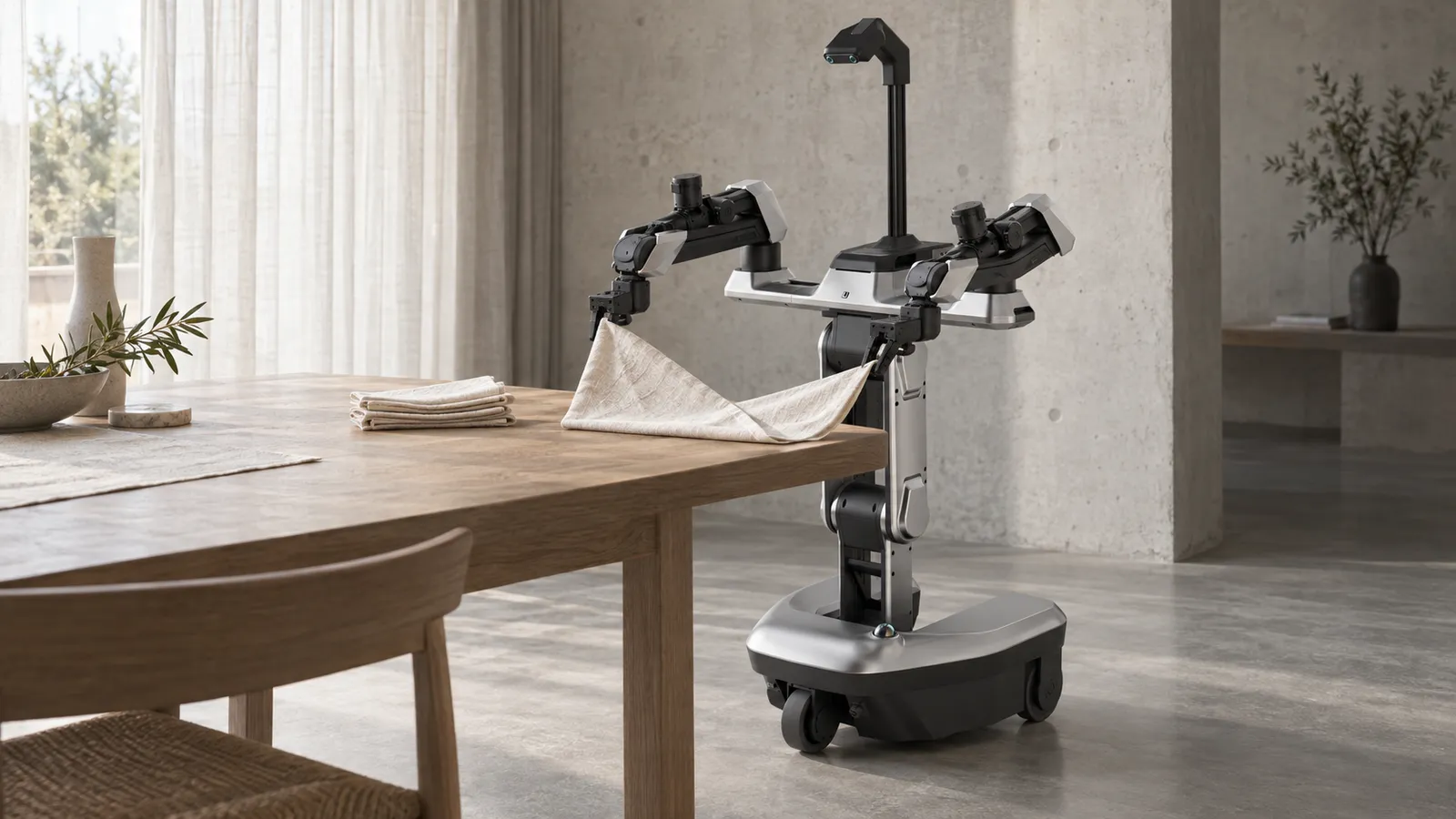
The R1 Lite is a two-armed wheeled robot that Galaxea used to record 500 hours of household and service tasks in real buildings. For labs building home-robot policies, it is a ready-made data rig, with the operator work still to plan.
- Degrees of freedom
- 23+: arms 2 × 6, torso 3, chassis 6 (omnidirectional), gripper 1 each
- Arms (A1X)
- 600 mm reach with gripper, 3 kg rated / 5 kg max payload, ±1 mm repeatability
- Grippers (G1)
- Force-controlled parallel, 0–100 mm, 150 N rated
- Vertical workspace
- 0–1,700 mm
- Size and weight
- 1,281 × 596 × 670 mm, 96 kg with battery
- Base speed
- 1.5 m/s, 360° omnidirectional
- Compute and cameras
- Intel Core i9-12900HK, 32 GB; two wrist cameras, optional depth and fisheye
- Price
- Listed at $39,999 on Galaxea Dynamics as of October 2026 (enquiry only)
Updated
The Galaxea R1 Lite is a wheeled bimanual robot from Beijing-based Galaxea Dynamics: two 6-DoF arms on a 3-DoF torso, a 360° omnidirectional base, and a vertical workspace from the floor to 1.7 m. It is not a consumer product. It is a research and data-collection platform, and the reason it belongs among home robots is what Galaxea did with it: more than 500 hours of teleoperated household, kitchen, retail and office tasks, released as an open dataset in LeRobot format. If you are building a home-robot policy, the R1 Lite is one of the few platforms where the hardware, the teleop rig and a large reference dataset all come from the same maker.
Can you buy an R1 Lite?
Not off the shelf. Galaxea's R1 Lite product page shows a price of $39,999 and, in the same place, "This product is not currently available for direct purchase from Galaxea Dynamics." Business and education buyers enquire through product@galaxea-dynamics.com or the contact page, and the price for a given configuration is set in that conversation. The base package includes the robot, both A1X arms and G1 grippers, two wrist cameras, an RC transmitter, a dual-button remote, a single-button emergency stop, a calibration board and a charger. Galaxea lists the dexterous hand, the VR teleoperation device and the R1 Lite-T teleoperation device as not included.
US buyers have one more thing to check. On July 28, 2026 the FCC added foreign-produced advanced robotic devices, except those granted a Department of War Conditional Approval, to its Covered List, and covered equipment cannot receive new FCC equipment authorizations (FCC public notice DA 26-786). The notice defines the category by reference to an attached determination, and we have not seen the FCC or Galaxea say how it applies to the R1 Lite. Ask Galaxea about authorization status before ordering for a US lab.
How to drive it remotely
Isomorphic teleoperation
VR teleoperation
RC transmitter
Low-cost whole-body rigs
The BRS result is worth taking seriously when you choose an input device. For whole-body household tasks, where the base, torso and two arms all move, a kinematic-twin leader beat VR controllers by a wide margin in that study. The same lesson holds on most bimanual robots: the closer the operator's device is to the robot's own joints, the more learnable the demonstrations.
Remote or on site: latency on a whole-body robot
A leader-follower rig like the R1 Lite-T is normally used next to the robot, with the operator watching the scene directly or through the robot's cameras. Moving the operator to another city is possible, but the budget changes. Galaxea's open data runs at 15 fps, so each frame is about 67 ms. At that rate:
Same building or metro, under ~50 ms round trip
Regional, ~100 to 200 ms
Intercontinental, above ~250 ms
Whatever the distance, keep a local safety layer on the robot that clamps base and arm speed and stops on lost connection, and keep the emergency stop with a person on site. Our latency guide sets out budgets by task.
The Galaxea Open-World Dataset
The Galaxea Open-World Dataset is the main reason labs look at this robot. All of it was recorded on one embodiment, the R1 Lite. Per the G0 paper and the dataset card:
Scale
Settings
Format
Annotations
License
Models
Starting from G0 instead of from scratch
The practical value of a same-embodiment dataset is that you do not have to collect everything yourself. Galaxea's three-stage recipe, cross-embodiment pre-training, then single-embodiment pre-training on R1 Lite data, then task-specific post-training, implies a plan for a new household task: start from a model trained on the open data, then collect a smaller, targeted set of demonstrations of your task, in your environment, with the same camera layout and action space. That targeted set is where operator quality matters most, because it is small and it decides the final behavior. Check the non-commercial license on both the dataset and any released weights before you build a product on them.
Recording your own R1 Lite data
Galaxea publishes GalaxeaLeRobotToolkit, an Apache-2.0 tool that converts rosbag and MCAP recordings to LeRobot datasets. It builds against ROS 2 Humble and includes a merge script for combining converted episodes. In practice that means recording raw sessions as bags on the robot and converting afterwards, which keeps the raw data intact if you later want RLDS or HDF5 instead. A few choices to fix before the first session:
Action space
Base and torso
Cameras
Labels
Our data collection guide covers episode structure and quality checks in more depth.
What a good R1 Lite operator does
Collecting in real homes: privacy and logistics
Galaxea's dataset was recorded in real buildings, including residential spaces. Anyone doing the same with an R1 Lite takes on the privacy duties of a home robot company: written consent from the household, rooms that are off limits, a rule on faces and personal documents in frame, and a retention period for raw video. With no vendor operator service, those rules are yours to set and enforce, and they need to be in place before an operator connects.
Logistics matter as much. A 96 kg robot that is 1.28 m tall needs a clear route through the front door, an outlet for the charger, and someone on site who can reset scenes between episodes. Budget the visit length around battery and reset time, not just the number of episodes you want, and record a short empty-scene pass at the start of each visit so you can check camera calibration later.
R1 Lite, R1 Pro or another bimanual platform?
Galaxea's own step up is the R1 Pro, which it describes as a high-performance, highly extensible wheeled humanoid mobile manipulation platform with 7-DoF dual arms. The extra joint per arm helps with reaching around obstacles and human-like motion, at the cost of slightly harder leader-arm mapping. Outside Galaxea, the closest alternatives for home-task data are the AgileX Cobot Magic, a Mobile ALOHA-style rig with leader arms built in, and the PAL TIAGo Pro, with torque-sensing 7-DoF arms and an official teleoperation station. The R1 Lite's advantage is the large same-embodiment dataset you can start from.
How RoboPilots staffs an R1 Lite program
The robot stays in your lab or your test homes. We agree the input device with you, whether Galaxea's teleoperation device, leader arms or VR, and train a dedicated group of operators on your unit and task protocol before they record anything. See our home and hospitality page for how this fits home-robot programs.
One-week trial
Coverage
Data
Interfaces, specs and sources
- R1 Lite-T teleoperation device (optional)
- VR teleoperation (optional)
- A1Z-T teleoperation arms
- RC transmitter and e-stop
- ROS 2 Humble recordings (rosbag / MCAP)
- LeRobot conversion toolkit
Availability: Research, by enquiry. Galaxea lists the R1 Lite at $39,999 but states "This product is not currently available for direct purchase from Galaxea Dynamics"; business and education buyers enquire through product@galaxea-dynamics.com (product page, checked October 16, 2026).
Specs are the maker's published figures, checked on . RoboPilots is not affiliated with Galaxea Dynamics; product names are trademarks of their owners.
- Galaxea R1 Lite product page: specs, price, accessories
- Galaxea Dynamics homepage: product line and address
- Galaxea Open-World Dataset (Hugging Face)
- Galaxea G0: Open-World Dataset and Dual-System VLA Model (arXiv 2509.00576)
- GalaxeaLeRobotToolkit (GitHub)
- OpenGalaxea on GitHub
- BEHAVIOR Robot Suite (Stanford, CoRL 2025)
- FCC public notice DA 26-786: advanced robotic devices added to Covered List, Jul 28, 2026
Frequently asked questions
- How much is the Galaxea R1 Lite?
- Galaxea lists it at $39,999 as of October 2026, but says it is not currently available for direct purchase. Buyers enquire through Galaxea for a quote.
- What teleop rig does the R1 Lite use?
- Galaxea offers an optional R1 Lite-T teleoperation device, A1Z-T teleoperation arms and a VR teleoperation device. Its own dataset was recorded with isomorphic teleoperation, which maps the operator's movements directly to the robot's joints.
- How do I use the Galaxea Open-World Dataset?
- It is on Hugging Face in LeRobot v2.1 format after you log in and accept the Galaxea Community License. The license is CC BY-NC-SA 4.0, so check it before commercial use.
- What is the difference between the R1 Lite and R1 Pro?
- The R1 Lite has 6-DoF arms and a 3-DoF torso. Galaxea describes the R1 Pro as a higher-performance wheeled humanoid platform with 7-DoF dual arms.
- Can the R1 Lite record data for LeRobot?
- Yes. Galaxea publishes a toolkit that converts rosbag and MCAP recordings from the robot into LeRobot datasets, built against ROS 2 Humble.