Robots · Home robots
Prosper Alfie teleoperation: a home robot designed around remote operators from day one
Most home-robot makers treat remote operation as a fallback. London's Prosper Robotics said from the start that people would drive most of Alfie's early work. That makes it the clearest case study in what a remote-first home robot asks of its operators and its owners.
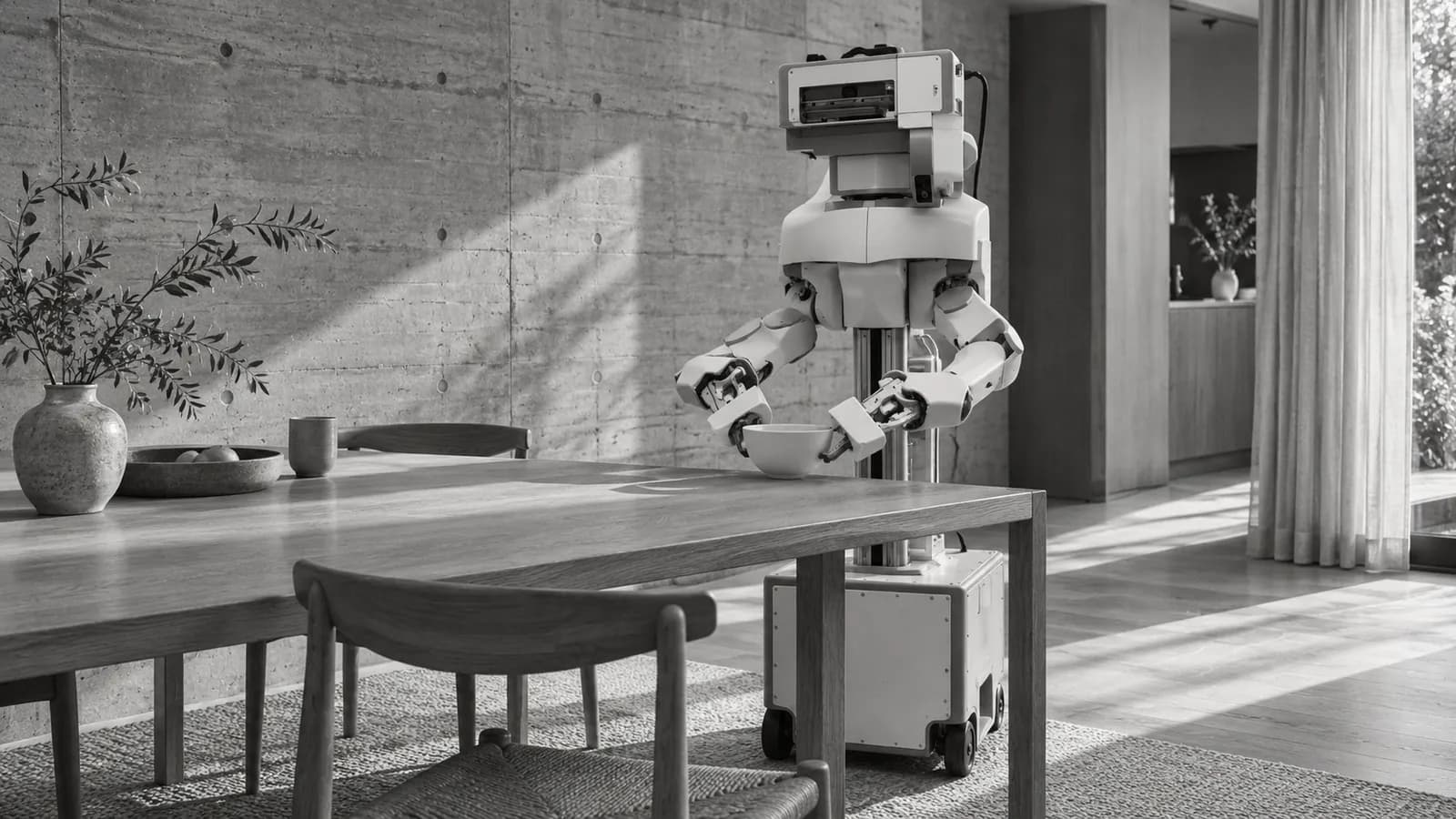
- Form factor
- Wheeled base, two arms, head, torso that rises and falls along a central spine
- Safety
- Two emergency stop buttons
- Charging
- Plugs itself into wall outlets, with a retracting cord (reported, 2023)
- Autonomy at first release
- About 20% of tasks (company estimate, reported Dec 2024)
- Operator interface
- Video-game-style controls using the robot's cameras and sensors
- Status and price
- Prototype; no price published by Prosper as of October 2026
Updated
Alfie is a wheeled, two-armed home robot built by Prosper Robotics, a small company in Hackney, London, founded in 2021 by Shariq Hashme, who previously worked at OpenAI and Scale AI. It is a prototype, not a product. It belongs on this list because of how openly Prosper described its operating model: at first, remote human operators would do most of Alfie's work, and each task they performed would become training data until the robot could do it alone. Many home robots now work this way to some degree. Prosper said it plainly years before the others, which makes Alfie a useful lens on the labor, privacy and economics of teleoperated home robots.
Can you buy Alfie?
No. Prosper's own site is a one-page statement, describing Alfie as "a robot whose purpose is to serve people", with a contact address and a footer reading "Made in Hackney". It lists no price, order form or release date. In 2023, Prosper told press it had about 20 households signed up for alpha testing and expected a market-ready version in about two years, per Interesting Engineering. In December 2024, MIT Technology Review reported the company had raised a relatively small amount of capital and was still months or years from shipping. Price targets quoted in that coverage changed between 2023 and 2024, and Prosper has not published one, so we leave them out. As of October 2026 we found no shipping announcement.
What Alfie was built to do
The tasks Prosper has shown or described are the core of kitchen and household work: clearing and wiping a table, rinsing dishes and loading the dishwasher, taking out the trash, putting items away, doing laundry, making beds and simple meal prep such as salads. Stacey on IoT described a wheeled base with a torso that rises and falls along a central spine and a robot that plugs itself into wall outlets, with a cord that retracts as it moves. MIT Technology Review added two emergency stop buttons and a deliberate design choice: Alfie is meant to look clearly like a robot, not pass as a person. A former Pixar animator leads its character design.
The remote-first model, as reported
Operators do the work first
About one task in five on its own
Who the operators are
How many repetitions a skill needs
Hashme called Alfie a "general purpose teleop robot" in a 2023 post quoted by Interesting Engineering. That framing is honest about where the hard part of home robotics sits today. The hardware can reach a sink. The skill of rinsing a plate without breaking it comes from human demonstrations, and the fastest way to get demonstrations in real homes is to have people do the real chores through the robot.
Privacy plans
A robot that is mostly remote-driven puts a stranger's eyes in a home for most of its working hours, so the privacy design matters more than on a robot that only calls for help occasionally. Prosper has not published a privacy policy for Alfie that we could find. What it told press:
Stacey on IoT's author asked for independent verification of the blurring and for owners to have access to Alfie's audio and video feeds, which is a sensible standard for any teleoperated home robot. Since these are stated plans for a robot that has not shipped, treat them as intentions rather than features until Prosper publishes terms.
Blurring is a good start and not a complete answer. An operator still has to see enough to do the job: the plate, the counter, the edge of the sink. A workable privacy design pairs redaction with limits on where the robot goes, a visible signal when a person is driving, short retention and a deletion path the household can actually use.
The labor question
MIT Technology Review raised the issue directly: a remote-first robot depends on a remote workforce, and the article set Prosper's plans against criticism of offshore data-labeling labor elsewhere in the AI industry. It is a fair question for any company in this space, including ours. Remote operation is skilled work. Operators need training on each robot, a clear task protocol, privacy rules they are held to, and pay and conditions that let them do it well for years rather than months. Whether that work sits in London, Manila or California, those are the things that decide whether the data is good and whether the households can trust it.
Latency and the shape of remote chores
Operators on another continent add round-trip delay, and Alfie's task list suits that better than most. Wiping a table, loading a dishwasher or carrying trash are tolerant of a few hundred milliseconds if the robot's own controller keeps motion smooth and enforces limits locally. Rinsing fragile dishes and anything involving fast contact are harder. Prosper has not published how its link is built. Our teleoperation latency guide sets out budgets by task for this kind of setup.
Alfie against today's remote-assisted home robots
Since Prosper first described Alfie, other makers have built remote help into products you can order. 1X's NEO lets owners schedule a remote Expert for unfamiliar chores. Weave's Isaac 1 is autonomous by default with "teleoperation assistance when needed". Both treat the remote person as the exception. Alfie's reported plan made the remote person the rule at launch, with autonomy growing from there. The three sit on one scale, and the only real difference is the share of work a person does at the start.
What a remote-first home robot company needs
Enough operators for the hours households use the robot
A protocol per task
Data that trains
Privacy rules in the contract
Questions to ask before inviting a remote-first robot home
If Alfie or a robot like it reaches the market, a household is agreeing to something closer to a remote cleaning service than an appliance. The useful questions follow from that:
None of these has a single right answer. A household that values the chores getting done may accept more remote time than one that values privacy above all. What matters is that the maker answers them in writing before the robot arrives.
How RoboPilots helps
We have no relationship with Prosper. For companies building remote-first or remote-assisted home robots, we supply the operator layer. We train a dedicated group of operators on your own unit and task protocol, including your household privacy rules, and the same group stays on your program. See our home and hospitality page for the wider category.
One-week trial
Coverage
Data
Interfaces, specs and sources
- Remote operators (video-game-style controls)
- Teleoperation as the training data source
- Two emergency stop buttons
- No public app or SDK
Availability: Prototype, not for sale. Prosper's site (prosper.org, checked October 16, 2026) describes Alfie in one line and lists no product page, price or orders. MIT Technology Review reported in December 2024 that Prosper was months or years from shipping, and we found no later shipping announcement.
Specs are the maker's published figures, checked on . RoboPilots is not affiliated with Prosper Robotics; product names are trademarks of their owners.
- Prosper (prosper.org)
- Prosper site mirror (prosper-site.onrender.com)
- MIT Technology Review: Will we ever trust robots?, Dec 23, 2024
- Stacey on IoT: Privacy and AI in the coming age of home robots, Jun 5, 2023
- Interesting Engineering: This robot butler will tackle all your household chores, Jun 4, 2023
- Weave Isaac 1 product page
- 1X NEO product page
Frequently asked questions
- Is the Prosper Alfie robot available?
- No. Alfie is a prototype, and Prosper's site lists no product page, price or orders as of October 2026.
- How much will Alfie cost?
- Prosper has not published a price. Early press coverage quoted company price targets that changed between 2023 and 2024, and nothing is on sale.
- Is Alfie remote controlled?
- That was the plan. Prosper said remote operators would complete tasks Alfie had not yet learned, and MIT Technology Review reported it expected the first release to do only about 20% of tasks on its own.
- Who are Alfie's remote assistants?
- MIT Technology Review reported in December 2024 that they would mostly work abroad, at least some in the Philippines, using video-game-style controls.
- What privacy protections has Prosper described?
- Prosper told press it would blur faces and visible text during remote sessions, remove sensitive objects and faces from recordings, and let users delete footage. It has not published a privacy policy for Alfie that we could find.