Robots · Home robots
Weave Isaac 1 teleoperation: what "teleoperation assistance when needed" means in your home
Isaac 1 is a home robot you can preorder today that says plainly a remote person will help it finish tasks it cannot yet do alone. Here is how that works, based on what Weave has published.
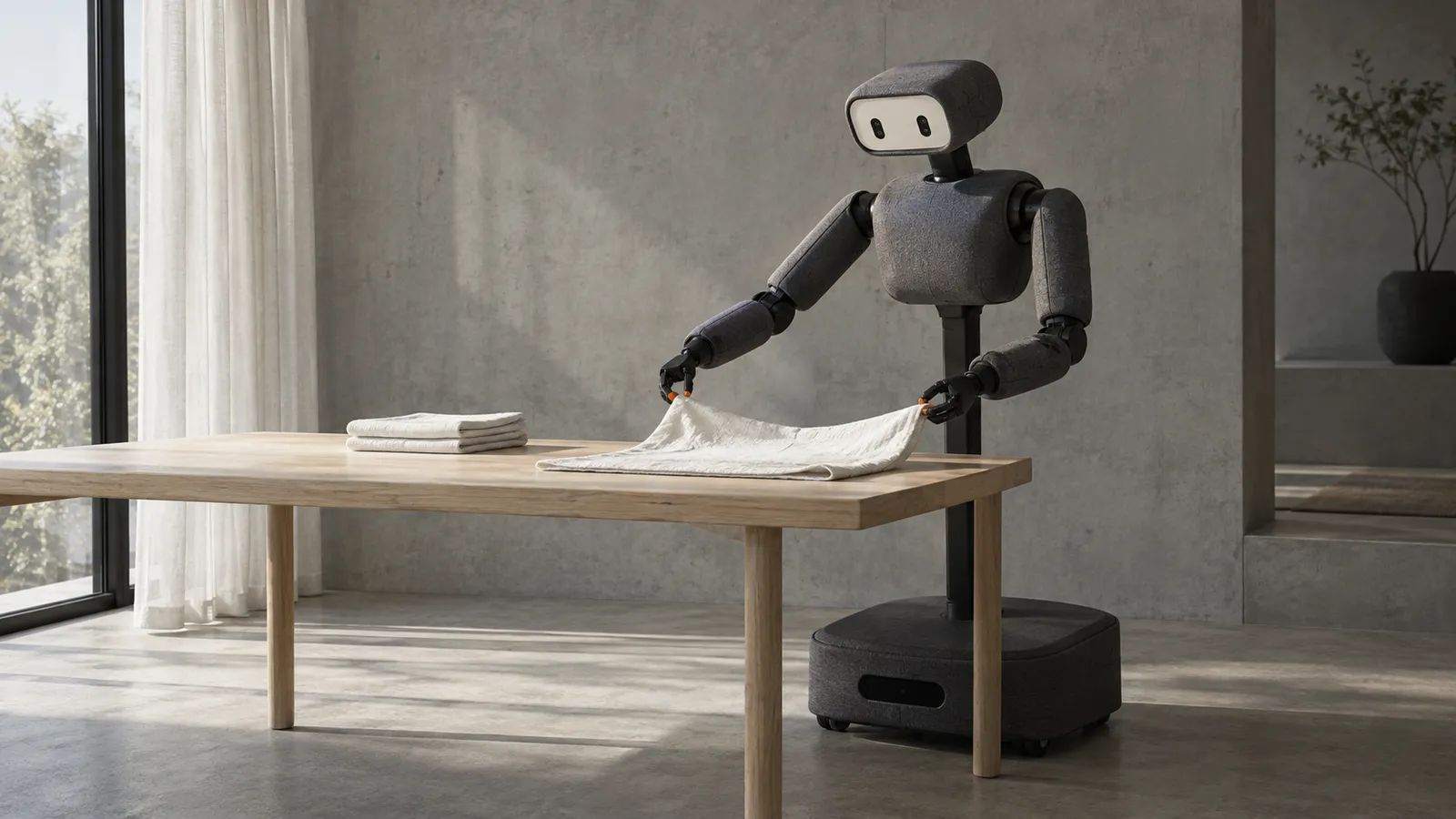
- Degrees of freedom
- Neck 2, arms 2 × 6, hands 2 × 1, torso 2, base 3
- Height
- 3 ft to 5 ft 9 in (collapsible torso)
- Reach
- 80 in vertical, 38 in horizontal
- Battery
- 8 h run time, 2 h charge
- Footprint
- 20.5 × 22 in
- Connectivity
- Wi-Fi
- Price
- Listed at $7,999 up front or $449/month on Weave as of October 2026
Updated
Weave Isaac 1 is a wheeled, two-armed robot with a telescoping torso that folds laundry, makes beds and puts clutter back where it belongs. What sets it apart from most consumer robots is a single line on its product page: Isaac 1 runs "autonomously by default, with teleoperation assistance when needed." In other words, when the robot is stuck on a garment or a layout it has not seen, a person at Weave can take over and finish the job remotely. That is human-in-the-loop robotics sold as a feature, and it is the reason a buyer should understand who that person is, what they see and what happens to the footage.
Can you buy Isaac 1?
You can preorder it. The Isaac 1 page lists $7,999 up front or a $449 monthly subscription, reserved with a $250 deposit that is fully refundable until the robot ships. Weave says first shipments begin in fall 2026, with California deliveries first and broader US availability through 2027. After you preorder, Weave says it will contact you before delivery to arrange an in-person demo at a Weave location or a remote video demo. Press coverage has mentioned an optional premium membership for owners who pay up front; Weave's product page does not list one, so confirm any ongoing fees with Weave before you budget.
The earlier Isaac 0 is on sale now, but it is a different machine: a stationary laundry folder that sits at a table, not a robot that moves around the house. Its product page lists $249 a month, or $3,999 up front plus $49 a month with priority delivery, and says it is shipping to California residents in limited quantities. Isaac 0 owners get preferred pricing on an upgrade to Isaac 1.
What Isaac 1 is built to do
Weave groups the robot's work into two routines, both run from a smartphone app, on demand or on a schedule, whether you are home or out.
Laundry Flow
Daily Reset
The body is designed around those jobs. The torso telescopes from 3 ft to 5 ft 9 in, giving 80 in of vertical reach for high shelves and a low posture for floor pickup, and it collapses when the robot is idle. Each arm has six degrees of freedom and a simple one-DoF hand. Soft fabric shells cover the hardware and can be swapped or removed. Weave CEO Kaan Dogrusoz told Business Insider (July 13, 2026) that the wheeled base balances passively, so the robot does not fall if it loses power, and that a T-shirt fold that once took up to four minutes now takes about two. He was clear that he cares more about the quality of the fold than the speed, because a fold you have to redo saves you nothing.
Teleoperation assistance when needed: how it works
Weave has published more about this on Isaac 0 than on Isaac 1, so the clearest picture comes from reading both pages together. Isaac 0 "blends autonomy with teleoperation", which Weave defines as remote assistance by a Weave specialist, so that every fold gets finished. T-shirts, shorts and long sleeves are mostly autonomous; other garments need more help, and Weave says that ratio improves as the system learns. An average load takes 30 to 90 minutes. Isaac 1 extends the same model to a robot that moves through the whole home: autonomous by default for its two routines, with a person available when the policy cannot complete a task.
Who the operators are
What they see
When they step in
How much is remote
Remote help was in the plan from the beginning. Weave's Y Combinator profile, written for its Summer 2024 batch, already said users could request remote operation for tasks Isaac could not yet do alone. That consistency is worth noting: this is a stated design choice, not a fallback added after launch.
The economics behind the model are the same as in any human-in-the-loop fleet. Each takeover gets today's chore done, which keeps the customer happy, and it also records exactly the case the policy failed on, in a real home. The business works if the share of tasks needing a person keeps falling. Our human-in-the-loop guide walks through that arc for larger fleets.
What Weave's privacy policy says
The product page says "Privacy is core to Isaac 1's design" and points to physical cues that show whether the robot is working, plus a torso that folds away out of sight. The legal detail is in Weave's privacy policy, last updated March 3, 2026, which covers Weave's robots, app and website together. Summarized from that page:
Cameras
Remote access
Device data
Model training
Your configuration
What the policy does not state, as of our October 2026 reading: how long robot video is kept, whether owners can opt out of their footage being used for training, and how to request deletion beyond contacting Weave's privacy email. Those are not unusual gaps for a startup policy that covers a website and a robot in one document, and Weave may answer them in its preorder agreement or directly. They are the right questions to ask before delivery, because on a teleop-assisted robot the remote session is where most of the sensitive footage is created.
Questions to ask Weave before your Isaac 1 ships
What remote help over home Wi-Fi can and cannot do
Weave has not published how its assist link is built, so this is the general picture, not Isaac 1's internals. Laundry and tidying are forgiving tasks for remote operation. Picking a sock off the floor, flattening a shirt or dropping a toy in a bin works fine with a few hundred milliseconds of delay, because the operator is directing a motion rather than steering it frame by frame. The robot's own controller still has to handle balance, collision limits and smoothing locally, since home Wi-Fi drops packets in ways a lab network does not. Work that depends on fast contact feedback, such as pulling a tangled sheet loose, is harder over a laggy connection. A specialist in San Francisco serving California homes also keeps the round trip short. Fox News' July 2026 coverage of the launch put the practical version plainly: a remote person could help if the robot gets confused by an item, a layout or a task. Our teleoperation latency guide has budgets by task.
Isaac 1 against 1X NEO and Sunday Memo
The nearest comparison is the 1X NEO, a legged humanoid that also brings in a remote person for unfamiliar chores. The difference is in how the human enters. On NEO, the owner schedules an Expert Mode session and accepts the operator in. On Isaac 1, Weave describes assistance as something that happens when needed to finish routine tasks, and has not published an owner-approval step. Price and scope differ too: 1X lists NEO at $20,000 for Early Access ownership or $499 a month on its order page, while Isaac 1 is $7,999 and focuses on two routines rather than general chores.
Sunday's Memo takes the opposite position. Sunday's technology page calls teleoperation "slow, costly, and intrusive" and says Memo learns from people wearing its Skill Capture Glove in their own homes, before the robot reaches yours. See our Sunday Memo page for that model. Neither approach is wrong. Glove capture front-loads human effort before deployment; Weave's model puts some of it inside the deployment, where it is easier to see and easier to price, and where it raises the privacy questions above.
Building a teleop-assisted home robot? How RoboPilots helps
We have no relationship with Weave. For other companies building a home robot with remote assistance, the operator layer is usually the hardest part to staff: people who can drive the robot well, follow household privacy rules every session and produce correction episodes clean enough to train on. We train a dedicated group of operators on your own unit and task protocol, and the same group stays on your program. See our home and hospitality page for the wider picture.
One-week trial
Coverage
Data
Interfaces, specs and sources
- Smartphone companion app
- On-demand or scheduled tasks
- Weave teleoperation assistance (remote specialist)
- Over-the-air updates
- No public SDK found
Availability: Preorder. Weave takes a $250 deposit, refundable until the robot ships, and says first Isaac 1 shipments begin in fall 2026, California first, with broader US availability through 2027 (weaverobotics.com/isaac-1, checked October 16, 2026). The stationary Isaac 0 folder is shipping to California residents in limited quantities.
Specs are the maker's published figures, checked on . RoboPilots is not affiliated with Weave Robotics; product names are trademarks of their owners.
- Weave Isaac 1 product page: specs, price, shipping, FAQ
- Weave Isaac 0 product page: teleoperation, specialists, plans
- Weave Robotics privacy policy (last updated Mar 3, 2026)
- Weave Robotics about page
- Weave Robotics on Y Combinator (S24)
- Business Insider Japan: interview with Weave CEO Kaan Dogrusoz, Jul 13, 2026
- Fox News / CyberGuy: Would you pay $8,000 for a robot to fold laundry?, Jul 10, 2026
- 1X NEO order page
- Sunday technology page (Skill Capture Glove)
Frequently asked questions
- Is the Weave Isaac 1 teleoperated?
- Partly. Weave says Isaac 1 is autonomous by default for Laundry Flow and Daily Reset, with teleoperation assistance from Weave when needed to complete a task.
- What can a Weave specialist see during remote assistance?
- For Isaac 0, Weave says specialists see only the head and wrist camera feeds plus diagnostic information, and that no audio is collected. Weave has not published a separate statement for Isaac 1 that we could find.
- Will footage from my home be used to train the robot?
- Weave's privacy policy lists training and fine-tuning AI models among the ways it improves its services, but does not say specifically whether robot video is used or whether owners can opt out. Ask Weave directly before delivery.
- How much does the Weave Isaac 1 cost?
- Weave lists $7,999 up front or $449 a month, reserved with a $250 deposit that is refundable until the robot ships, as of October 2026.
- When will Isaac 1 ship outside California?
- Weave says first shipments begin in fall 2026 in California, with broader US availability through 2027. It has not announced international shipping.
- What is the difference between Isaac 0 and Isaac 1?
- Isaac 0 is a stationary laundry folder that works at a table and is shipping in California now. Isaac 1 is a mobile robot with a telescoping torso that also picks up clothes, makes beds and tidies, and is on preorder.