Robots · Home robots
Tau Robotics teleoperation: how a human-operated humanoid cleans your apartment
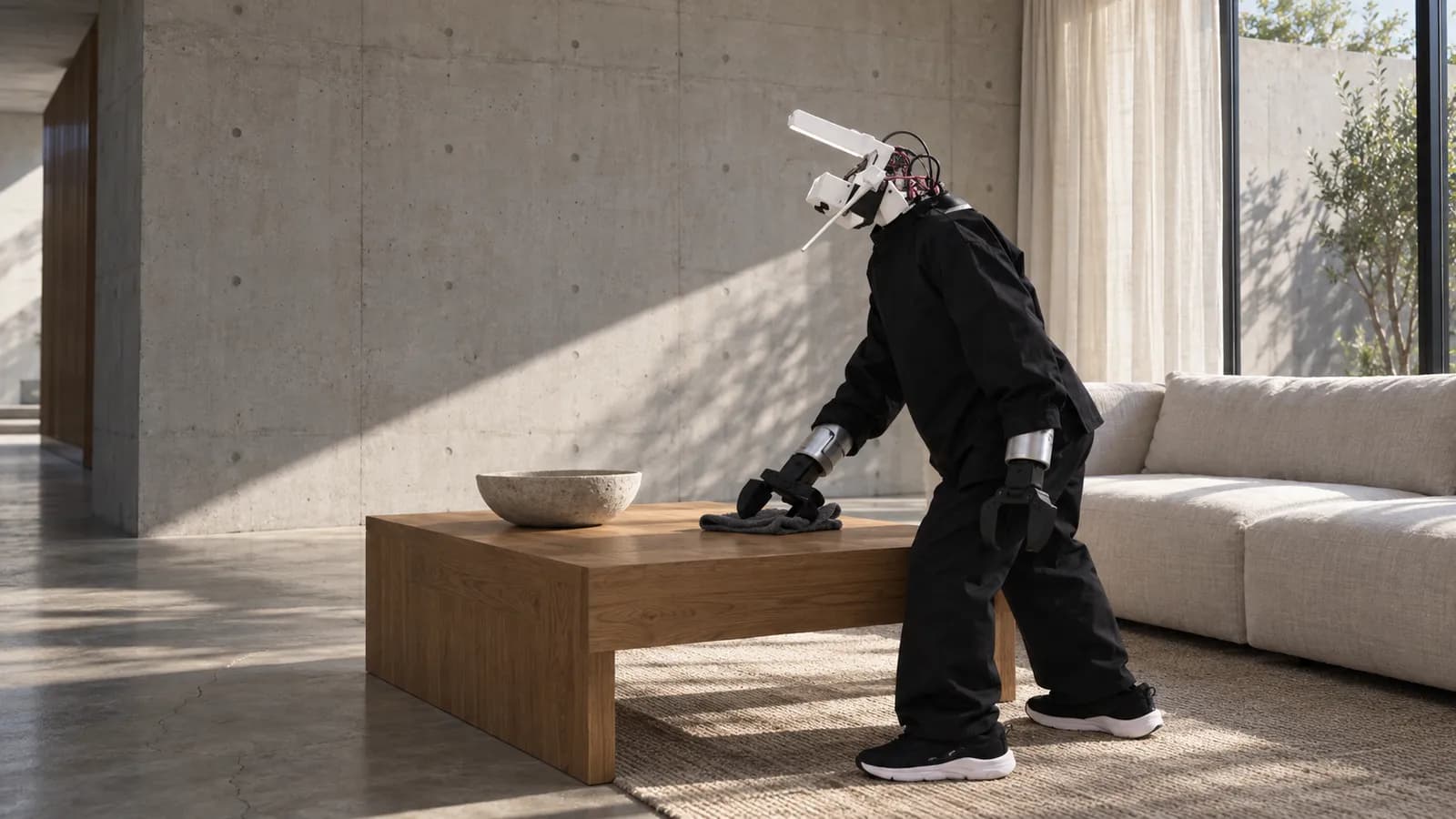
Tau runs the clearest example of a home robot service with a person in the loop: humanoids that clean San Francisco apartments while trained operators steer them. Its own documents are unusually detailed, so this page reads them closely.
- Service
- Humanoid cleaning: dusting, surfaces, toilets, vacuuming, mopping
- Price
- Listed at $30 per humanoid for a one-hour visit in Tau's service terms as of October 2026; two are sent, so $60
- Area
- San Francisco, invite-only, waitlist
- Hardware
- Unitree G1 body with Tau's own cameras, grippers and onboard compute (per TechTimes)
- Recorded per visit
- Head and wrist video, depth, telemetry, operator commands; microphones disabled
- Operators
- W-2 employees at Tau's San Francisco facility, never from home or outside the US
- Retention
- Video and telemetry kept indefinitely unless you request deletion
Updated
Tau Robotics sends humanoid robots to clean apartments in San Francisco, and it does not pretend they clean on their own. Its FAQ answers "Are the robots autonomous?" with "No, robots are operated by humans and AI." A trained operator steers each robot from Tau's facility, a supervisor comes with the robots, and every visit is recorded to train the models that should one day need less help. That makes Tau the most transparent example of human-in-the-loop home robotics a consumer can actually book, and its privacy policy and service terms spell out the trade-offs in plain language. This page walks through how the service works, what Tau records and keeps, the points where its own documents disagree, and what a company building a similar service should take from it.
What Tau offers, and who can book it
The Tau homepage describes a humanoid cleaning service covering dusting, wiping surfaces, cleaning toilets, vacuuming and mopping, in kitchens, bathrooms, bedrooms, living rooms, hallways and offices. Tau supplies its own products (it names Mrs. Meyers multi-purpose cleaner and unscented Bona for floors) and lets you request your own. Booking is by invitation: you join a waitlist and Tau sends an invite code when a spot opens near you.
The price is in the service terms, last updated October 12, 2026: $30 per humanoid for a one-hour visit, and "We send two humanoids to every visit, so a cleaning is $60." You can cancel or reschedule up to 24 hours ahead for a full refund; later cancellations get 50% back. Euronews reported in September 2026 that Tau had cleaned more than 50 apartments and condominiums and planned longer sessions. CBS News reported the pilot is open to 1,000 households, with a goal of 1,000 cleanings a week in San Francisco by 2027 before other US cities and international markets by 2028.
The hardware: a Unitree G1 with Tau's own sensing
Tau does not publish hardware specs, and its privacy policy describes the robot only as "a humanoid robot". TechTimes reported in August 2026 that it "runs on a Unitree G1 body", with Tau building its own camera systems, grippers and onboard computing on top. That matches what CEO Alexander Koch told CBS News: "The camera system, the networking and the computers are all our own." CBS also reported each robot costs $50,000 to make. Unitree lists the stock G1 at 1,320 mm tall and about 35 kg, with about two hours of battery, which helps explain one-hour visits. Our Unitree G1 page covers the base robot and its teleop options in detail.
Tau's FAQ says the robots are dropped off with a supervisor and can walk up stairs and use elevators. The service terms list what they will not do: climb ladders, clean exterior windows, handle biohazards, or move heavy furniture or appliances.
Who is driving: operators, supervisors and the AI policy
Three roles show up across Tau's documents and press coverage. Read together, they describe a remote-operation service with a person physically present.
The remote operator
The AI policy
The on-site supervisor
This is a shared-control setup rather than pure teleoperation: the operator directs the task, the policy handles more of the motion over time, and every intervention is logged. Tau records "the motion inputs our operator sends to the robot, and the timing of those inputs", which is exactly the correction data a home policy needs. This is the same pattern industrial humanoid fleets use for fallback.
Do you need to be home? Tau's own pages disagree
This is the one point to check before you book. Tau's homepage FAQ answers "Do I need to be present?" with "No, we only need access to the property. You're welcome to stay of course." The service terms say the opposite in section 3: "You, or another adult you authorize, must be present in the home for the entire visit." They add that Tau does not hold keys, does not accept lockbox or door codes, and does not clean unoccupied properties. TechTimes reported the same requirement. When we read both pages on October 16, 2026, the terms carried the later date, and terms are what you agree to when booking, so plan on an adult being home. The privacy policy adds that the person who books cannot consent on behalf of everyone else in the household, and that anyone present can ask the operator to stop at any time.
What Tau records, keeps and trains on
Tau's service privacy policy is the most specific published document of its kind we have found for a home robot. Its main terms, summarized from the policy and the service terms:
What is captured
Audio
Faces
Training
Retention and deletion
Rooms
Storage and access
Some coverage has framed these terms as alarming. A fairer reading is that Tau has written down what most learning robots do and not said: the data from your home is the product's raw material. Customers can weigh that clearly, which is more than many devices with cameras allow. The parts worth thinking about are the unblurred faces, the indefinite default retention and the fact that deletion cannot reach a model already trained.
The FCC Covered List and foreign-produced robots
Because the robots run on Unitree hardware, a regulatory change is relevant. On July 28, 2026, the FCC's Public Safety and Homeland Security Bureau added "foreign-produced advanced robotic devices" to its Covered List (DA 26-786), except devices granted a Conditional Approval by the Department of War. The determination defines advanced robotic devices to include humanoid robots, quadrupeds and autonomous mobile robots over 4.4 lb that have sensors, network connectivity and control software. The notice says covered equipment is prohibited from receiving FCC equipment authorizations; it does not describe revoking authorizations already granted, and it applies by place of production rather than by company. How it affects any particular robot model, including future G1 hardware revisions, depends on where the robot is produced and on Conditional Approvals, which we have not seen published for Tau's units.
Tau against Gatsby
The nearest alternative is also in San Francisco. Gatsby books humanoid cleans through an iOS app at "$150 flat per clean, regardless of apartment size", says a typical apartment takes about three hours, and answers "Is a human present during the clean?" with "No." It does not build robots and describes itself as robot-agnostic. The contrast is useful. Tau tells you that a person operates its robots and exactly what it records. Gatsby tells you no human is in your home, but has not said publicly whether anyone assists its robots remotely. Those are different claims, and a buyer should ask each company the question the other one has already answered.
What a good operator does on a cleaning humanoid
Home cleaning is also forgiving on latency compared with fine assembly: wiping, vacuuming and carrying tolerate a few hundred milliseconds when the robot keeps its own balance and smooths commands locally. Our latency guide gives budgets by task.
For companies building a similar service
Tau built its own operator floor in San Francisco, and we have no relationship with it. Other home-robot companies would rather not hire, train and schedule a remote workforce themselves. RoboPilots supplies that layer for robot makers and service operators, on their hardware and under their privacy rules. For each program we train a dedicated group of operators on your unit, your cleaning protocol and your household rules (consent, off-limits rooms, what the camera may show, when to stop), and the same group stays on it.
One-week trial
Coverage
Data
Interfaces, specs and sources
- Remote operator station (Tau facility, SF)
- VR headset view through robot cameras
- On-site supervisor
- AI policy with human takeover
- Booking by invite code
Availability: Service. Invite-only in San Francisco with a waitlist; Tau sends invite codes as spots open (tau-robotics.com, checked October 16, 2026). CBS News reported the pilot was announced in July 2026 and is open to 1,000 households. You book a cleaning; you cannot buy the robot.
Specs are the maker's published figures, checked on . RoboPilots is not affiliated with Tau Robotics; product names are trademarks of their owners.
- Tau Robotics: homepage and FAQ
- Tau Robotics: service privacy policy (updated Oct 12, 2026)
- Tau Robotics: service terms (updated Oct 12, 2026)
- CBS News: Tau Robotics humanoid cleaning robots in San Francisco
- Euronews: would you let a humanoid robot clean your home, Sep 8, 2026
- TechTimes: Tau cleaning robot hardware and terms, Aug 1, 2026
- FCC: foreign-produced power inverters and robots added to Covered List, Jul 28, 2026
- FCC Public Notice DA 26-786 with National Security Determination (PDF)
- Unitree G1 product page
- Gatsby: humanoid cleaning in San Francisco
Frequently asked questions
- Are Tau Robotics robots autonomous?
- No. Tau's FAQ says its robots are operated by humans and AI: a trained operator at Tau's San Francisco facility controls them in real time and decides when to let the AI run a task on its own.
- How much does Tau cost?
- Tau's service terms list $30 per humanoid for a one-hour visit. Tau sends two humanoids to every visit, so a cleaning is $60, as of October 2026.
- Do I need to be home during a Tau cleaning?
- Tau's homepage says no, but its service terms, updated October 12, 2026, say you or another adult you authorize must be present for the entire visit, and Tau does not accept keys or lockbox codes. Go by the terms.
- Does Tau record my home?
- Yes. Every visit records continuous video from the head and wrist cameras, depth data, telemetry and operator commands, and that footage trains Tau's models. Microphones are disabled and faces are not blurred.
- Can I delete my Tau footage?
- You can ask Tau to delete raw video and telemetry and remove them from training sets. Tau says it cannot un-train a model that has already been trained on that data.
- Are Tau robots safe around pets?
- Tau's FAQ says dogs usually get comfortable quickly and cats tend to watch, ignore or hide. Its service terms ask you to secure pets, because the robot is a large moving machine.