Robots · Home robots
Gatsby robot cleaning teleoperation: autonomous routines, human-driven hard parts
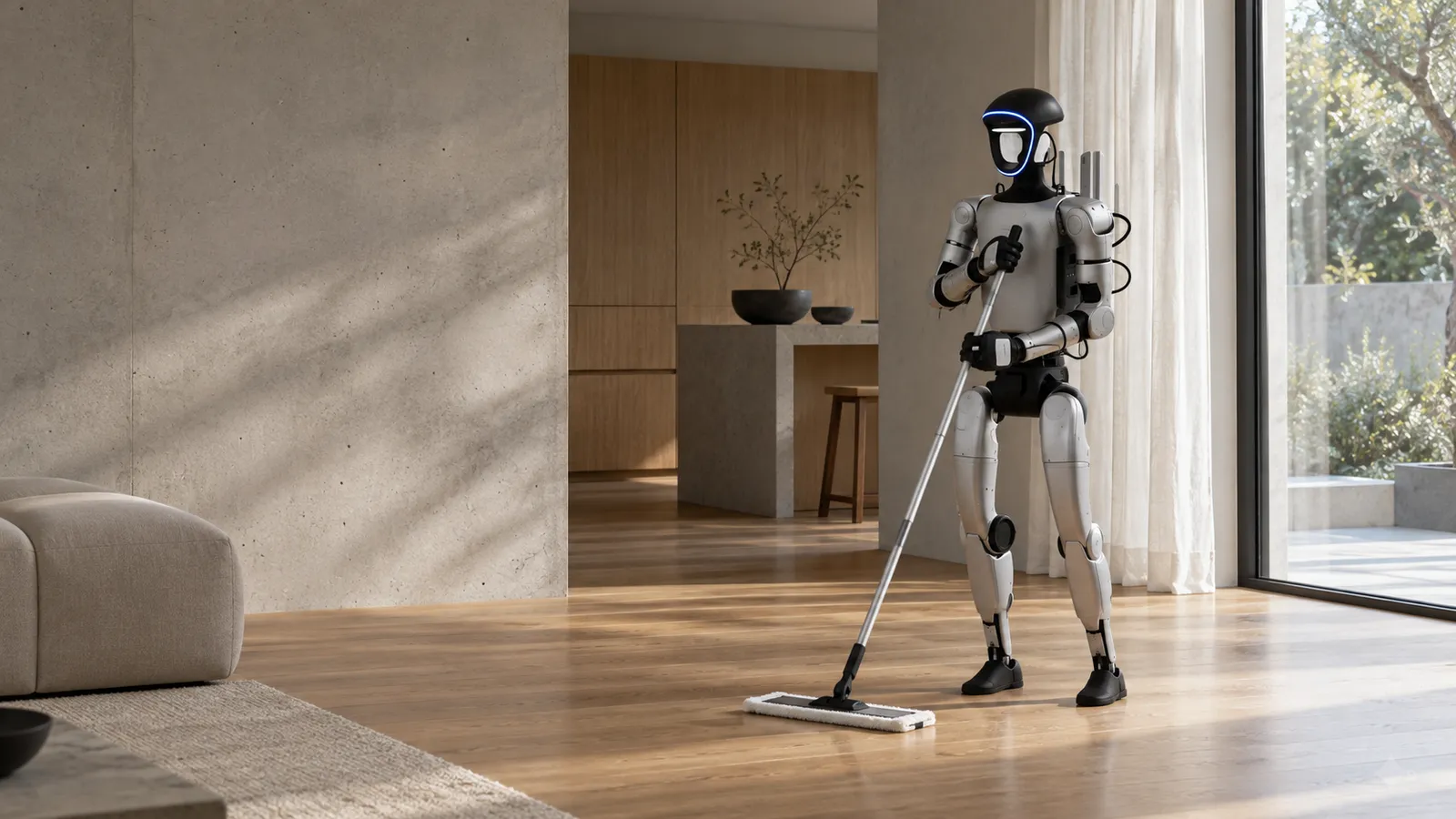
Gatsby books humanoid robots to clean San Francisco apartments through an app, with nobody from the company inside your home. Its own site says the routine work is autonomous and the harder parts are teleoperated by people. Here is what that means.
- Service
- Floors, countertops, stovetops, mirrors, surfaces
- Price
- Listed at $150 flat per clean, any apartment size, on Gatsby as of October 2026
- Area
- San Francisco only; waitlist for other cities
- Typical clean
- About 3 hours for a typical apartment
- Control
- Routine tasks autonomous; harder parts teleoperated by remote humans
- Robot
- Partner humanoids; Gatsby says it is robot-agnostic and does not build hardware
- Damage
- Gatsby says it pays for a replacement if it damages anything
Updated
Gatsby is a San Francisco startup that sends a humanoid robot to clean your apartment for a flat $150. You book in an iOS app, a robot arrives, cleans for about three hours and leaves, and no one from Gatsby comes inside. That last point is the headline of its marketing: "No strangers in your home." It is also where the details matter, because Gatsby's own site says the robot is not working alone. Routine work is autonomous; the harder parts are "teleoperated by real humans". This page explains how the service works, what Gatsby has and has not published about remote operators and privacy, how it compares with Tau Robotics a few miles away, and what a company building a similar service should plan for.
What Gatsby offers
The Gatsby homepage describes an on-demand cleaning service "that uses humanoid robots instead of human cleaners." The price is "$150 flat per clean, regardless of apartment size", with no tips or surcharges, which Gatsby compares with $150 to $300 for a typical San Francisco cleaner. A typical apartment takes about three hours; one example on the site ran from 8:42 to 11:47 AM. The service is San Francisco only as of 2026, with a waitlist for other cities. Its robot page lists the work as floors, countertops, stovetops, mirrors and surfaces, and makes a damage promise: "If Gatsby damages anything during a clean, we pay for a replacement."
Gatsby's first-clean announcement says it performed the first humanoid robot cleaning for a US consumer on May 14, 2026, for a customer picked at random from its San Francisco waitlist. The company is part of West Egg Labs, founded in January 2026 with a pre-seed from Entrepreneurs First per its press page, and lists NVIDIA Inception among its programs. Its team page names Aron Frishberg as CEO and Akiva Himelhoch as CTO.
A distribution layer, not a robot maker
Gatsby does not build robots. Its FAQ calls it "a consumer distribution platform for humanoid robotics" that is robot-agnostic and partners with robot makers, so customers get "the best robot available on a given day". It has not named which humanoids it uses. Its first public photos show a robot wiping surfaces and working a kitchen during a test clean at the company's house in Pacific Heights, without a model name.
That model has real advantages: Gatsby can switch hardware as better humanoids appear, and the customer experience (booking, pricing, guarantees) stays the same. It also means the robot in your home on Tuesday may not be the robot that came last week, with different cameras, different software and possibly a different company behind the hardware. For privacy and reliability, the questions that matter apply to each partner robot, not only to Gatsby.
Who is driving: autonomy plus remote teleoperation
Gatsby's robot page is direct about it: "The routine stuff is fully autonomous. The harder parts are teleoperated by real humans to make sure everything's done right." Fox News reported the same in May 2026, writing that "Gatsby says harder tasks can be handled through remote human teleoperation, while routine work is autonomous", and that "while a person may not be standing in your apartment, the service may still involve remote human help." Earlier coverage, such as Interesting Engineering's report on the first clean, called the robot "autonomous" without mentioning remote help.
So the accurate summary is: no human is physically present, and a remote human may be operating the robot for part of the clean. Gatsby's homepage answers "Is a human present during the clean?" with "No", which is true in the physical sense. "No humans present" and "no humans watching" are different claims, and Gatsby's site makes only the first. There is also a third channel: "If the robot has a question mid-clean, like where to put something, it'll text you." Gatsby has not published who its operators are, where they work, how many robots each supervises, or how they connect to partner hardware.
This is the same shared-autonomy pattern most home robots use today: a policy handles the repetitive motions and a person takes over for the long tail. It is a sound design. The difference between companies is how much they tell you about the person.
Privacy: what Gatsby's policy covers
Gatsby's privacy policy, effective February 24, 2026, covers the Gatsby app operated by West Egg Labs: your name, phone, email, address and unit, payment through Stripe, booking history, Firebase authentication data, and address searches sent to Google Places. It says your profile is deleted or de-identified within 30 days of deleting your account. When we read it in October 2026, it did not mention robot cameras, video, audio, home maps, remote operators, partner robot makers or model training. Its homepage claims "no privacy concerns" because no stranger enters the home. With remote teleoperation in the loop, the open questions are about what the robot sees, not who walks in:
Gatsby against Tau Robotics
The nearest alternative is Tau Robotics, also in San Francisco. The two services make almost opposite choices about what to put in writing.
Price and visit
People involved
Hardware
Privacy terms
Neither approach is wrong. Gatsby offers a simpler experience with no visitor at all; Tau offers far more disclosure at the cost of a person in the home. A careful customer can ask Gatsby the questions Tau has already answered.
What a flat price means for remote help
Gatsby charges the same $150 whether a clean goes smoothly or needs a lot of human help, and whether the apartment is a studio or larger. That is good for the customer, who knows the price in advance, and it puts the cost of every teleoperated minute on the provider. For any service built this way, the share of each clean that needs a remote person has to fall over time for the price to hold. That is why the takeover moments are valuable beyond the clean itself: recorded and labeled well, they are the training examples that teach the policy to handle the same step on its own next time.
For a customer, the practical comparison per hour is rough but useful. Gatsby's $150 for about three hours works out to around $50 per hour of robot time. Tau's listed $60 buys one hour with two humanoids. The two are not doing identical work, and neither publishes how much of a visit is autonomous, so price alone does not tell you which robot does more of the cleaning by itself.
What remote operators on a service like this have to handle
Unattended homes
Mixed hardware
Clean handoffs
Home internet
Discretion
For companies building a similar service
Gatsby's model, a booking layer over partner robots with remote humans for the hard parts, needs a reliable operator bench behind it. We have no relationship with Gatsby. RoboPilots supplies that bench for robot makers and service companies. For each program we train a dedicated group of operators on your specific robots, your cleaning protocol and your household privacy rules, and the same group stays on it.
One-week trial
Coverage
Data
Interfaces, specs and sources
- Gatsby iOS app (booking)
- Robot texts you questions mid-clean
- Remote human teleoperation for harder tasks
- Robot-agnostic: partner humanoids
Availability: Service. Gatsby operates in San Francisco only, booked through its iOS app, with a waitlist for other cities (gatsby.bot, checked October 16, 2026). Its first consumer clean was on May 14, 2026. You book a clean; you do not buy a robot.
Specs are the maker's published figures, checked on . RoboPilots is not affiliated with Gatsby (West Egg Labs); product names are trademarks of their owners.
- Gatsby: homepage, price and FAQ
- Gatsby: the robot (autonomy and teleoperation)
- Gatsby: team
- Gatsby: press page
- Gatsby: first consumer humanoid cleaning, May 14, 2026
- Gatsby: privacy policy (effective Feb 24, 2026)
- Fox News / CyberGuy: humanoid robot cleans first US apartment, May 31, 2026
- Interesting Engineering: Gatsby humanoid cleans an apartment
- Tau Robotics: service privacy policy
- Tau Robotics: service terms
Frequently asked questions
- Is Gatsby's robot autonomous?
- Partly. Gatsby's site says the routine work is fully autonomous and the harder parts are teleoperated by real humans to make sure everything is done right.
- How much does Gatsby cost?
- Gatsby lists $150 flat per clean regardless of apartment size, with no tips or surcharges, as of October 2026.
- Which robot does Gatsby use?
- Gatsby has not named one. It says it is robot-agnostic, does not build hardware and partners with humanoid makers to use the best robot available on a given day.
- How long does a Gatsby clean take?
- About three hours for a typical apartment, according to Gatsby. One example on its site ran just over three hours.
- Is anyone present during a Gatsby clean?
- No one from Gatsby comes inside. Remote operators may teleoperate the robot for harder tasks, and the robot can text you questions during the clean.
- Where is Gatsby available?
- San Francisco only as of 2026, booked through the iOS app, with a waitlist for other cities.