Robots · Home robots
SwitchBot onero H1 teleoperation: an on-device home humanoid and its open questions
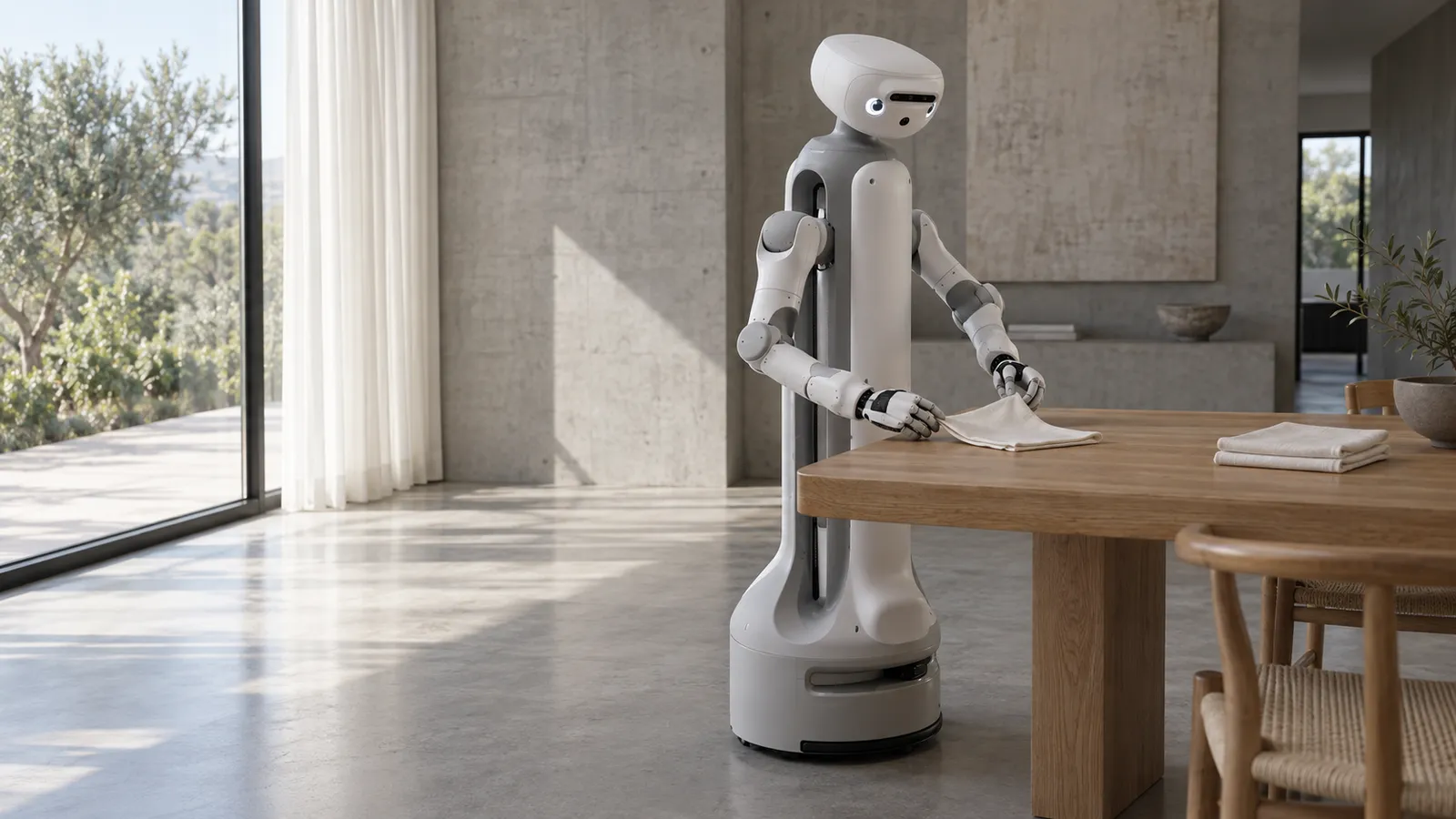
The onero H1 is a wheeled humanoid from one of the best-known smart-home brands, priced just under $10,000. SwitchBot has said a lot about what it should do and little about how it learns or what happens when it gets stuck.
- Form factor
- Humanoid upper body with head, arms and hands on a wheeled base
- Degrees of freedom
- 22
- Sensing
- Vision, depth and tactile feedback; Intel RealSense cameras at head, arms, hands and abdomen (per Interesting Engineering)
- AI model
- OmniSense VLA, described by SwitchBot as on-device
- Price
- Listed at $9,999 on SwitchBot as of October 2026, marked "Coming Soon"
- Store terms shown
- 1-year warranty, 30-day money-back guarantee
Updated
SwitchBot built its name on small smart-home gadgets: button pushers, curtain motors, robot vacuums. At CES 2026 it showed something much larger, the onero H1, a humanoid upper body with 22 degrees of freedom on a wheeled base, meant to tidy, load laundry and work alongside the company's other devices. Its US store now lists it at $9,999, which would make it one of the cheapest full-size chore robots announced. What SwitchBot has not published is how the onero H1 was trained, how reliable it is, and whether any person ever steps in remotely when its on-device model fails. This page sets out what is confirmed, marks what is not, and lists the questions a buyer or a builder should ask.
Can you buy the onero H1?
Not yet. The onero H1 listing on SwitchBot's store shows a price of $9,999.00 with the only variant labeled "Coming Soon" and marked unavailable when we checked on October 16, 2026. The listing shows a one-year warranty and a 30-day money-back guarantee, but no product description, specifications or ship date. SwitchBot's January 5, 2026 CES release, published on PR Newswire in German, called it the most affordable AI household robot and said the onero H1 and its A1 robotic arms would soon be open for preorder on SwitchBot's website. heise reported the same week that it was expected to cost under $10,000 and be available by the end of 2026.
So the honest status in October 2026 is: priced, listed, not orderable, and with no published delivery date. SwitchBot's Japanese release says it plans to sell in Japan too, again without a date. If you see a different price elsewhere, treat it as unconfirmed until it appears on SwitchBot's own store.
What SwitchBot says it does
SwitchBot's releases describe the onero H1 as a step from single-purpose devices to a general helper for chores that have been hard to automate. The Japanese release describes it autonomously handling "non-routine" tasks such as putting away clothes and clearing dishes, and gives a division-of-labor example: while a SwitchBot robot vacuum cleans the floor, the H1 tidies the table. The German release lists grasping, pushing, opening and organizing as the actions it is built to do reliably, and says it adapts to different tasks and homes.
Shown in demo video
Shown live at IFA 2026
Caveats from press
Demo videos and trade-show runs are the normal way chore robots are shown before launch, and they are not the same as independent testing. We found no hands-on review of a production unit as of October 2026.
How it learns: OmniSense VLA, on the device
The onero H1 runs a model SwitchBot calls OmniSense VLA, a vision-language-action model. The German release calls it an "On-Device" OmniSense VLA model; the Japanese release says it fuses visual, auditory, depth and tactile information to judge an object's position, shape, orientation and contact state, and that the robot learns its environment and improves day by day. Interesting Engineering described it as self-developed and able to "learn and adapt across different household scenarios".
What is not public is just as important for anyone comparing home robots:
Training data
Remote help
Learning in your home
Success rates
An on-device model is a genuine privacy advantage when it means camera data does not leave the home. It also means the robot has no obvious fallback when the model fails. Robots such as 1X NEO and Weave Isaac 1 solve that with a remote person; robots without one have to be reliable enough on their own, or simply stop. Which approach the onero H1 takes is the single most useful thing SwitchBot could clarify.
Privacy: what SwitchBot's current policy covers
SwitchBot's privacy policy was last updated on January 19, 2024, two years before the onero H1 was announced, and does not mention it. It does cover home robot products such as robot vacuums: it says some robot products may have cameras, that with the AI function on the camera "is only used to provide visual information to help the robot detect and avoid obstacles", that this data "will not be provided to other third-party platforms for use", and that the company may collect "information about the robot's movement throughout the environment and spatial information". It also says "We do not sell your personal information."
Those terms were written for a floor robot avoiding obstacles. A humanoid that handles clothes and dishes has many more cameras (Interesting Engineering counted RealSense units at the head, arms, hands and abdomen) and, by SwitchBot's account, an auditory channel as well. Before ordering, ask for an onero-specific policy that says whether video or audio ever leaves the robot, whether any of it is used for training, and whether anyone outside the home can ever see the cameras live.
onero H1 against the nearest alternatives
The closest comparison on price is Weave Isaac 1, a wheeled two-armed robot listed at $7,999 or $449 a month on Weave as of October 2026, with a refundable $250 deposit and first shipments in fall 2026, California first. The design philosophies differ. Weave says Isaac 1 is autonomous by default "with teleoperation assistance when needed to guarantee we complete tasks". SwitchBot has said nothing about remote help and stresses on-device intelligence. The other reference point is Sunday Memo, which is in an invite-only beta, has no price, and says plainly that it does not learn through teleoperation in the home.
SwitchBot's distinctive bet is integration. Its releases position the H1 as one part of a household of SwitchBot devices, splitting chores with a robot vacuum and passing tasks to specialized appliances. For a home that already runs on SwitchBot, that could matter more than raw dexterity.
A US regulatory note
On July 28, 2026, the FCC added foreign-produced advanced robotic devices to its Covered List, defined to include humanoid robots and mobile robots over 4.4 lb with sensors, network connectivity and control software, unless granted a Conditional Approval by the Department of War. Covered equipment cannot receive FCC equipment authorizations. SwitchBot has not said where the onero H1 is produced or whether it has sought a Conditional Approval, so how the rule applies to it is unknown. It is a fair question to put to SwitchBot before relying on a US delivery date.
Questions to ask before you preorder
For teams building a similar robot
An on-device VLA still needs demonstrations to learn from and evaluation in real homes before launch, and many teams keep a remote fallback for the cases it cannot handle. RoboPilots staffs that work for robot makers, on their hardware and under their privacy rules. For each program we train a dedicated group of operators on your unit and task protocol, and the same group stays on it. A one-week trial sets the clean-episodes-per-operator-hour baseline, shifts run across time zones including US Pacific, and every session is labeled by task and outcome and delivered as LeRobot, RLDS or HDF5. See our home and hospitality page and the human-in-the-loop guide for how these programs are scoped.
Interfaces, specs and sources
- OmniSense VLA (on-device)
- Works with other SwitchBot devices
- No public SDK found
- No published teleop mode
Availability: Announced, not shipping. SwitchBot's US store lists the onero H1 at $9,999 but marks it "Coming Soon" and unavailable (switch-bot.com, checked October 16, 2026). SwitchBot's January 2026 release said preorders would open soon; heise reported availability expected by the end of 2026. No ship date is published.
Specs are the maker's published figures, checked on . RoboPilots is not affiliated with SwitchBot; product names are trademarks of their owners.
- SwitchBot store: onero H1 listing
- SwitchBot CES 2026 release (PR Newswire, German), Jan 5, 2026
- SwitchBot CES 2026 release (PR Times via techno-edge, Japanese), Jan 8, 2026
- heise: SwitchBot onero H1 at CES 2026, Jan 5, 2026
- Interesting Engineering: SwitchBot onero H1 unveiled, Jan 5, 2026
- Euronews: humanoid robots at IFA 2026, Sep 8, 2026
- SwitchBot privacy policy (updated Jan 19, 2024)
- Weave Robotics: Isaac 1
- FCC: foreign-produced power inverters and robots added to Covered List, Jul 28, 2026
Frequently asked questions
- How much is the SwitchBot onero H1?
- SwitchBot's US store lists it at $9,999 as of October 2026, marked Coming Soon. SwitchBot's launch coverage described it as costing under $10,000.
- When is the onero H1 release date?
- SwitchBot has not published one. Its January 2026 release said preorders would open soon, heise reported availability expected by the end of 2026, and the store listing was still marked unavailable in October 2026.
- Can the onero H1 really fold laundry?
- A SwitchBot demo video showed folding, according to Interesting Engineering. At IFA 2026 Euronews saw it load a washing machine, slowly. No independent test of a production unit has been published.
- Is the onero H1 teleoperated?
- SwitchBot has not said. Its releases describe an on-device OmniSense VLA model and do not mention teleoperation or remote assistance either way.
- Is the onero H1 on preorder yet?
- Not as of October 16, 2026. The store page shows a price but the only option is labeled Coming Soon and cannot be ordered.