Robots · Home robots
Hello Robot Stretch 4 teleoperation: web control, puppet teleop and in-home data
Stretch 4 is the robot labs buy when they want to study manipulation in real homes rather than on a lab bench. It ships with three ways to drive it remotely, and the choice between them shapes the data you get.
- Reach
- 55 cm + 6 cm wrist
- Payload
- 2.5 kg arm extended, 4 kg retracted
- Weight
- 46 kg; 33 kg with ballast off for transport
- Size
- 160 cm tall, 45 cm diameter
- Runtime
- 8 hours (light CPU load), self-charging
- Software
- Open-source ROS 2 and Python SDK
- In the box for teleop
- Gamepad and pistol teleop controllers
- Price
- Listed at $29,950 on Hello Robot as of October 2026
Updated
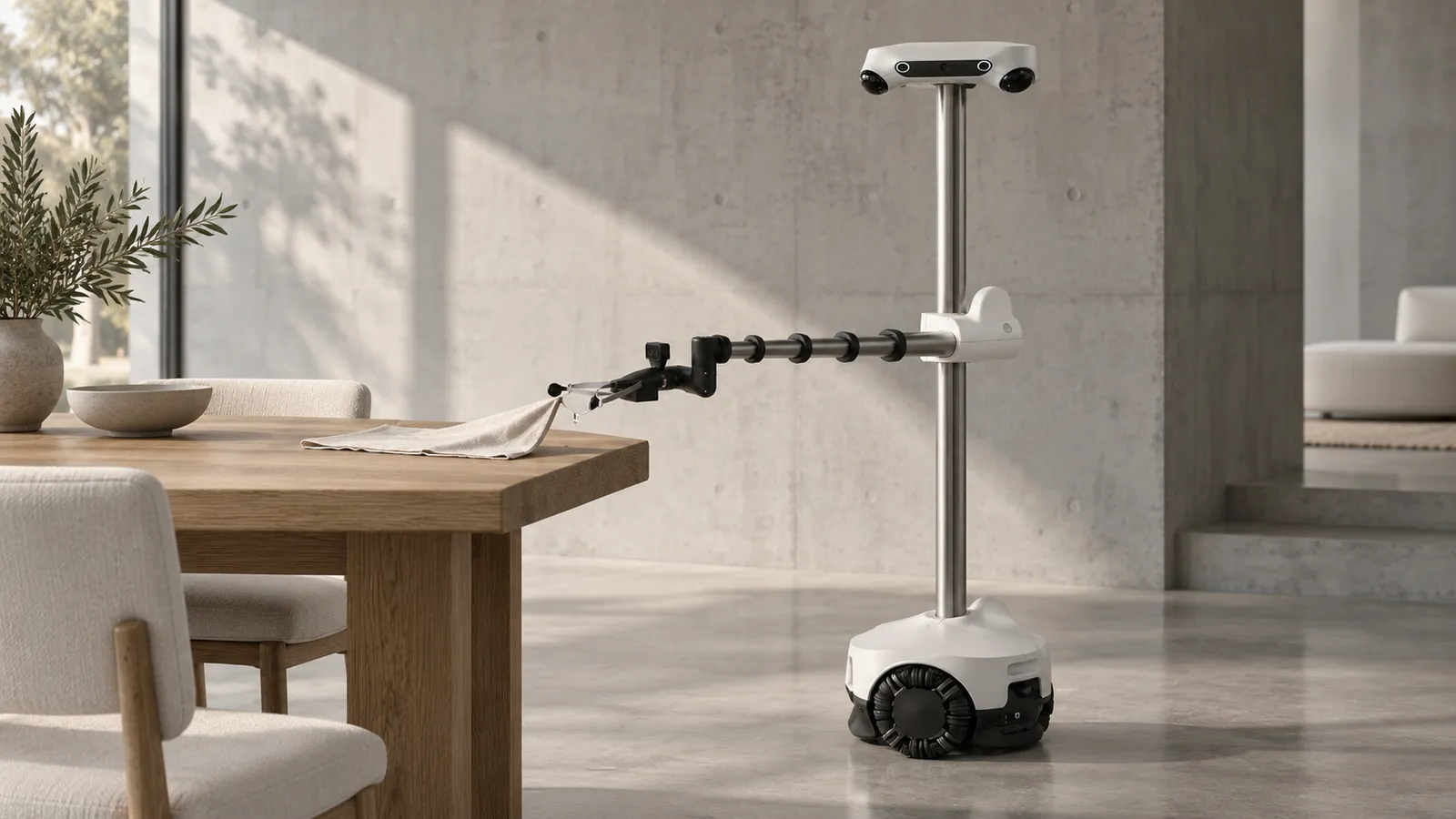
Hello Robot's Stretch is the most common research robot built for the inside of a house: a slim, light mobile manipulator with one arm, a lift and an omnidirectional base, designed to work next to people rather than behind a fence. Stretch 4, released in May 2026, keeps that idea and ships with the tools to drive it remotely out of the box: a browser interface, a gamepad, and a "puppet" mode in which one Stretch controls another. For teams collecting demonstration data in real homes, those choices matter more than any spec. This page covers how each teleop path works, what data you can get out of it, what Stretch 4 can and cannot do today, and how it compares with the bimanual alternatives.
Price, availability and the research-only certification
The Hello Robot purchase page lists Stretch 4 at $29,950 and says it "typically ships within 2-4 weeks from receipt of purchase order or pre-payment". It comes with a compliant gripper, battery and ballast, a wall power supply, ArUco markers, tools, and gamepad and pistol teleop controllers. Add-ons include a docking station ($1,495), a parallel gripper ($1,495), an NVIDIA Jetson Orin NX ($2,995) and a three-year warranty extension ($2,495). Hello Robot does not offer upgrades from Stretch 3 or earlier units.
Two caveats belong up front. First, Stretch 4 "is currently only certified for laboratory and research use", so a lab running a study in a participant's home should plan that under its own research and safety protocols. Second, its LiDAR sensors are made by Hesai, and Hello Robot notes the robot is subject to the DoD 1260H designation, "which may restrict purchase through use of certain government funds". TechCrunch reported in June 2026 that the company expected to build 200 to 300 units at its Martinez, California headquarters and that the first run had sold out.
Three ways to drive Stretch 4 remotely
The Stretch 4 docs group teleoperation into mobile (web), gamepad and puppet modes. Each suits a different job.
Web Teleop
Gamepad
Puppet teleop
Puppet teleop solves the embodiment problem neatly: every demonstrated motion is one the robot can physically make, because the operator made it on an identical robot. The cost is that it needs two Stretch 4 units, about $60,000 at list price, and the operator stands next to the Controller. For remote operators in another city, Web Teleop is the practical option.
Running Web Teleop over the internet
Hello Robot's docs say you can operate Stretch "entirely remotely" through a secure tunneling service such as ngrok, with setup in the stretch4_web_teleop repository. Treat that as a starting point rather than a production link. The same page marks the documentation as beta, tells users to "proceed carefully", and notes that browsers will show an invalid-certificate warning when connecting, which is expected with the default setup. For a study in someone's home, put the operator connection behind your own VPN or authenticated relay, log every session, and agree with the household when the robot may be connected at all.
Latency is forgiving for most Stretch tasks. Fetching objects, opening drawers and wiping a counter tolerate a couple of hundred milliseconds if the operator moves deliberately and the robot's own controllers enforce speed limits. Precise grasps of small objects are the exception, and the gamepad guide notes the teleop script stops sending commands a few milliseconds after input stops, so a dropped link halts the robot rather than leaving it moving. Our latency guide gives budgets by task.
Data from Stretch: what exists and how to record it
The best-known public Stretch dataset came from a demonstration tool rather than teleoperation. Dobb-E, an open-source framework for household manipulation, used "the Stick", built from a $25 reacher-grabber, 3D-printed parts and an iPhone, to collect the Homes of New York dataset: 13 hours across 22 homes and 1.5 million frames. Deployed on Stretch, it reported an 81% success rate over 109 tasks in 10 New York City homes, learning a new task in about 20 minutes (five minutes of demonstrations plus fifteen of fine-tuning). It is a useful reference point for how far cheap handheld capture can go on this robot.
For teleoperated data, the Stretch 4 docs list a puppet-teleop data collection tutorial and a "Logging Data" page. LeRobot's main branch does not include a Stretch driver as of October 2026 (its built-in robots include SO-series arms, Koch, OpenArm, Reachy 2 and Unitree G1), so most teams either record ROS 2 bags and convert them, or write a small LeRobot Robot class around the Stretch Python SDK. Whichever route you pick, fix these before the first episode:
Action space
Base motion
Cameras
Home privacy
Export to LeRobot, RLDS or HDF5 once the schema is stable. Our data collection guide covers episode structure and quality checks.
Who uses Stretch at home, and with a person in the loop
Stretch has a long assistive history, and Hello Robot runs a pilot program for people with significant mobility impairments. Its assist page describes two routes: select individuals and care partners "invited to remotely test-pilot Stretch", and a small in-home program where engineers and an occupational therapist bring the robot to the participant. TechCrunch described a quadriplegic user who sends Stretch to move autonomously and then takes direct control from a voice-operated iPhone app; a protein-shake task that first took nearly two hours came down to minutes. A Hello Robot staff member put the design choice plainly: "Being in control is a feature." On Stretch, teleoperation is not only a way to collect data. For many users it is the product.
What a good Stretch operator does
What Stretch 4 can and cannot do today
Shown in homes
Limited by
Autonomy
Stretch 4 against bimanual alternatives
The usual comparison is a wheeled two-armed platform. The Galaxea R1 Lite lists at $39,999 on Galaxea's site, though Galaxea says it is "not currently available for direct purchase", with two 6-DoF arms rated at 3 kg each, a 3-DoF torso and a 96 kg weight. A bimanual wheeled humanoid such as Pollen Reachy 2 is LeRobot-native. Those platforms can do two-handed tasks Stretch cannot. Stretch's case is the opposite trade: about half the weight, a narrow body that fits real apartments, a price that lets a lab run several units, and the puppet mode for matched-embodiment demonstrations. For single-arm home tasks across many homes, Stretch is usually the cheaper way to get coverage.
How RoboPilots staffs a Stretch program
The robots stay with you, in your lab or in participants' homes. We agree the input path with you (Web Teleop behind your VPN, or puppet teleop at your site) and train a dedicated group of operators on your Stretch units, your task protocol and each household's privacy rules before they record anything.
One-week trial
Coverage
Data
Interfaces, specs and sources
- Web Teleop (browser)
- Gamepad teleop (included)
- Puppet teleop (Stretch drives Stretch)
- Open-source ROS 2 and Python SDK
- Remote access via tunneling (ngrok)
Availability: Buyable for research. Hello Robot lists Stretch 4 at $29,950 and says it typically ships within 2-4 weeks, but it is "currently only certified for laboratory and research use" (hello-robot.com/purchase, checked October 16, 2026). Its assistive page says Stretch 4 "isn't yet available for sale for individual use".
Specs are the maker's published figures, checked on . RoboPilots is not affiliated with Hello Robot; product names are trademarks of their owners.
- Hello Robot: Stretch 4 product page and specifications
- Hello Robot: purchase, price, certification and accessories
- Hello Robot: assistive pilot program
- Stretch 4 docs: Web Teleop demo
- Stretch 4 docs: puppet teleop primer
- Stretch 4 docs: gamepad teleop primer
- TechCrunch: Hello Robot and Stretch 4, Jun 4, 2026
- Dobb-E and the Homes of New York dataset
- LeRobot built-in robots (GitHub)
- Galaxea R1 Lite product page
Frequently asked questions
- How much does Stretch 4 cost?
- Hello Robot lists Stretch 4 at $29,950 as of October 2026, typically shipping within two to four weeks. A docking station, parallel gripper and Jetson Orin NX are extra.
- Can I use Stretch 4 at home?
- Hello Robot says Stretch 4 is currently only certified for laboratory and research use and is not yet for sale for individual use. People with mobility impairments can apply to its assistive pilot program.
- How do you teleoperate Stretch 4?
- Through the browser-based Web Teleop interface, the included gamepad, or puppet teleop, where one Stretch fitted with a pistol grip drives a second Stretch by streaming joint positions at 80 Hz.
- Can Stretch 4 be operated over the internet?
- Yes. Hello Robot's docs say Web Teleop can run entirely remotely through a secure tunneling service such as ngrok. For real deployments, use your own VPN or authenticated relay and log every session.
- Does LeRobot support Stretch 4?
- Not in LeRobot's main branch as of October 2026. Teams record ROS 2 bags and convert them, or write a small LeRobot Robot class around the Stretch Python SDK.
- Can I upgrade a Stretch 3 to Stretch 4?
- No. Hello Robot's purchase page says it does not currently offer upgrades from Stretch 3 or earlier versions.