Robots · Home robots
Roborock Saros Z70 teleoperation: driving the OmniGrip arm, and what a 300 g arm can do
The Saros Z70 is the first mass-market home robot with an arm you can buy. It is autonomous, nobody drives it remotely, but its app lets you steer the arm yourself, which makes it a small, real test of home teleoperation.
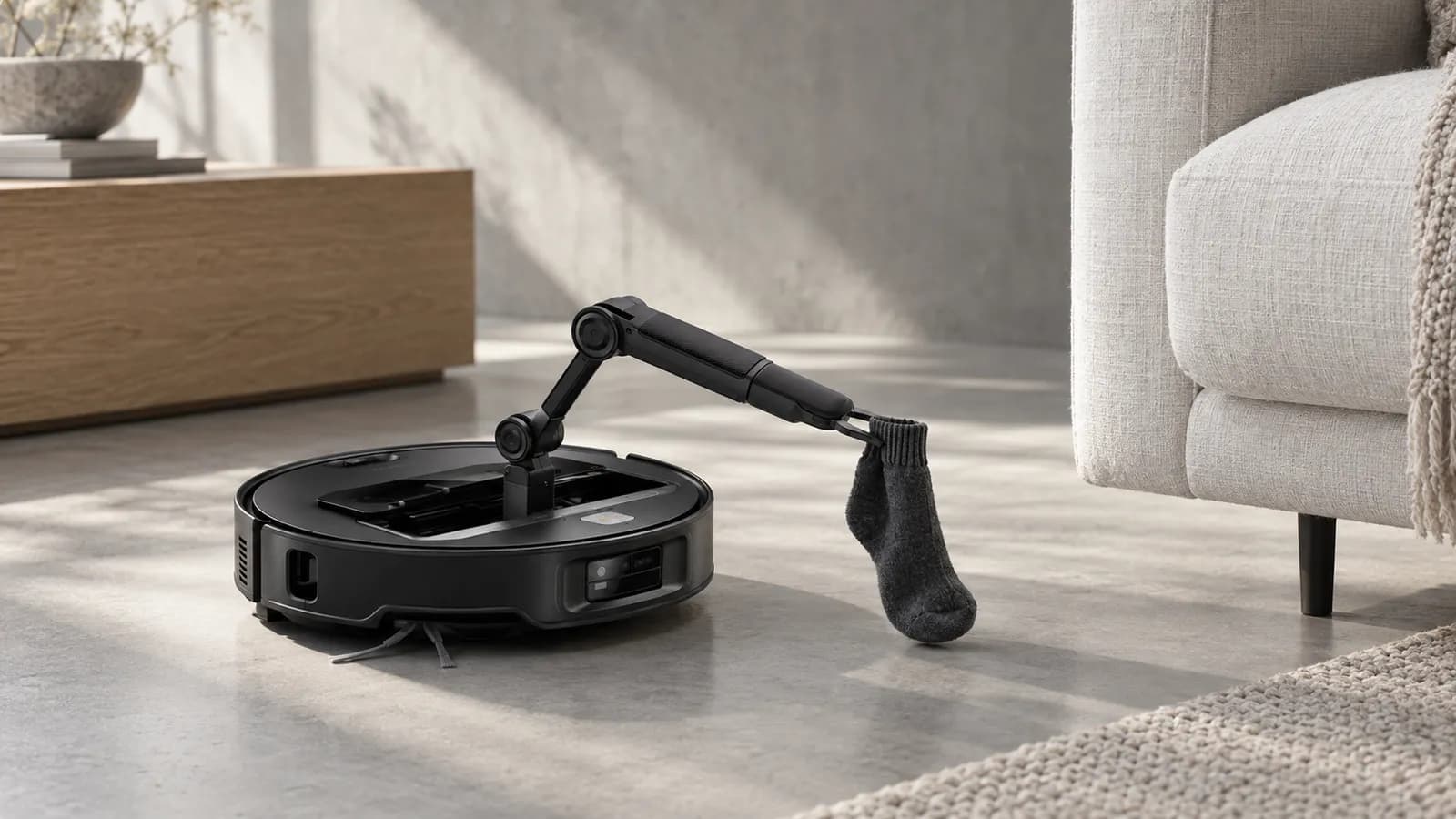
- Arm
- OmniGrip foldable five-axis arm with camera, LED and weight sensor
- Arm lift limit
- Weight sensor stops lifts above 300 g
- Suction
- 22,000 Pa (IEC 62885-2, Max+ mode)
- Obstacle recognition
- 108 object types, plus up to 50 user-defined objects
- Robot size
- 350 × 353 × 79.8 mm
- Dock
- Multifunctional Dock 4.0 (80°C mop wash, auto empty, warm-air drying)
- Charging
- 2.5 h fast charge
- Price
- Listed at $2,599.99 on Roborock's US store, shown on sale at $999.99, as of October 2026
Updated
The Roborock Saros Z70 is a flagship robot vacuum and mop with one addition no other mass-market floor robot had when it launched: a foldable, five-axis arm, which Roborock calls OmniGrip, that unfolds from the top of the robot to pick up socks, tissues, slippers and small towels before the vacuum runs over them. It is the first home manipulator many households will actually own. It is also a useful case study for anyone thinking about home robots and the people behind them, because it shows what a cautious, low-payload arm can do on autonomy alone, and because its app lets the owner take the arm over by hand.
Is the Saros Z70 teleoperated?
Not by anyone at Roborock. The Z70 is an autonomous product: it recognizes liftable objects, picks them up and drops them at places you set in the app. There is no remote operator service and no human-in-the-loop fallback. What it does have is a manual mode. Roborock's Saros Z70 page says the mechanical arm and the chassis can be "manually controllable" through the Roborock app. That is teleoperation in its simplest consumer form: the owner, on a phone, steering a robot arm in their own home.
It is worth separating three things that get blurred in coverage of home robots. Owner-driven control, as on the Z70, keeps the human and the home on the same side: nobody outside the household is looking through the camera. Remote takeover by a company operator, as Weave describes for Isaac 1, lets a robot finish tasks its policy cannot. Demonstration collection, in which operators drive robots to produce training data, is how most manipulation policies are built. The Z70 only does the first.
How OmniGrip works
Off by default
Seeing the object
Weighing it
Putting it somewhere
Everything else on the robot is a high-end vacuum and mop: 22,000 Pa of suction measured under IEC 62885-2 in Max+ mode, recognition of 108 obstacle types plus up to 50 objects you define and label in the app (between 10 × 10 cm and 100 × 100 cm), and a 79.8 mm tall body that fits under low furniture. The arm folds flat inside that height.
What the arm can and cannot do today
Reviews line up on the same picture. BGR's June 2025 review saw the Z70 pick up rolled socks, small towels, crumpled tissues, paper balls and slipper-style sandals, and also listed the limits Roborock itself acknowledged to the reviewer:
Speed
Fabric on carpet
Flat, small and shiny objects
Weight
BGR's verdict was that at the $2,599 launch price the arm felt more like a gimmick than a product, most useful in homes with kids or pets, and it suggested the Saros 10R as the cheaper alternative. That was a fair reading at launch. Seen from a robot-learning angle, the Z70 is doing the hardest version of a simple task: grasping deformable, low-profile objects from the floor, in a home it has never seen, with no human fallback. The cautious speed and the 300 g cap are the safety envelope that makes that acceptable.
Why the weight sensor matters: a floor robot cannot tell a sock from a phone charger by sight alone every time. A hard weight limit checked at the moment of lifting is a simple, robust guard, and it is the kind of local safety rule any home manipulator needs whether a policy or a person is driving it.
Getting better pick-ups if you own one
Give it room to drop things
Label your own clutter
Expect the floor type to matter
Use manual control for the odd case
Camera and privacy: what Roborock says
An arm with its own camera, on a robot that already has an RGB camera, raises the obvious question. Roborock's product page says all camera functions are off by default and work only when the user allows them, that the robot is certified by TÜV against the EN 303 645 consumer IoT security standard, and that it does not collect user data for third parties. The Roborock Trust Center, last updated August 2026, adds these statements:
That last training statement is the most interesting one for this section of the site. Roborock says it builds its models from simulated homes rather than footage from customers. It is the opposite trade-off from robots that learn from real-home demonstrations or remote sessions, and it fits a product whose skills are narrow and well defined. It also partly explains why new object types arrive slowly through updates rather than being learned in your house.
A US regulatory note
On July 28, 2026 the FCC added "Foreign-produced advanced robotic devices, except advanced robotic devices which have been granted a Conditional Approval by DoW" to its Covered List (FCC public notice DA 26-786). Equipment on the list cannot receive new FCC equipment authorizations. The notice defines "advanced robotic devices" by reference to an attached national security determination, and we have not seen Roborock or the FCC say how the rule applies to the Saros Z70 or to future Roborock models. If you are planning a purchase around a model that has not launched in the US yet, check its status before you wait for it.
Saros Z70, Saros 10R or Dreame Cyber10 Ultra?
The closest sibling is the Saros 10R. It shares the same 350 × 353 × 79.8 mm body, the 108-type obstacle recognition, the StarSight navigation and the 10-in-1 Multifunctional Dock 4.0. Its "FlexiArm" is an extending side brush and mop for corners, not a gripper. If you want clean floors and are happy to pick up your own socks, the 10R is the simpler buy. The Z70 makes sense if floor clutter is your real problem, or if you want to see where home manipulation is heading.
Outside Roborock, the nearest rival is Dreame's arm vacuum. Vacuum Wars reported from IFA 2025 that the Cyber10 Ultra's arm reaches about 33 cm and handles up to 500 g, with pricing and availability not yet confirmed. See our Dreame Cyber10 Ultra page for its current status.
What an arm vacuum would need to become generally useful
The Z70 handles a short list of object classes, each with a fixed destination. Going from there to "tidy this floor" is a data problem more than a hardware one, and it is the same problem every home robot faces:
Many homes, not one
Recoveries
Consistent strategy
Privacy by design
Our data collection guide covers how teams structure those episodes and check their quality.
Building a floor-level manipulator? How RoboPilots helps
We have no relationship with Roborock, and the Z70 has no remote-operator program. For companies building their own home manipulators, from arm vacuums to mobile bimanual robots, we staff the people who collect demonstrations and, where your product needs it, take over remotely when autonomy stalls. We train a dedicated group of operators on your unit and task protocol before they record anything. More on the category on our home and hospitality page.
One-week trial
Coverage
Data
Interfaces, specs and sources
- Roborock app
- Manual arm and chassis control in the app
- Up to 50 custom object labels
- Cameras off until enabled
- Matter (announced via OTA)
- No remote operator service
Availability: Buyable. Roborock sells the Saros Z70 through its US store and lists Amazon, Best Buy, Wayfair and NFM as retailers. On October 16, 2026 Roborock's US store showed a $2,599.99 list price and a $999.99 sale price, with mixed stock messages on the same page.
Specs are the maker's published figures, checked on . RoboPilots is not affiliated with Roborock; product names are trademarks of their owners.
- Roborock Saros Z70 product page: OmniGrip, specs, privacy
- Roborock US store: Saros Z70 listing and price
- Roborock Trust Center (last updated Aug 2026)
- Roborock US shop privacy policy (Feb 27, 2025)
- Roborock Saros 10R product page
- BGR: Roborock Saros Z70 review, Jun 1, 2025
- Vacuum Wars: Dreame Cyber10 Ultra at IFA 2025
- FCC public notice DA 26-786: advanced robotic devices added to Covered List, Jul 28, 2026
Frequently asked questions
- Can the Roborock Saros Z70 pick up socks?
- Yes, with limits. Roborock lists socks among the objects OmniGrip handles, but reviewers found flat socks can be missed, and Roborock says it does not yet pick up fabric items on carpet.
- How much can the Saros Z70 arm lift?
- Roborock says a built-in weight sensor stops any lift above 300 g, so the arm is meant for light items such as socks, tissues, slippers and small towels.
- Can I control the Saros Z70 arm myself?
- Yes. Roborock says the arm and the chassis can be manually controlled through the Roborock app, in addition to the automatic pick-up routines.
- Are the Saros Z70 cameras private?
- Roborock says all camera functions are off by default, obstacle photos are stored encrypted on the robot, AI runs on-device, and the robot is TÜV certified to EN 303 645. These are Roborock's own statements.
- Is the Saros Z70 worth it over the Saros 10R?
- The two share the same body, navigation and dock; the Z70 adds the OmniGrip arm. If floor clutter is not your main problem, reviewers have pointed to the 10R as the better value.