Robots · Home robots
Dreame Cyber10 Ultra teleoperation: an arm vacuum, and what it takes to make one useful
Dreame's Cyber10 Ultra is the most capable arm vacuum announced so far on paper: a five-degree-of-freedom arm that lifts 500 g and swaps tools from its dock. A year after its debut it is still not on sale, and much of how it works has not been published.
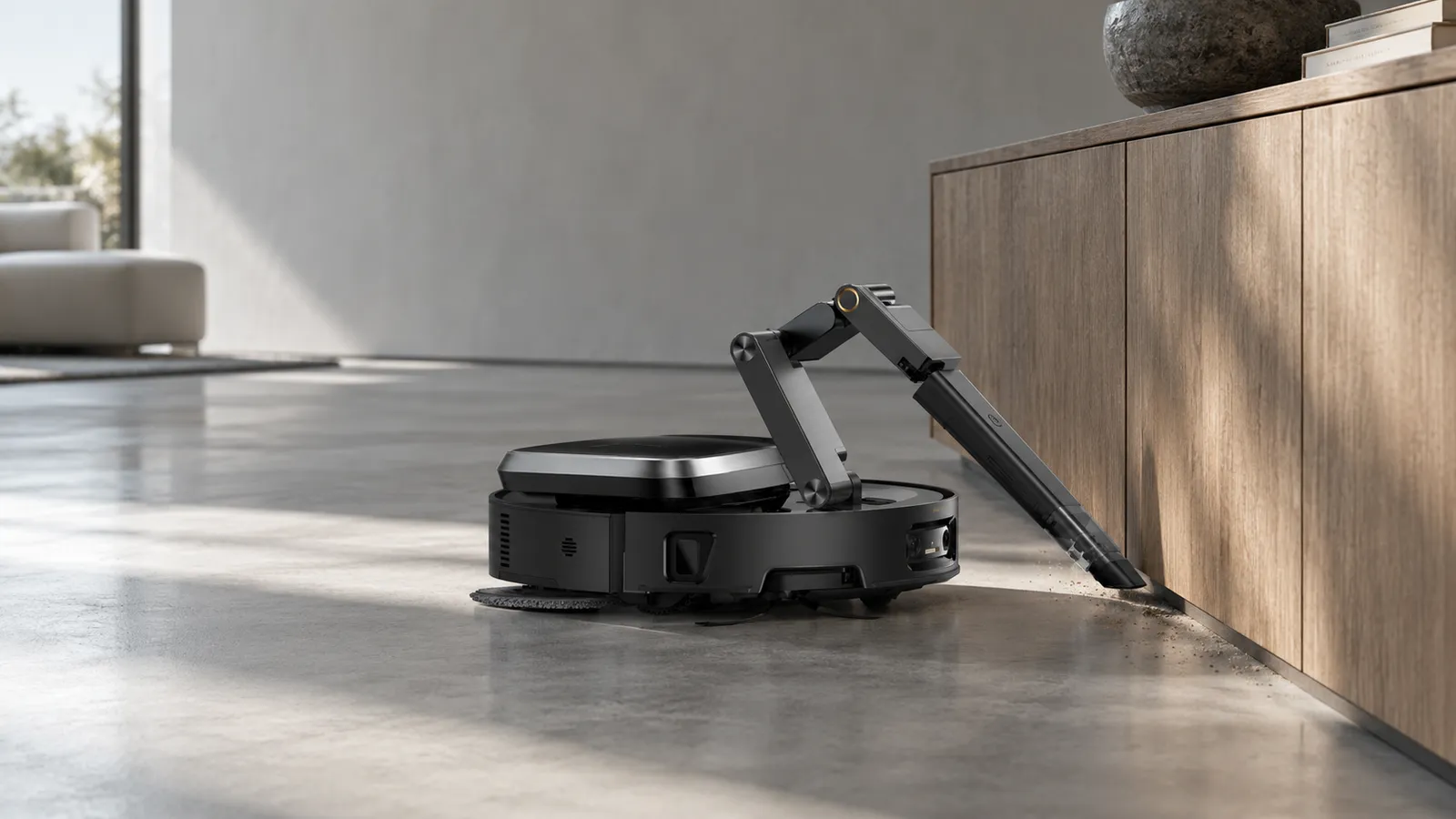
- Arm
- 4 joints, 5 degrees of freedom
- Arm reach
- About 33-40 cm depending on the tool
- Arm lift
- Up to 500 g
- Suction
- 30,000 Pa (announced)
- Perception
- TriSight: AstroVision front camera, arm-mounted camera, side laser ToF
- Obstacle climbing
- Thresholds up to about 6 cm (announced)
- Price
- Not announced as of October 2026
Updated
Robot vacuums have started to grow arms. Roborock sells one today in the Saros Z70, and Dreame answered at IFA 2025 with the Cyber10 Ultra: a robot vacuum with a four-joint, five-degree-of-freedom arm that can lift 500 g, pick up clutter in its path, and swap cleaning tools from its dock. It reappeared at CES 2026. As of October 2026 it has no price, no US listing and no confirmed release date. This page collects what has been published about the Cyber10 Ultra, marks what is still unknown, compares it with the arm vacuum you can actually buy, and explains why the hard part of an arm vacuum is not the arm but the data that teaches it what to pick up.
Status: shown twice, not yet sold
Vacuum Wars covered the IFA 2025 debut in Berlin and wrote that pricing and availability were yet to be confirmed. Notebookcheck reported on September 8, 2025, citing Dreame, that it would reach stores in early 2026. At CES 2026 Dreame demonstrated it on the show floor again, and Vacuum Wars' CES coverage described it as a "technology showcase" rather than a near-term consumer product. A search of Dreame's US store returned no Cyber10 Ultra listing on October 16, 2026.
We have seen retail price and launch-month figures for Europe on aggregator sites, but none on a Dreame page, so we are not repeating them. Until Dreame publishes a listing, treat the Cyber10 Ultra as announced.
What Dreame has announced
The arm
Clutter handling
Tool use
Perception
Base and dock
Not every "bionic arm" from Dreame is a manipulator. In its April 28, 2026 DREAME NEXT release in San Francisco, Dreame said its second-generation bionic arm technology extends a side brush up to 12 cm and a mop up to 16 cm, and it applied the "bionic arm" name to airflow arms on an air conditioner, articulated wings on a range hood and a cruising wash arm in a dishwasher. The Cyber10 Ultra's arm is the one that picks things up.
What is still unknown
Which objects
Speed and success rate
Manual control
How it was trained
Camera privacy
Price and date
Cyber10 Ultra against the Roborock Saros Z70
The arm vacuum you can buy today is the Roborock Saros Z70. Its product page describes a "foldable five-axis mechanical arm" called OmniGrip with a weight sensor that stops lifts above 300 g. Its tidying feature currently covers socks, sandals, crumpled tissues and towels under 300 g, it recognizes 108 obstacle types plus up to 50 custom objects you define, and its arm and chassis can be controlled manually from the Roborock app. Roborock says all camera functions are off by default and that the robot is certified by TÜV to ETSI EN 303 645. Suction is 22,000 Pa.
On paper the Cyber10 Ultra lifts more (500 g against 300 g), adds tool swapping and claims higher suction. The Z70 has the advantages of existing: a published object list, a stated privacy default and an app mode that lets a person drive the arm. Until Dreame publishes the equivalent details, the Z70 is the one you can evaluate.
Why the data matters more than the arm
A 500 g arm on a vacuum is mechanically modest. What makes it useful is judgment: telling a sock from a charging cable, a toy from a pet bowl, a tissue from a receipt, and knowing what not to touch. That comes from training data that covers the clutter of real homes, and from a fallback when the robot is unsure. Roborock's manual arm control shows one way people already sit behind these robots: the owner as a casual teleoperator. Every company building a pick-up arm for the home faces the same questions:
What good demonstrations look like on an arm vacuum
Dreame has not said how it trains the Cyber10 Ultra, so this is general practice for any low-slung pick-up arm, shaped by the specs Dreame announced. An operator recording demonstrations on a robot like this should:
The same release that described Dreame's bionic arm platform also introduced a Z1 Laundry Robot with a multi-joint arm that Dreame says can pick up, wash, dry and retrieve clothing without human intervention. Dreame is clearly investing in manipulation across its range; how it teaches those arms is the part it has not yet described.
A US regulatory note
On July 28, 2026, the FCC added foreign-produced advanced robotic devices to its Covered List. The determination defines them as mobile devices, including autonomous mobile robots, that move and avoid obstacles, operate at a distance from a human based on commands or sensor data, weigh over 4.4 lb with any docking station, and have sensors, network connectivity and control software, unless granted a Conditional Approval by the Department of War. Covered equipment cannot receive new FCC equipment authorizations. How that definition applies to robot vacuums in general, and to a new model such as the Cyber10 Ultra in particular, is a question for Dreame and the FCC; we have not seen guidance on it. It is worth asking about before relying on a US launch date.
For appliance makers building arm robots
An arm vacuum needs the same thing a humanoid does: many clean, consistent demonstrations recorded on the actual robot, and evaluation runs that show where it fails. RoboPilots staffs teleoperated demonstration collection and remote takeover for robot makers, on their hardware and under their privacy rules. For each program we train a dedicated group of operators on your unit and task protocol, and the same group stays on it. A one-week trial sets the clean-episodes-per-operator-hour baseline, shifts run across time zones including US Pacific, and every episode is labeled by object, task and outcome and delivered as LeRobot, RLDS or HDF5. Our data collection guide and home and hospitality page cover how these programs are scoped.
Interfaces, specs and sources
- Autonomous clutter pick-up
- Arm tool switching from the dock
- TriSight perception (incl. arm camera)
- Matter compatibility (announced)
- Manual arm control: not published
Availability: Announced, not on sale. Dreame showed the Cyber10 Ultra at IFA 2025 and again at CES 2026; Notebookcheck reported Dreame expected it in stores in early 2026, but Dreame's US store had no Cyber10 Ultra listing and no price when we checked on October 16, 2026. No release date has been confirmed.
Specs are the maker's published figures, checked on . RoboPilots is not affiliated with Dreame Technology; product names are trademarks of their owners.
- Vacuum Wars: Dreame Cyber10 Ultra at IFA 2025
- Vacuum Wars: Dreame's CES 2026 lineup
- Notebookcheck: Dreame sales start for arm robot vacuum, Sep 8, 2025
- Dreame: DREAME NEXT Living Next showcase, Apr 28, 2026
- Roborock Saros Z70 product page
- FCC: foreign-produced power inverters and robots added to Covered List, Jul 28, 2026
- FCC Public Notice DA 26-786 with National Security Determination (PDF)
Frequently asked questions
- When is the Dreame Cyber10 Ultra release date?
- Dreame has not confirmed one. Notebookcheck reported in September 2025 that Dreame expected it in stores in early 2026, but Dreame's US store had no listing in October 2026.
- How much will the Cyber10 Ultra cost?
- Dreame has not announced a price as of October 2026. Figures circulating online have not appeared on a Dreame page.
- How much can the Cyber10 Ultra arm lift?
- Up to 500 g, according to Dreame's announcement, with a reach of about 33 to 40 cm depending on the tool. The arm has four joints and five degrees of freedom.
- Dreame Cyber10 Ultra vs Roborock Saros Z70: which is better?
- On paper the Cyber10 Ultra lifts more and swaps tools. The Saros Z70 is on sale, publishes which objects it picks up, keeps cameras off by default and lets you drive the arm from the app.
- Is Dreame making a humanoid robot?
- Dreame has not announced a home humanoid that we could verify. Its 2026 releases focus on extending its bionic arm technology across vacuums and appliances, plus a laundry robot with a multi-joint arm.