Robots · Home robots
Matic robot vacuum: no teleoperation, no cloud, and what that means next to chore robots
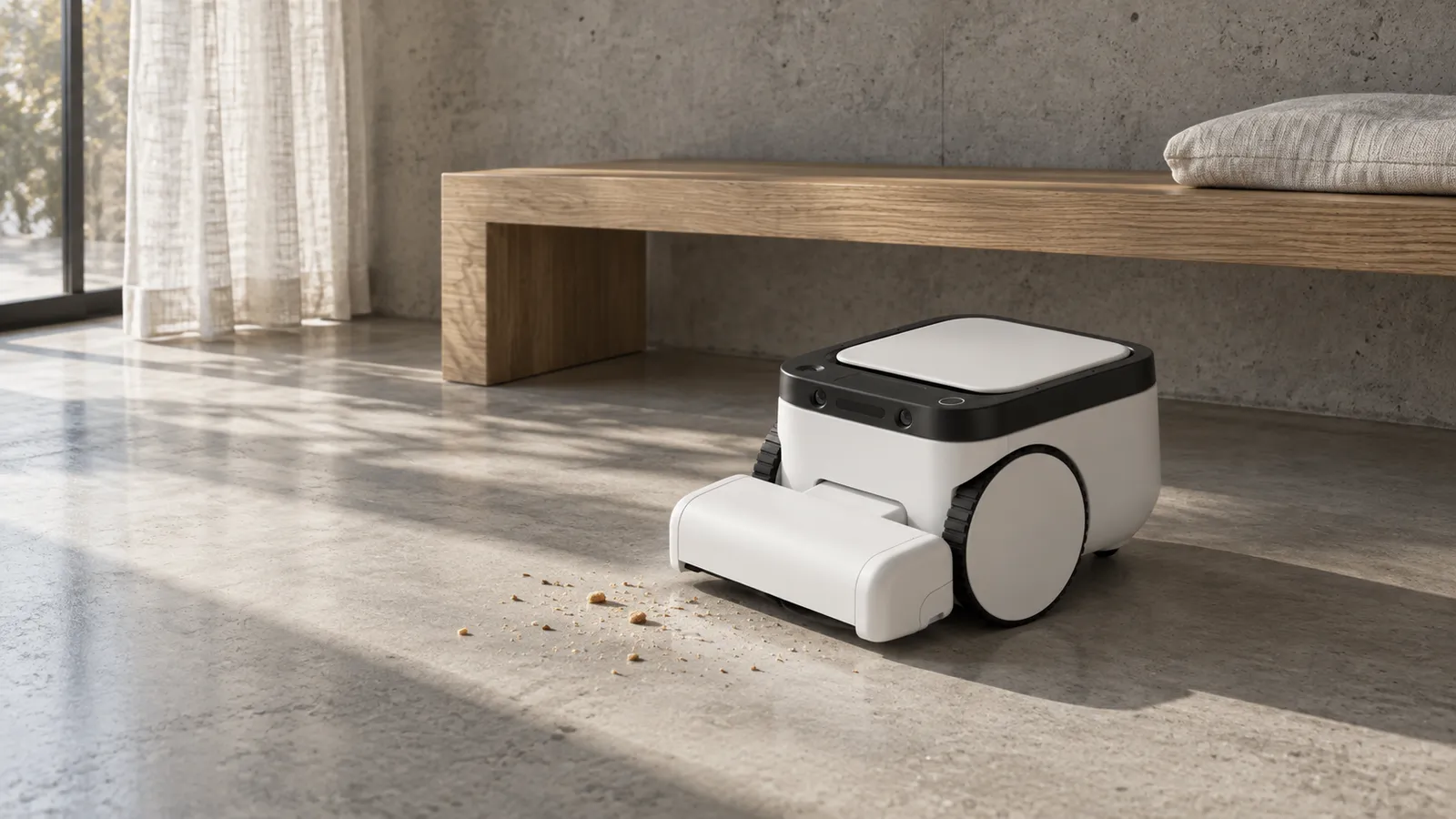
Matic cleans floors with cameras and keeps the processing on the robot. Nobody drives it remotely and nothing has to leave your home. Next to chore robots that rely on remote operators, it shows the other end of the privacy trade-off.
- Navigation
- Vision-first, five RGB-IR cameras, no LiDAR (Vacuum Wars)
- Mapping
- Maps a 3,000 sq ft home in under 20 minutes (Matic)
- Cleaning
- Vacuums rugs and roller-mops hard floors; HEPA bag
- Height
- 7.8 in (Vacuum Wars measurement)
- Controls
- App, voice and gesture (Matic Cues), tap to scrub
- Processing
- On the robot; maps streamed to the app over home Wi-Fi
- Price
- Listed at $1,495 on Matic as of October 2026
Updated
Matic is a floor-cleaning robot from Matic Robots of Mountain View, California, that navigates with cameras instead of LiDAR and runs its AI on the robot itself. It has no arm, and it does not do chores beyond vacuuming and mopping. It is on this list because of how it handles privacy. Many of the home robots on these pages learn from human demonstrations and call on remote operators when they get stuck, which means video from the home has to reach someone. Matic was designed so that it does not. For buyers weighing a more capable chore robot, and for builders deciding how much data has to leave the house, it is the clearest reference point.
Can you buy a Matic?
Yes. Matic's site lists it at $1,495, with free shipping and returns in the lower 48 states, a one-year warranty with US-based support, and a six-month trial in which you can return it for a full refund. It says the robot ships in two weeks, and HSA and FSA payment is available for qualifying customers. The price went up in September 2026; Matic said at the time the increase reflected rising costs for memory and other components, as reported by The Verge.
Does anyone ever operate it remotely?
No. Matic is fully autonomous. There is no remote operator service, no teleoperation mode and no human-in-the-loop fallback. You control it through the app, by voice, or by pointing: Matic Cues, launched in August 2026, lets you tell it or show it where to clean. The only time a person at Matic may see video, according to its privacy policy, is a support case you explicitly authorize.
The closest thing to remote control is your own phone. With tap to scrub, you mark a spot on the map in the app and Matic goes there for a deep clean. With Cues, announced on Matic's press page on August 13, 2026, you can point at a mess or say what you want. Both are ways for the owner to direct an autonomous robot, not to drive it, and both keep the household as the only humans in the loop. Setup is the same idea: Matic says you turn it on, open the app and it handles the mapping itself.
What Matic's privacy policy says
The homepage summary is "Private by design": maps and cleaning data are processed on the device and stay in your home, no cloud is required, and you choose what to share. The privacy policy, last updated August 13, 2026, puts it in more detail:
Video and audio
Processing
Gestures
Voice
Remote access
Usage data
Two points are worth reading closely. Voice commands do leave the robot, to Google, after the wake word. And the policy says Matic may use personal information for research and development and lists AI providers among its service providers, without saying specifically whether any robot data trains its models. Neither undermines the core claim that camera footage stays on the robot, but both are the kind of detail a careful buyer checks.
The trade-off is real. A robot that keeps every frame at home cannot have a remote expert finish a task it fails, and its maker cannot learn from your home's hard cases unless you send them. For floor cleaning, a narrow and well-understood job, that is a good trade. For a robot that folds laundry or loads a dishwasher, every maker shipping today has chosen some form of human help instead.
Six privacy questions, and how Matic answers them
These are the questions we suggest asking of any home robot with cameras, remote-operated or not. Matic's answers, from its own pages, make a useful baseline to compare others against:
Can a person at the company see through the robot?
Can a person at the company drive the robot?
Where is camera data processed?
What leaves the home by default?
Is home data used to train models?
Can I delete what was collected?
Run the same six questions against a remote-assisted robot such as Weave Isaac 1 and the answers to the first two change by design. That is not a reason to avoid such robots. It is a reason to want the other four answered just as clearly.
What it can and cannot do
Matic vacuums rugs, mops hard floors and steers around toys, cables and pet paws, and its app warns you when the HEPA bag is full or the water is low. Vacuum Wars' review (last updated September 16, 2026) recorded the highest suction it has measured, 8.11 kPa, and a perfect score on its flattened pet hair test. It also found real limits:
Height
Speed
Bag and dock
Obstacles
Matic's own page quotes stronger verdicts, including WIRED's "This is the only 10/10 rating I have ever given in over a decade of reviewing products." Different testers weight different things. If under-bed cleaning and an auto-empty dock matter most to you, those are the trade-offs to weigh.
FCC status: a Conditional Approval
On July 28, 2026 the FCC added "Foreign-produced advanced robotic devices, except advanced robotic devices which have been granted a Conditional Approval by DoW" to its Covered List (FCC public notice DA 26-786). Covered equipment cannot receive new FCC equipment authorizations. On October 2, 2026, FCC public notice DA 26-1063 announced that the Department of War had granted Conditional Approval to Matic Robots' Robotic Floor Cleaner Model 4MA0001 and Charging Dock Model 4DK0008, exempting them from the Covered List. The exemption depends on Matic's continued compliance with the onshoring plan in its application and updated vetting of its products. Vacuum Wars reported that Matic designs, tests and assembles the robot in Mountain View, uses components from multiple countries, and had said in August that it did not yet meet a 65% domestic-component threshold.
Matic against the Roborock Saros Z70
The nearest comparison for a privacy-minded buyer is the Roborock Saros Z70, a flagship vacuum with a five-axis arm that picks up socks and tissues. Roborock also says its AI runs on-device and that obstacle photos are stored encrypted on the robot, and it says its models are trained on simulated homes rather than customer data. The differences: the Z70 has an arm, a low 79.8 mm body that fits under furniture and a self-emptying, mop-washing dock; Matic has a taller vision-first design, local-only map streaming by default, and voice and gesture control. Both makers keep remote humans out of the loop, which is why neither can do much beyond the jobs it was built for.
What chore-robot builders can take from Matic
Make local the default
Separate support from operation
Say what leaves the house
Keep training data narrow
Our human-in-the-loop guide covers how remote takeover programs set those rules on larger robots.
Building a home robot that needs human help? How RoboPilots works
We have no relationship with Matic, and Matic does not use remote operators. For companies whose home robots do need people, to collect demonstrations or to take over when autonomy stalls, we train a dedicated group of operators on your own unit and task protocol, with your household privacy rules (session approval, camera limits, off-limits rooms, retention) written in from the first day. See our home and hospitality page for more.
One-week trial
Coverage
Data
Interfaces, specs and sources
- Matic app over local Wi-Fi
- Matic Cues (voice and gesture)
- Tap to scrub
- Opt-in encrypted cloud for remote app use
- No remote operator, no arm
Availability: Buyable in the US. Matic lists it at $1,495 with free shipping and returns in the lower 48 states, "Ships in 2 weeks", and a six-month full-refund trial (maticrobots.com, checked October 16, 2026). On October 2, 2026 the FCC announced a Department of War Conditional Approval exempting Matic's floor cleaner (model 4MA0001) and charging dock (4DK0008) from the Covered List, subject to its onshoring plan (FCC DA 26-1063).
Specs are the maker's published figures, checked on . RoboPilots is not affiliated with Matic Robots; product names are trademarks of their owners.
- Matic homepage: price, shipping, privacy summary, reviews
- Matic privacy policy (last updated Aug 13, 2026)
- Matic press page
- FCC public notice DA 26-786: advanced robotic devices added to Covered List, Jul 28, 2026
- FCC public notice DA 26-1063: Conditional Approvals incl. Matic, Oct 2, 2026
- Vacuum Wars: Matic robot vacuum review (updated Sep 16, 2026)
- Vacuum Wars: Matic on FCC domestic-content rules, Aug 20, 2026
- Roborock Trust Center
Frequently asked questions
- Does Matic send video to the cloud?
- Matic says it does not collect any video or audio except for support you explicitly authorize, and that all processing happens on the robot. Spoken commands after the wake word are sent, encrypted, to Google.
- How much is the Matic robot?
- Matic lists it at $1,495 as of October 2026, with free shipping and returns in the lower 48 states and a six-month full-refund trial.
- Is the Matic robot teleoperated?
- No. Matic is fully autonomous and has no remote operator service. You control it through the app, by voice or by pointing.
- Matic vs Roborock: which is more private?
- Both say their AI runs on the robot. Matic adds that maps stream to your app over local Wi-Fi by default and that it collects no video without your authorization; Roborock says photos are stored encrypted on the robot and its models are trained on simulated homes.
- Is Matic affected by the FCC Covered List?
- The FCC announced on October 2, 2026 that Matic's floor cleaner and charging dock received a Conditional Approval exempting them from the Covered List, subject to Matic's onshoring plan and product vetting.