Robots · Home robots
AgileX Cobot Magic teleoperation: buying a Mobile ALOHA rig, and staffing the people who drive it
Cobot Magic packages Stanford's Mobile ALOHA design, the robot that learned to cook shrimp and rinse a pan from human demonstrations, as a rig you can order. The hardware is the easy part. The demonstrations still need people.
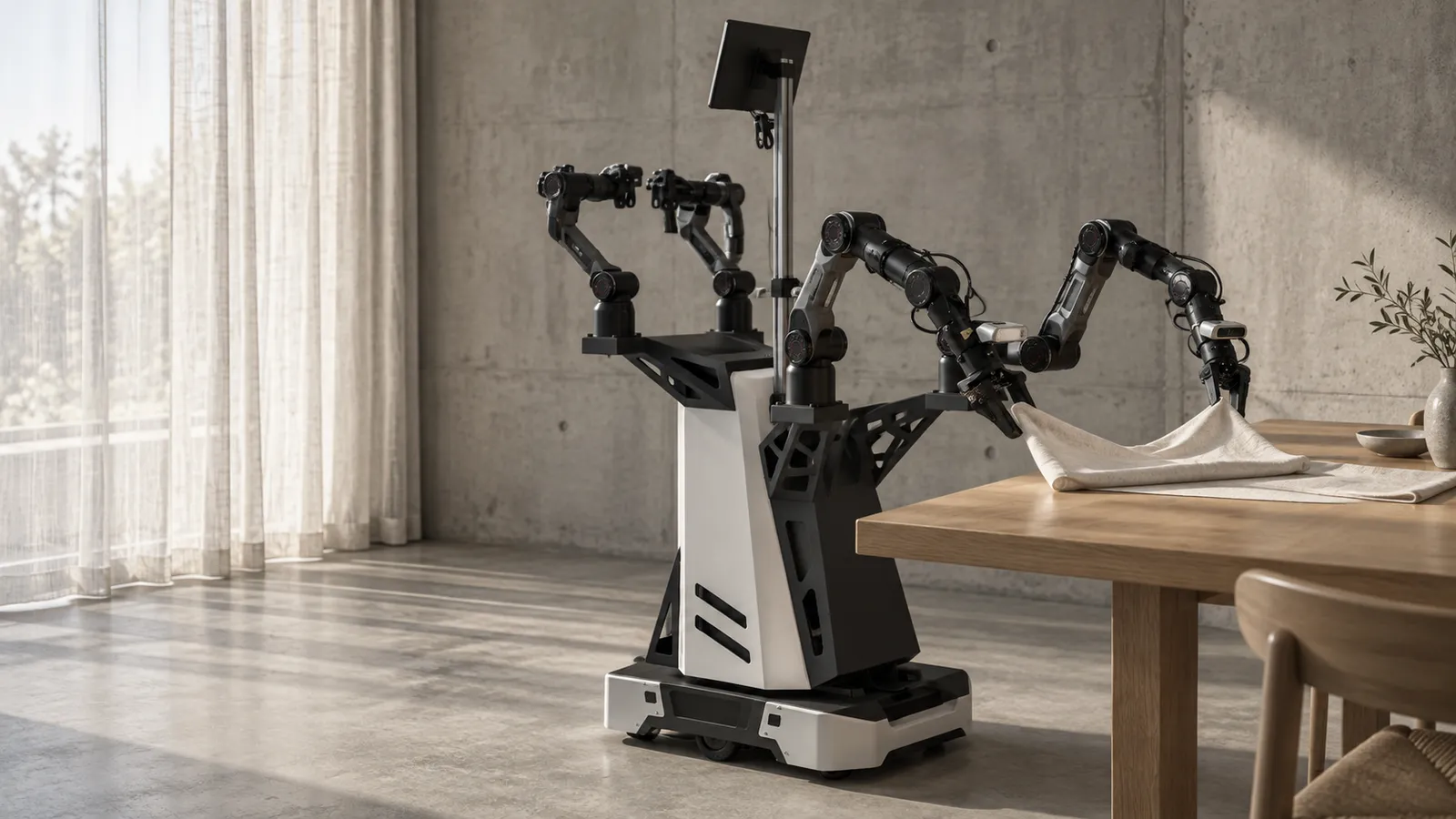
- Base
- AgileX Tracer indoor differential-drive base
- Arms
- Four 6-DoF lightweight arms customized by AgileX (leader and follower pairs)
- Cameras
- Two wrist cameras and one top camera (Orbbec Dabai depth cameras in AgileX's 2024 build)
- Recorded state
- 14 arm joints plus 2 base degrees of freedom
- Compute
- Industrial PC required: Jetson Orin Nano 8 GB, or i7-9700 with RTX 4060 and 32 GB
- Software
- Mobile ALOHA code, AgileX act-plus-plus fork, ROS, URDF sim models
- Price
- Not listed by AgileX as of October 2026 (sales enquiry)
Updated
AgileX Cobot Magic is a commercial build of Mobile ALOHA, the open-source system from Stanford that put a two-armed teleoperation rig on a mobile base and trained it to do kitchen and household tasks from human demonstrations. AgileX swaps in its own Tracer base and arms, adds an industrial PC and cameras, and integrates the Mobile ALOHA code. For a lab or a home-robot startup, it answers one question quickly: how do I get a bimanual mobile rig that records learnable demonstrations without building one? It leaves a second question open: who will drive it, for how many hours, and how consistently?
What Mobile ALOHA showed
The Mobile ALOHA paper by Zipeng Fu, Tony Z. Zhao and Chelsea Finn (January 2024, CoRL 2024) describes a system that "augments the ALOHA system with a mobile base, and a whole-body teleoperation interface." The headline result, from the project page: "With 50 demonstrations for each task, co-training can increase success rates by up to 90%", where co-training means mixing the new mobile demonstrations with existing static ALOHA datasets. The robot then performed tasks such as sautéing and serving a piece of shrimp, opening a two-door wall cabinet to store heavy pots, calling and entering an elevator, and rinsing a used pan under a faucet.
Fifty demonstrations per task is the number that matters for anyone budgeting a home-robot data program. It is small enough that a trained operator can record a task's worth in a session or two, and large enough that quality and consistency across those 50 decide whether the policy works. The Mobile ALOHA code is public under MIT: MarkFzp/mobile-aloha holds the teleoperation and recording scripts, tested on ROS 1 Noetic, with its record_episodes.py script saving each episode as an HDF5 file, and the learning code lives in act-plus-plus, a fork of the original ACT repository. Teleop starts when the operator closes the leader gripper.
What AgileX sells
AgileX's Cobot Magic page calls it "an open-source robotic system that uses Mobile ALOHA for controlling both a mobile base and a robotic arm", credits the Stanford authors, and says it integrates the Mobile ALOHA code with an environment for data collection and model training and support for VLA frameworks and world models. The hardware is built on four arms, two wrist cameras and one top camera, on AgileX's Tracer differential-drive base. AgileX's 2024 write-up on Open Robotics Discourse gives more detail on that build:
Arms
Base
Cameras
Compute
Data
Extras
Current listings differ in detail from that 2024 build. European reseller Generation Robots lists Cobot Magic with AgileX PiPER arms (6 DoF, 626 mm reach, 1.5 kg payload), a top speed of 1.6 m/s, a four-hour charge time and delivery within two months. Confirm the exact arm, camera and computer configuration with AgileX when you request a quote.
AgileX also publishes mobile_aloha_sim, URDF and Xacro models of Cobot Magic and its split-type ALOHA variants, so teams can rehearse tasks and test code in simulation before booking robot time.
How a Cobot Magic session works
1. Set the scene
2. Drive with the leader arms
3. Record
4. Reset and repeat
5. Train and evaluate
Leader-follower rigs make the operator's motion the training signal, joint for joint. That is why they produce such learnable data, and also why operator habits show up directly in the policy: a hesitation, a regrasp or a wide approach gets copied. Training operators to a single protocol is not polish; it is most of the data quality.
What a good Cobot Magic operator does
Data: formats and public sets
The Mobile ALOHA research data has been ported to LeRobot. lerobot/aloha_mobile_shrimp, for example, holds 18 episodes and 67,500 frames at 50 fps with a high camera and two wrist cameras at 640 × 480, in LeRobot v3.0 format under Apache-2.0. It is a good reference for structuring your own Cobot Magic episodes, even though the arms differ. If your stack expects HDF5 or RLDS, decide at the start which is the master format and convert from it, rather than recording in two. Our data collection guide covers episode structure and quality checks.
Buy a teleop rig or hire operators?
This is the decision Cobot Magic forces, and it is really two decisions. The rig is a capital purchase with a known lead time. The operator hours are a running cost, and for most teams they become the larger and harder one to manage. The trade-offs:
In-house operators
A managed operator team
A mix
The figure to track either way is clean episodes per operator hour, measured on your rig and your task, because it converts directly into what each skill costs to teach.
Latency and remote operation
A leader-follower rig is normally run with the operator in the room, holding the leader arms. Running one from another site means a second set of leader arms at the operator's station, a low-latency video link from the robot's cameras, and a local safety layer that stops the arms and base on a lost connection. For tabletop pick-and-place a regional link works; for fast contact tasks like the shrimp-flipping demo, the operator should be close. Our teleoperation latency guide has budgets by task.
A note for US buyers
On July 28, 2026 the FCC added "Foreign-produced advanced robotic devices, except advanced robotic devices which have been granted a Conditional Approval by DoW" to its Covered List (FCC public notice DA 26-786), and covered equipment cannot receive new FCC equipment authorizations. The notice defines the category by reference to an attached national security determination, and we have not seen the FCC or AgileX say how it applies to Cobot Magic. Ask AgileX or your reseller about authorization status before ordering for a US lab.
Cobot Magic against other Mobile ALOHA-style rigs
The closest alternative is the Trossen ALOHA Mobile AI. Trossen lists it at $33,695.95 without a laptop on its Mobile AI page as of October 2026, with two leader-follower pairs of WidowX AI arms, three RealSense D405 cameras and LeRobot among its supported software. Cobot Magic uses AgileX's own base and arms, and AgileX makes the PiPER arm as a separate product for teams building their own rigs. For a larger wheeled platform with a lifting torso and an open household dataset, see the Galaxea R1 Lite.
How RoboPilots staffs a Cobot Magic program
The robot stays in your lab or test home. We train a dedicated group of operators on your unit and your task protocol, record against the episode spec you set, and hand back data your training pipeline can use without cleanup. See our home and hospitality page for how this fits home-robot programs.
One-week trial
Coverage
Data
Interfaces, specs and sources
- Leader ("teaching") arms
- Whole-body teleop of arms and base
- Mobile ALOHA code and ACT++ fork
- ROS
- URDF models for simulation
- VLA frameworks (per AgileX)
Availability: Research, by enquiry. AgileX's product page lists no price and routes buyers to sales@agilex.ai (checked October 16, 2026). European reseller Generation Robots lists delivery within two months. US buyers should also check FCC authorization status after the July 28, 2026 Covered List update for foreign-produced advanced robotic devices.
Specs are the maker's published figures, checked on . RoboPilots is not affiliated with AgileX Robotics; product names are trademarks of their owners.
- AgileX Cobot Magic product page
- AgileX on Open Robotics Discourse: Cobot Magic hardware and setup, Mar 8, 2024
- mobile_aloha_sim: Cobot Magic URDF models (GitHub)
- Mobile ALOHA project page
- Mobile ALOHA paper (arXiv 2401.02117)
- MarkFzp/mobile-aloha (GitHub)
- lerobot/aloha_mobile_shrimp dataset (Hugging Face)
- Generation Robots: Cobot Magic listing (delivery time)
- Trossen Robotics Mobile AI kit
- FCC public notice DA 26-786: advanced robotic devices added to Covered List
Frequently asked questions
- How much does Cobot Magic cost?
- AgileX does not list a price on its product page as of October 2026; buyers contact AgileX sales for a quote.
- Where can I buy Mobile ALOHA?
- Stanford released Mobile ALOHA as open-source research, not a product. AgileX sells Cobot Magic as a commercial build based on it, and Trossen Robotics sells the ALOHA Mobile AI kit.
- How many demonstrations does Mobile ALOHA need?
- The Mobile ALOHA paper reports that with 50 demonstrations per task, co-training with existing static ALOHA datasets can increase success rates by up to 90%.
- Is Cobot Magic the same as Stanford's Mobile ALOHA?
- It follows the same design and integrates the Mobile ALOHA code, but uses AgileX's Tracer base, AgileX arms and its own computer and cameras instead of the original parts.
- Can Cobot Magic be teleoperated remotely?
- It is designed for an operator using leader arms beside it. Remote operation needs a second leader station, a low-latency video link and a local safety layer on the robot.