Robots · Home robots
Sunday Memo teleoperation: why Memo learns from a glove instead of a remote operator
Memo is the best-funded home robot built on the idea that it should never need a remote operator in your house. Here is what that promise covers, what Sunday has not yet said, and how glove data compares with teleoperation.
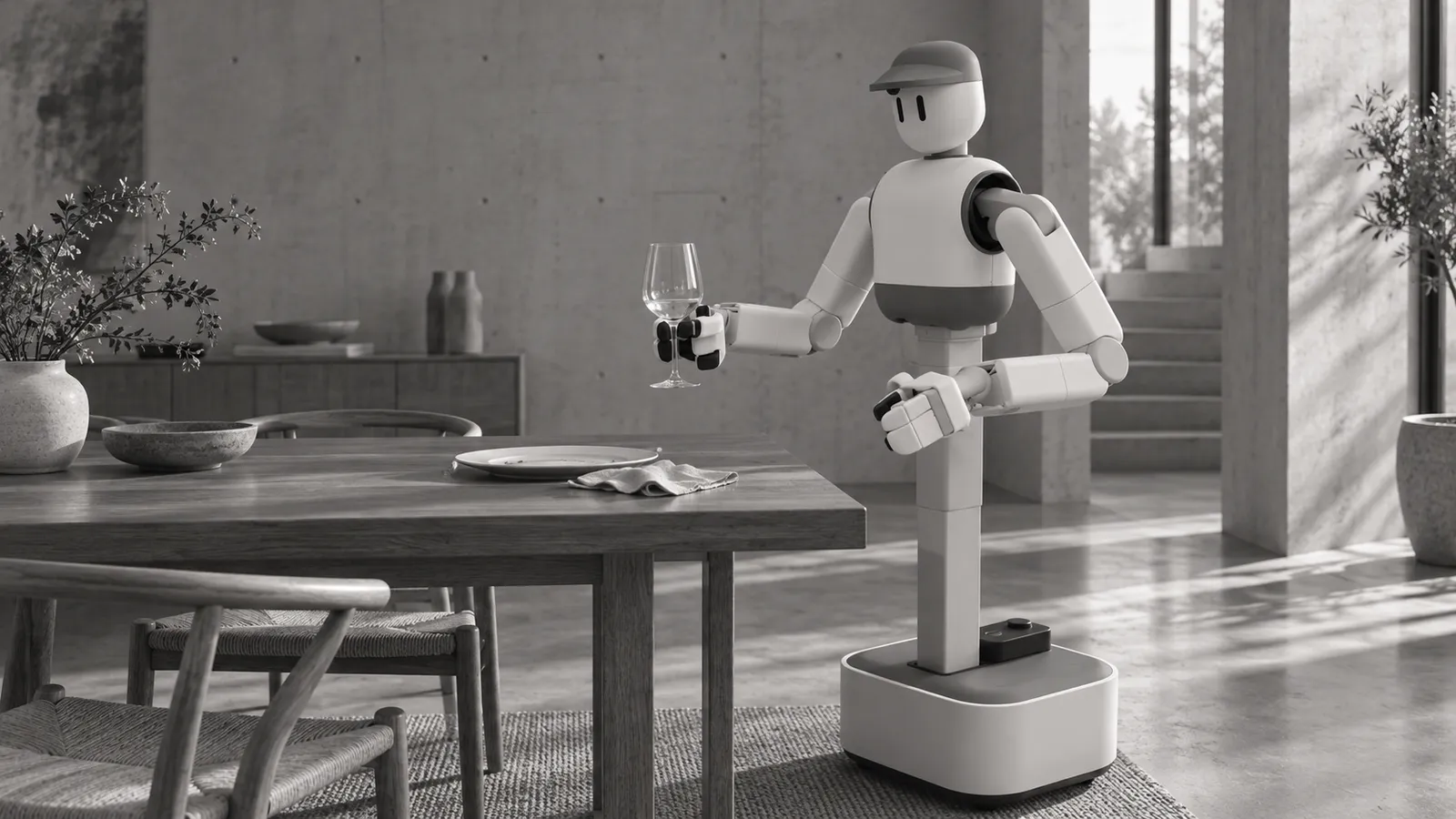
- Height and reach
- Lowers to the ground or reaches up to 7 ft; rests at about 4 ft
- Pace
- Most tasks trained at about 50% of natural human pace
- Precision target
- Movements accurate to a few millimeters
- Safety
- Compliant control, passive stability, low center of gravity
- Shell
- Soft silicone, no sharp corners, wipeable
- Training data
- Skill Capture Glove worn by Memory Developers; no in-home teleop
- Price
- Not for sale; Sunday says a hand-built unit costs about $20,000 to make, not the expected retail price (October 2026)
Updated
Most home robots learn their chores from a person driving them. Sunday built Memo around a different bet. Instead of collecting teleoperation sessions on the robot, it ships a wearable Skill Capture Glove to people it calls Memory Developers, who record themselves doing housework in their own homes, and it trains Memo on that. Sunday puts it plainly on its homepage: "Memo is an autonomous robot that does not need to learn through human tele-operation in your home." That makes Memo the clearest counterpoint to robots such as 1X NEO, which bring a remote operator in on request. This page explains how the glove approach works, what it means for privacy, where Memo stands on availability, and what anyone building a home robot can take from it.
Can you get a Memo?
Not yet. Sunday's FAQ says Memo is not for sale and points people to the 2026 beta. The beta program page describes it as invite-only with "No cost to participate", lists it as "Launching late 2026", and says Sunday anticipates "starting to ship Memo at scale 2027-2028". Beta members, called the Founding Family, are first in line for a limited-edition numbered Memo, get white-glove delivery and guidance, and are asked to propose new skills and help find the problems Memo meets in new homes. The first 50 members also receive a 3D-printed Mini Memo.
On price, Sunday is unusually open about cost. It says building one Memo today, by hand with custom components, costs "approximately $20,000", that it does not expect that to be the retail price, and that large-scale manufacturing should cut costs "by at least 50%". Exact pricing "will be announced closer to launch". Treat any retail figure you see elsewhere as a guess until Sunday publishes one. Funding is not a constraint in the near term: in its Series B post of March 12, 2026, Sunday announced a $165M round at a $1.15B valuation led by Coatue, and said it was shifting its focus "entirely" to real-world deployment.
What Memo does today
Sunday lists three skill areas on its homepage, with a short history of how they arrived. In December 2024 Memo had one arm and had learned to arrange shoes. By October 2025 it could fold socks, handle glassware and pull espresso.
Dishes
Coffee
Laundry
The hardware is designed for people nearby rather than for speed. Memo can lower to the floor or reach 7 feet, rests at about 4 feet, and software caps its speed: most tasks are trained at about half of a human's natural pace. Sunday describes compliant control (you can push a limb mid-task and it gives way), passive stability (cutting power in any state does not drop the robot's weight), a low center of gravity and a soft silicone shell you can wipe with household cleaners. Sunday also says it is still working on reliability and generalization so skills work in any home out of the box, which is the honest status of every home robot today.
How Memo learns: the Skill Capture Glove
Sunday's technology page sets out the pipeline. The company says it owns "the entire stack: software, hardware, data, training, and model evaluation". The data side works like this:
The glove mirrors the hand
Memory Developers record chores at home
Skill Transform converts the data
QA, then daily evaluation
Fast turnaround
ACT-1, announced November 19, 2025, was described as trained "all without a single trajectory of teleoperation data". Its showcase task cleared a dining table and loaded a dishwasher in unseen Airbnb homes: 33 unique and 68 total dexterous interactions with 21 objects over more than 130 feet of navigation, using 3D maps of each home for conditioning. The approach has a lineage. Sunday's CTO Cheng Chi is listed first on the Universal Manipulation Interface paper (RSS 2024), which collected robot demonstrations with hand-held grippers instead of a robot, and Sunday's company page credits him with inventing Diffusion Policy.
Glove data, teleoperation data and remote takeover compared
There are three common ways a person ends up behind a home robot's skills, and they produce different data with different costs. None is strictly better; they solve different parts of the problem.
Wearable capture (glove, UMI-style grippers)
Teleoperated demonstrations
Remote takeover (human-in-the-loop)
Many robot-learning teams mix all three: wearable data for breadth, teleop episodes to close the embodiment gap on hard tasks, and takeover data for the long tail. Our data collection guide covers how to keep those sources consistent in LeRobot, RLDS or HDF5 so they can be trained together.
Does a remote person ever operate Memo in your home?
Sunday's public answer is about learning: Memo "does not need to learn through human tele-operation in your home". Its pages do not mention remote operators at all. What they do say about the beta leaves one question open. The beta page says Memo "performs tasks autonomously in new homes", and also that the beta will "experiment with a combination of supervision, collaboration, and complete hands-off Memo magic". It does not say what supervision means, who provides it, or whether it happens on site or remotely. We are not inferring an answer. If you are invited, it is a fair thing to ask directly, alongside these:
Privacy: what Sunday has published so far
The no-teleop design is Sunday's main privacy argument, and it is a real one: a robot trained on glove data from volunteers' homes does not need a stranger looking through its cameras in yours. The beta page also says Memo is "uniquely engineered with strict standards for safety and privacy". The written policy is narrower. Sunday's privacy policy, effective September 3, 2025, covers the website and communications: names, emails and phone numbers given at newsletter or beta sign-up, cookies, IP-derived location and browsing activity. When we read it in October 2026 it did not address robot cameras, home maps, sensor data, retention periods or model training. That is not unusual for a company that has not shipped yet, but it means the terms for data a Memo collects inside a home are not public. Before a robot with cameras and a 3D map of your house arrives, ask for those terms in writing.
What the ACT-2 numbers say, and what they do not
Sunday's ACT-2 preview, published July 17, 2026, reports 99.1% zero-shot success on laundry folding: 778 good folds out of 785 autonomous attempts across unseen environments, a mean fold quality of 4.72 out of 5, and a median of 2 minutes 13 seconds per garment including retries. Blouses were the hardest category at 94.7% over 19 attempts. Sunday says no data from the evaluation homes or garments was used for training or model selection, and that ACT-2 treats dropped or tangled garments as recoverable states rather than dead ends.
Those are strong results for one task, published with a clear method. What the post does not report is the number of homes, the size of the pretraining dataset, or how many times a person reset the scene or stepped in. That is normal for a research preview, and it is the gap between a benchmark and a product: a household cares about a full chore list, every day, with nobody standing by.
Memo against the nearest alternatives
The closest comparisons are the home robots that take the opposite approach to remote help. 1X NEO is a home humanoid that, per 1X, "works autonomously by default" and lets owners schedule a 1X Expert to guide it through chores it does not know; it is on preorder with a $200 deposit. Weave Isaac 1 is a wheeled two-armed robot that Weave says is autonomous by default "with teleoperation assistance when needed to guarantee we complete tasks", listed at $7,999 or $449 a month on Weave as of October 2026, with first shipments in fall 2026 starting in California.
The trade-off is direct. NEO and Isaac 1 can promise that a task gets finished today because a person can step in, at the cost of a remote viewer in the home. Memo promises no in-home teleoperation, so its usefulness rests entirely on how well glove-trained policies generalize. Buyers who rank privacy highest will lean toward Memo; buyers who want a guarantee that the laundry gets folded will lean toward a teleop-assisted design. Neither is available at scale yet.
For teams building the robot-side version
Sunday runs its own data program, and we have no relationship with it. Many home-robot teams, though, still need people driving the robot itself: teleoperated demonstrations to close the gap between human and robot motion, evaluation runs, and remote takeover when a deployed robot stalls. That is the work RoboPilots staffs. For each program we train a dedicated group of operators on your unit, your chore list and your household privacy rules, and the same group stays on it.
One-week trial
Coverage
Data
Interfaces, specs and sources
- Sunday app and voice scheduling
- Skill Capture Glove (training data)
- ACT-1 and ACT-2 models
- No in-home teleoperation
- No public SDK found
Availability: Beta. Memo is not for sale. Sunday runs an invite-only, no-cost 2026 "Founding Family" beta that its beta page says is launching late 2026, and its FAQ says it anticipates shipping Memo at scale in 2027-2028. Final pricing will be announced closer to launch (sunday.ai and sunday.ai/beta-program, checked October 16, 2026).
Specs are the maker's published figures, checked on . RoboPilots is not affiliated with Sunday Robotics; product names are trademarks of their owners.
- Sunday: Memo homepage, skills, specs and FAQ
- Sunday: 2026 beta program
- Sunday: technology and Skill Capture Glove
- Sunday: company and founders
- Sunday: ACT-1, a robot foundation model trained on zero robot data, Nov 19, 2025
- Sunday: ACT-2 preview, Jul 17, 2026
- Sunday: Series B announcement, Mar 12, 2026
- Sunday: privacy policy (effective Sep 3, 2025)
- Universal Manipulation Interface (RSS 2024)
- Weave Robotics: Isaac 1
Frequently asked questions
- Is Sunday Memo teleoperated?
- Sunday says Memo is an autonomous robot that does not need to learn through human teleoperation in your home. It is trained on data recorded by people wearing Sunday's Skill Capture Glove in their own homes. Sunday's pages do not say whether beta supervision involves anyone remotely.
- How much will a Memo cost?
- Sunday has not announced a price. It says a hand-built unit costs about $20,000 to make today, that this is not the expected retail price, and that manufacturing at scale should cut costs by at least 50%.
- When can I get a Memo?
- Sunday runs an invite-only, no-cost beta that its beta page says launches in late 2026, and it anticipates shipping Memo at scale in 2027 to 2028.
- What can Memo do?
- Sunday lists clearing tables and loading the dishwasher, making espresso and folding laundry. Its July 2026 ACT-2 preview reported 99.1% success across 785 autonomous laundry-folding attempts in unseen environments.
- Is Memo safe around people?
- Sunday cites compliant control, so a limb gives way when pushed, and passive stability, so cutting power does not drop the robot. It also limits speed, with most tasks trained at about half of human pace, and uses a soft silicone shell.
- What is a Memory Developer?
- It is Sunday's name for the people who wear its Skill Capture Glove while doing household chores at home. Their recordings are converted into robot training data for Memo.