Robots · Home robots
UniX AI Panther teleoperation: a wheeled home humanoid and the proof to ask for
Panther is the Chinese wheeled humanoid that UniX AI says was the first service humanoid to enter real household deployment. The spec sheet is detailed; the evidence for what it does in homes, and how, is thinner.
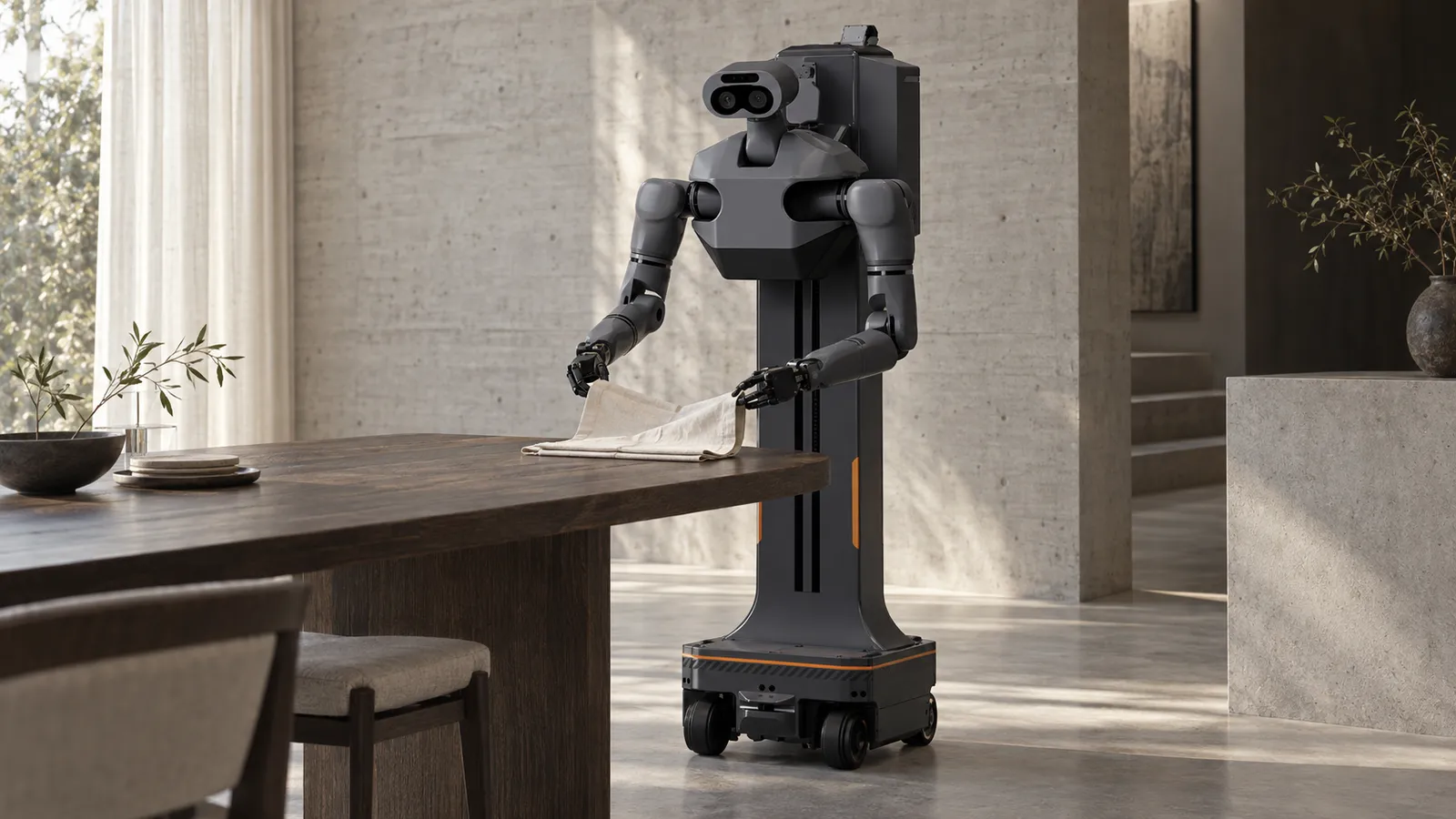
- Joints
- 34 high-DoF joints; 8-DoF bionic arms; 2-DoF head
- Height
- 1,600-1,750 mm; upper-body lift 600-800 mm
- Arms
- 12 kg dual-arm load, 982 mm single-arm reach, ±0.5 mm repeatability
- Base
- 4WS/4WD omnidirectional chassis, 2 m/s, 65 cm minimum passage width
- Sensors
- Head dual RGB and RGBD cameras, front and rear 360° LiDAR, ultrasonic, optional top 3D LiDAR, 6-mic array
- Compute
- Up to 2,070 TOPS edge computing
- Battery
- 6-12 h (UniX AI product page)
- Price
- Not published; sales by inquiry
Updated
UniX AI's Panther is a full-size humanoid upper body with two 8-DoF arms on a four-wheel-steer, four-wheel-drive base, built by a Suzhou company founded in 2024. UniX AI says it was "the world's first service humanoid robot to enter real household deployment" and that it has begun global deliveries. Demo videos show it making beds and preparing breakfast. For a buyer, a researcher or a company building a competing robot, the useful questions are the ones the announcements do not answer: what Panther does in a home without help, how it was taught, and who, if anyone, steps in when it fails. This page sets out the published specs, the claims and their sources, and the evidence worth asking for.
Can you buy a Panther?
UniX AI's April 8, 2026 release, republished by TNGlobal, says the company "commenced global deliveries of Panther" and has delivered "over 100 units per month" since 2025 (a figure that appears to cover its robots generally, including the earlier Wanda line). The company site lists no price and points buyers to business and global sales email addresses. We found no public price, configurator or order page as of October 2026. Treat it as a quote-based product, sold mainly to businesses.
US buyers have an additional question. On July 28, 2026 the FCC added "foreign-produced advanced robotic devices" to its Covered List, with a definition that includes humanoid robots and other mobile robots over 4.4 lb with sensors, network connectivity and control software. Covered equipment cannot receive FCC equipment authorizations unless the Department of War grants a Conditional Approval. We found no published Conditional Approval for Panther. Ask UniX AI directly about its US authorization status before planning a US deployment.
The hardware, from UniX AI's spec sheet
The Panther product page is detailed. Panther stands 1,600 to 1,750 mm tall, its upper body lifts through 600 to 800 mm so it can work at floor level or reach high shelves, and its two arms carry 12 kg together with a 982 mm single-arm reach and ±0.5 mm repeatability. The chassis is omnidirectional with four-wheel steering and drive, rated at 2 m/s, and needs a 65 cm gap to pass. Sensing includes dual RGB and RGBD cameras in the head, front and rear 360° LiDAR, ultrasonic sensors, an optional top 3D LiDAR, dual speakers and a six-microphone array. UniX AI lists up to 2,070 TOPS of edge compute, a 48 V power platform and 6 to 12 hours of battery life.
Two numbers matter most for a home. The 65 cm passage width is fine for most interior doors but tight for narrow hallways, bathrooms and the space between furniture. And the 12 kg dual-arm load is generous for household objects; the limiting factor in homes is rarely weight, it is grasp reliability on soft, cluttered and unfamiliar items.
What Panther has been shown doing
Live: tea-making
Demo video: a morning routine
Household deployment
None of this is unusual for a robot at this stage, and none of it is proof of daily household use. A live tea-making demo is an autonomous run in a controlled setting. A morning-routine video shows the task is possible on the hardware; it does not show how often it succeeds, how much was staged, or whether a person helped.
How Panther learns
UniX AI describes a three-part software stack in its release. UniFlex "supports efficient cross-scenario task generalization and imitation learning"; UniTouch is a set of visuo-tactile models for precise manipulation; UniCortex handles long-horizon planning for multi-step tasks. The product page adds "Fast Learning & Rapid Deployment" and says Panther ships "preloaded with popular L4-level applications". Founder and CEO Fred Yang says "real intelligence comes from real-world data", gathered from robots working in hospitality and service settings, and describes a "data-product-market" model in which deployed robots feed the next round of training.
Imitation learning needs demonstrations, and UniX AI has not said how it collects them: teleoperation rigs, motion capture, video, or deployed robots. It also has not said whether a remote operator can take over a Panther in service. Its pages do not mention teleoperation at all. Both are unknown, and both are reasonable to ask about.
Privacy: what UniX AI's policy covers
UniX AI's English privacy policy, linked from its homepage and effective December 29, 2025, covers the UniX AI Mall, its online store: account details, orders, payment, customer service records including images or videos you upload, and cookies. It says personal information collected in mainland China is stored in China and is not currently transferred abroad. It does not address what Panther's cameras, LiDAR or six microphones record in a home, whether that data leaves the robot, or whether it trains models. For a robot that its maker says learns from real-world data, those are the terms to request in writing before deployment.
Why wheels, and what that costs in a home
UniX AI's release says it deliberately chose a wheeled dual-arm design rather than legs. The trade-off is easy to see against a legged humanoid. Unitree lists its G1 at about two hours of battery; UniX AI lists Panther at 6 to 12 hours, and a wheeled base does not spend energy or attention on balance while the arms work. The 600 to 800 mm torso lift does the job knees do on a biped, letting the same arms reach the floor and a high cabinet. The cost is stairs and thresholds: a wheeled robot is a one-floor robot unless the home has a lift, and raised door sills, thick rugs and pet gates all become obstacles. For a single-level apartment or a hotel corridor that is a good trade; for a multi-story house it limits where Panther can help.
What a remote operator would need on Panther
UniX AI has not published a teleoperation interface, so this is a practical reading of the spec sheet rather than a description of its stack. The product page lists cameras only in the head: dual RGB and RGBD. For a person operating two 8-DoF arms remotely, that is a limited view of the hands, and most bimanual teleop rigs add a camera on each wrist so the operator can see the grasp. Teams evaluating Panther for demonstration collection or remote takeover should ask whether wrist cameras are available. A good operator on a robot like this would also:
The proof to ask for before you buy
Unedited runs
Intervention rate
Teleop share
Training data
Data and regulation
Panther against the nearest alternatives
The closest comparison in form is the Galaxea R1 Lite, another Chinese wheeled two-armed platform, which Galaxea lists at $39,999 but says is "not currently available for direct purchase". It has two 6-DoF arms rated at 3 kg each and is positioned for research and data collection, with optional teleoperation devices; Panther has 8-DoF arms, a heavier combined payload and a service-robot pitch with preloaded applications. In the US consumer market, Weave Isaac 1 is a lighter wheeled two-armed robot listed at $7,999 on Weave as of October 2026, which says openly that it uses teleoperation assistance when needed. For research teams, the Rainbow RB-Y1 is another wheeled bimanual platform we cover separately. Panther's case rests on its larger arms and lift range; its weakness, for now, is how little is published about its behavior in homes.
For teams building a wheeled home humanoid
A robot that learns by imitation and improves from deployment data needs two kinds of human work: demonstrations to start, and takeovers in the field to cover what the policy cannot yet do. RoboPilots staffs both for robot makers, on their hardware and under their privacy rules. For each program we train a dedicated group of operators on your unit and task protocol, and the same group stays on it. A one-week trial sets the clean-episodes-per-operator-hour baseline, shifts run across time zones including US Pacific, and every session is labeled by task and outcome and delivered as LeRobot, RLDS or HDF5. Our home and hospitality page covers how these programs are scoped.
Interfaces, specs and sources
- UniFlex imitation learning
- UniTouch visuo-tactile models
- UniCortex task planning
- Preloaded applications
- Sales by inquiry (no public SDK found)
Availability: Claimed shipping, price on request. UniX AI announced on April 8, 2026 that it had "commenced global deliveries of Panther"; its site lists no price and directs buyers to a sales contact (unix-group.ai, checked October 16, 2026). Units produced outside the US fall under the FCC Covered List entry for foreign-produced advanced robotic devices added July 28, 2026, unless granted a Conditional Approval.
Specs are the maker's published figures, checked on . RoboPilots is not affiliated with UniX AI; product names are trademarks of their owners.
- UniX AI: Panther product page and specifications
- UniX AI: homepage, lineup and contacts
- UniX AI privacy policy (effective Dec 29, 2025, PDF)
- UniX AI release via TNGlobal: Panther enters household deployment, Apr 8, 2026
- eWeek: UniX AI Panther home robot, Apr 1, 2026
- FCC: foreign-produced power inverters and robots added to Covered List, Jul 28, 2026
- FCC Public Notice DA 26-786 with National Security Determination (PDF)
- Galaxea R1 Lite product page
- Weave Robotics: Isaac 1
- Unitree G1 product page
Frequently asked questions
- How much is the UniX AI Panther?
- UniX AI has not published a price. Its site directs buyers to sales contacts, so Panther is quote-based as of October 2026.
- Can I buy a Panther in the US?
- UniX AI says it has begun global deliveries, but foreign-produced advanced robotic devices were added to the FCC Covered List on July 28, 2026, which blocks new FCC equipment authorizations unless a Conditional Approval is granted. Ask UniX AI about its authorization status.
- Can Panther make beds and cook?
- A UniX AI demo reported by eWeek showed it making a bed and preparing breakfast, and the company demonstrated autonomous tea-making live in March 2026. No independent testing in homes has been published.
- Is Panther the first household humanoid?
- UniX AI calls it the world's first service humanoid robot to enter real household deployment. That is the company's claim; it has not published how many homes or what results.
- Is the UniX AI Panther teleoperated?
- UniX AI's pages do not mention teleoperation. It describes imitation learning through its UniFlex system but has not said how demonstrations are collected or whether remote operators assist deployed robots.