Robots · Humanoids
EngineAI PM01 teleoperation: an open SDK and RL stack with no teleop app, and how to add one
The PM01 is one of the lower-cost open humanoids, with BSD-licensed SDK, ROS 2 and reinforcement learning code. What it lacks is a teleoperation stack, so data programs on it start by building one.
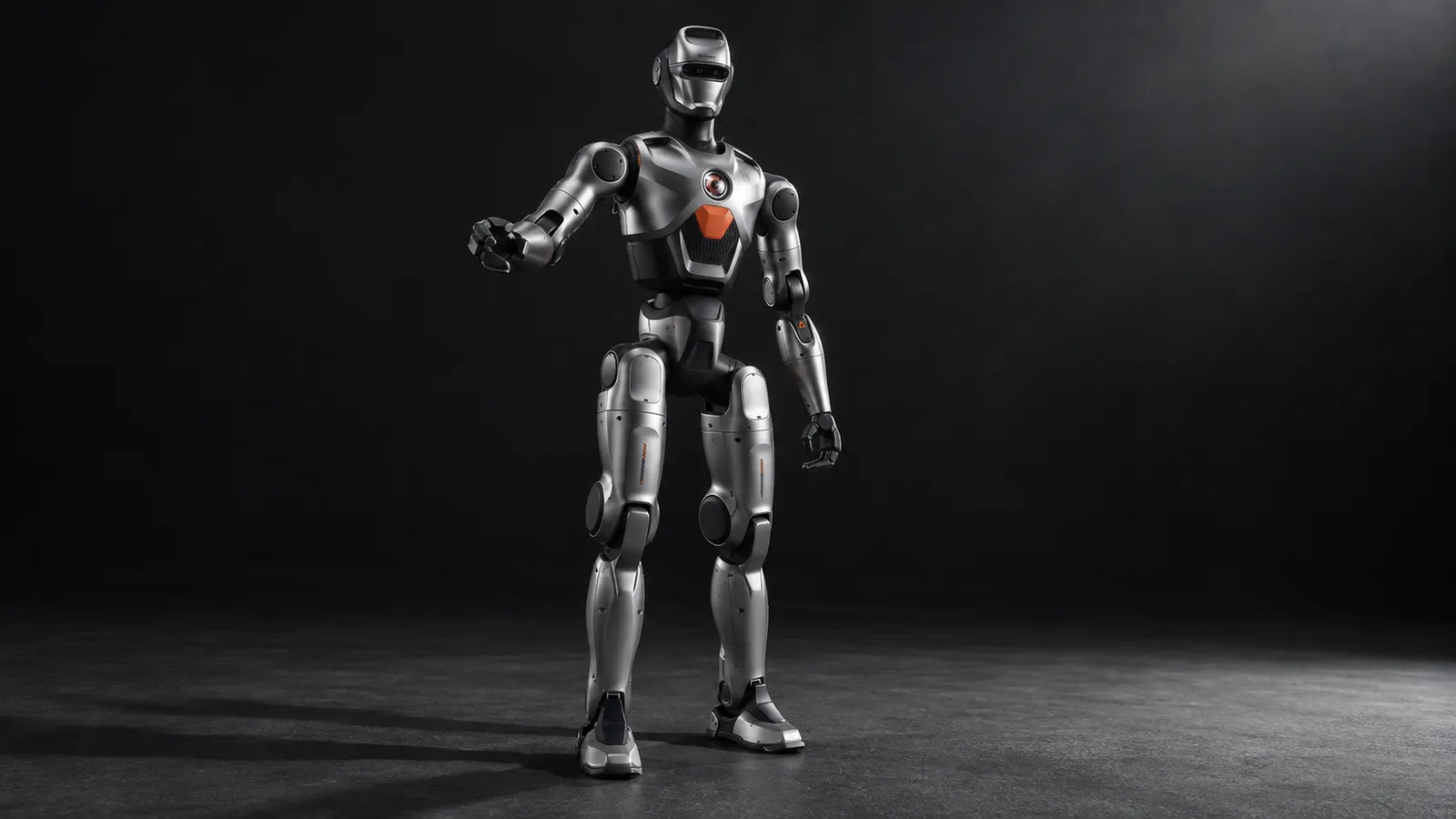
- Height and weight
- 1,400 mm; about 44 kg (Education edition)
- Degrees of freedom
- 24: 6 per leg, 5 per arm, 1 waist, 1 neck
- Max joint torque
- 164 N·m; peak torque density 145 N·m/kg
- Waist rotation
- Over 300 degrees (320 degrees in EngineAI highlights)
- Battery
- About 2 h; 2 h full charge; quick-release smart battery
- Compute
- 8-core CPU plus NVIDIA Jetson Orin NX (16 GB)
- Sensors
- Two binocular cameras (head and waist); 3D LiDAR on the Navigation edition
- Secondary development
- Supported on the 2026 Education and Navigation editions
Updated
EngineAI's PM01 is a 1.4 m, 44 kg humanoid with 24 joints, a waist that turns more than 300 degrees, and a Jetson Orin NX on board. It launched in December 2024 at RMB 88,000, and EngineAI backs it with open code: a native control SDK, a ROS 2 workspace and Isaac Lab reinforcement learning environments, all BSD-3-Clause. That makes it attractive as a lower-cost alternative to better-known research humanoids. The catch for a data program is simple. EngineAI publishes no teleoperation stack, and the PM01's 5-DoF arms have no hand in the spec sheet. This page covers what you can build on it, and what kind of data it is suited to.
Which PM01 to buy
EngineAI's PM01 page lists two 2026 editions with the same body, joints and torque. Both support secondary development.
Education edition
Navigation edition
As of October 2026, foreign-produced advanced robotic devices are on the FCC Covered List under FCC public notice DA 26-786 (July 28, 2026), unless the Department of War grants them a Conditional Approval. The FCC definition covers mobile robots, including humanoids, quadrupeds and autonomous mobile robots, that weigh over 4.4 lb with any base or dock and have a sensor, network connectivity and control software, when they do not qualify as US-made under the federal Buy American test, whatever the nationality of the maker. Covered models cannot receive new FCC equipment authorizations, which most devices need before they can be imported or sold in the US, while the FCC says models it authorized earlier can still be imported, sold and used; US buyers should confirm the current status with the seller.
What EngineAI gives you to build on
Native SDK
ROS 2 workspace
Isaac Lab RL environments
EngineAI's own launch release says it used optical motion capture to collect large amounts of human motion data, which fed a network trained with reinforcement and imitation learning. In other words, the maker's own path to PM01 behaviors runs through human motion, not through live teleoperation.
Two ways to teleoperate a PM01
Live teleop: VR plus the walking controller
Motion capture into a tracking policy
Rehearse in MuJoCo first. Both the native SDK and engineai_rl_lab run in simulation with a virtual gamepad, so you can check retargeting, joint limits and the soft stop before an operator drives the real robot.
Getting a PM01 ready for remote sessions
Most of the first week on a PM01 goes into plumbing rather than teleop. EngineAI's repos describe the steps, and each one is a place where a remote session can fail if it is skipped.
Development environment
Deployment
Mode switching
Battery
What to record
Observation
Action
Metadata
Hands, grippers and what the PM01 can demonstrate
The PM01 spec lists 5-DoF arms (470 mm each) and no hand or gripper. For grasping you will need an end effector of your own, and the arm's five joints limit how it can be presented to an object. That pushes PM01 data toward what the body does well: walking, turning, balance, whole-body motion tracking, and simple contact with the arms. If your program needs dexterous manipulation, the T800 Pro and Max editions add 7-DoF arms and 7-DoF hands, and EngineAI's T800 page rates the hands at 5 kg each.
Whole-body versus upper-body data
On the PM01, the interesting data is often whole-body. A tracking policy needs the full joint vector, the IMU and the reference motion at a fixed rate. A live-teleop dataset with walking should record the velocity command as its own action field, separate from the arm targets, so a policy can learn when to move the base. Pick one representation for the whole dataset, write it in the dataset card, and do not mix the two. Our data collection guide covers episode structure and quality checks.
Latency
Velocity commands to the walk state tolerate a long link because balance runs on the robot. Arm teleop is more sensitive: below about 100 ms round trip it feels direct, between 100 and 200 ms operators slow down, and beyond that the operator should position the robot and leave fine work to a policy. Keep IK, joint limits and the soft stop on the robot side so a late packet never turns into a jerk. Our latency guide covers budgets by task.
What a good PM01 operator does
PM01 or T800?
EngineAI's T800 is the full-size step up: 173 cm and 75 to 85 kg in four editions. Basic and Open Source have 25 DoF with 5-DoF arms; Pro has 43 including two 7-DoF hands; Max has 46 with a 3-DoF waist. Secondary development is listed for Open Source, Pro and Max, not Basic. Shenzhen's development and reform commission reported the basic configuration from RMB 180,000 in December 2025, with other configurations by quote. For manipulation data the T800 Pro or Max is the EngineAI to buy; for locomotion and motion research, the PM01 costs less and is easier to handle.
Against other makers, the PM01's main gap is tooling around teleop and data, not hardware. LeRobot's built-in robots include the Unitree G1 but no EngineAI robot as of October 2026, and the Unitree G1 has a maintained XR teleop app. If your team would rather integrate than buy a finished stack, the PM01's BSD-licensed code is a reasonable base.
Takeover and fallback
When a PM01 runs a policy in the rl_lab state, the teleop stack you build becomes the fallback channel. Decide what triggers a handover, keep the soft stop one action away, and record each takeover as a correction episode. Our human-in-the-loop guide covers the escalation design.
How RoboPilots runs PM01 teleoperation
Your robot stays at your site. We agree the input with you, live VR teleop or mocap into a tracking policy, connect operators through a computer on your network, and train a dedicated group of operators on your unit and your task protocol, including EngineAI's mode switching and stop. Several humanoid makers have sent us robots to test our operating protocols, and that work is where every new program starts.
One-week trial
Coverage
Data
Interfaces, specs and sources
- EngineAI native SDK (ROS 2 Humble / Jazzy)
- engineai_ros2_workspace (Cyclone DDS)
- engineai_rl_lab (Isaac Lab)
- MuJoCo sim2sim
- Gamepad and touchscreen remote
- Custom VR or mocap teleop
Availability: Buyable. EngineAI's product page links to purchase without listing a price. At launch the PM01 was listed at RMB 88,000 for both editions by EngineAI (Newsfile release, December 26, 2024, valid to March 31, 2025). On US storefronts the PM01 EDU showed $26,500 with a request-a-quote form as of August 11, 2026, according to Grabarobot. US buyers: see the FCC note on foreign-produced robots (DA 26-786).
Specs are the maker's published figures, checked on . RoboPilots is not affiliated with EngineAI; product names are trademarks of their owners.
- EngineAI PM01 product page and specifications
- EngineAI T800 product page and specifications
- EngineAI repositories (GitHub)
- engineai_robotics_native_sdk (GitHub)
- engineai_ros2_workspace (GitHub)
- engineai_rl_lab (GitHub)
- EngineAI PM01 launch release (Newsfile, December 26, 2024)
- Shenzhen DRC: EngineAI T800 price report (December 5, 2025)
- Grabarobot: humanoid price guide 2026 (US storefront prices, August 11, 2026)
- LeRobot built-in robots (GitHub)
- FCC public notice DA 26-786: foreign-produced robots added to the Covered List (July 28, 2026)
Frequently asked questions
- Does the EngineAI PM01 have a teleoperation stack?
- No official one as of October 2026. EngineAI publishes a native SDK, a ROS 2 workspace and Isaac Lab RL environments, and teams build VR or mocap teleop on top of them.
- Can I develop on the EngineAI PM01?
- Yes. EngineAI lists secondary development on both 2026 PM01 editions, and its native SDK supports the pm01_edu configuration.
- How much does the EngineAI PM01 cost?
- EngineAI launched it at RMB 88,000 in December 2024. In August 2026 Grabarobot found the PM01 EDU at $26,500 on a US storefront with a request-a-quote form.
- Does the PM01 have hands?
- Its spec lists 5-DoF arms and no hand or gripper. For dexterous manipulation EngineAI offers the T800 Pro and Max with 7-DoF hands.
- Is EngineAI PM01 code open source?
- Yes. The native SDK, the ROS 2 workspace and engineai_rl_lab are on GitHub under the BSD-3-Clause license.