Robots · Humanoids
AgiBot X2 teleoperation: why the Ultra is the only X2 you can build on
The X2 is a 1.31 m humanoid sold for performances and interaction, with an official store price. Only one version opens up for development, and AgiBot has no teleop kit for either.
- Height
- About 1.31 m
- Weight
- About 35 kg (Neo), about 39 kg (Ultra)
- Degrees of freedom
- 30 (Neo); 31 (Ultra New Version, 2-DoF neck); 7 per arm
- Compute
- 2 × RK3588; Ultra adds Orin NX (157 TOPS)
- Battery
- About 500 Wh, about 2 h at 0.5 m/s, swappable, ≤1.5 h charge
- Payload
- 3 kg in specific postures, ≤1 kg across full range
- Arm reach
- 558 mm, excluding end effector
- Walking speed
- Typical ≤0.8 m/s, up to 2 m/s in the lab
Updated
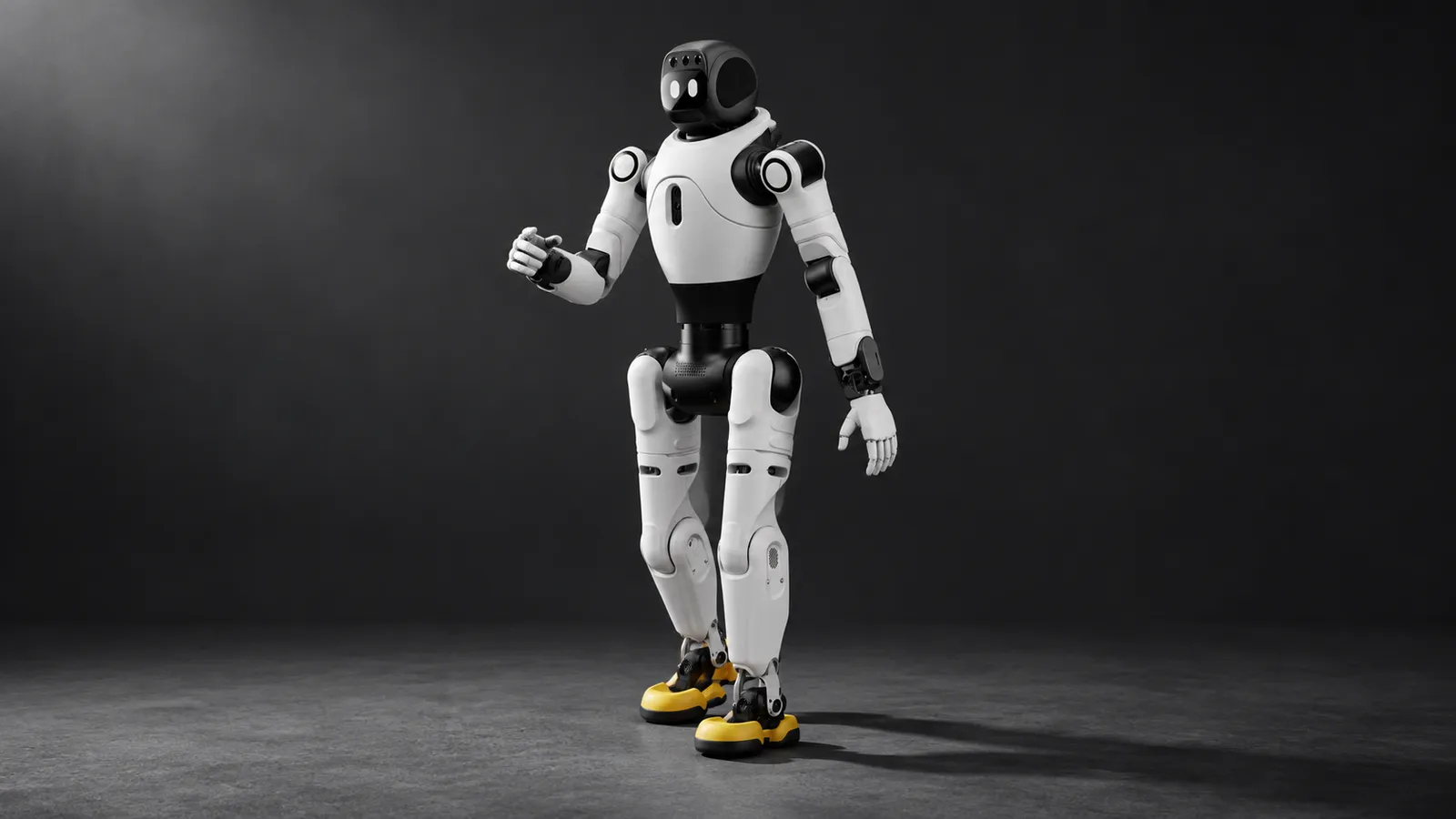
The AgiBot X2 is a compact humanoid, about 1.31 m tall and 35 to 39 kg, built for performances, receptions and interactive shows. It dances, gestures, talks and reacts to touch, and its entry version has a public price in US dollars on AgiBot's own store. That makes it a common first humanoid for venues and content teams. For teleoperation and data work it comes with two catches that are easy to miss before ordering: only the X2 Ultra supports development at all, and AgiBot's VR teleoperation kit does not support any X2.
X2 Neo or X2 Ultra: the development line
The AgiBot store listing puts the two current versions side by side, and the difference that matters is in the last rows of the table:
X2 Neo, listed at $25,600 on the AgiBot store as of October 2026
X2 Ultra New Version, price on request
If you plan to teleoperate an X2 with anything other than its handheld controller and app, or record data from it, buy the Ultra. A Neo cannot be developed on, and it has no wired network port or head cameras for an operator view.
One more caution on versions. AgiBot's X2 product page still shows an earlier spec table: 25 DoF with 5-DoF arms for the X2 and 30 DoF for the X2 Ultra. The store calls its listing the X2 "Refresh" series and tells buyers to "match the model and hardware generation named in each guide". When you order, confirm the arm DoF in writing; a 5-DoF arm and a 7-DoF arm need different teleop mappings.
There is no official X2 teleop stack
AgiBot's VR Teleoperation Kit is "Compatible only with AGIBOT A2 Ultra and AGIBOT A2 Lite". Neither the X2 product page nor the store listing mentions teleoperation or motion capture. Out of the box, an X2 is driven with its included handheld controller and the mobile app, and programmed motions come from AgiBot's content tools. AgiBot's developer site, the AIMA Open Platform, groups LinkCraft for motion content, LinkSoul for interaction agents, Genie Studio for task development and the Link-U OS open-source robot operating system, but it does not list which tools support which robot. Ask AgiBot which of them your X2 Ultra configuration supports before planning around one.
Building teleoperation for an X2 Ultra
With development access on the Ultra, there are three practical ways to put a remote operator in control. Each one assumes AgiBot's development interfaces on your unit give you the control level it needs, which is the first thing to confirm with sales.
VR upper body, controller for walking
Whole-body retargeting from motion capture
Recorded motion with live triggers
Setting up an X2 Ultra operator station
Network
Video
Local monitor
Limits
Stop authority
One clock
Latency on a small, fast robot
The X2 walks at a typical 0.8 m/s or less and can reach 2 m/s in the lab. At 0.8 m/s and a 200 ms round trip it moves 16 cm before the operator sees the result, which matters on a stage edge or in a crowd. Keep the gait controller on the robot, cap speeds in teleop mode, and put the operator on a wired link to the robot's network where possible; the Ultra's RJ45 ports make that straightforward. Gestures and expressive motion tolerate more delay than reaching for objects. Our teleoperation latency guide covers budgets by task.
What X2 data is good for
Be realistic about the body. The X2 carries 3 kg only in specific postures and 1 kg or less across its full range of motion, with a 558 mm reach, and no hands are included: AgiBot's OmniHand and OmniPicker are sold separately for the Ultra. So the X2 is not a manipulation-data robot in the way a full-size humanoid with dexterous hands is. Where it is useful:
Motion and performance data
Interaction data
Small-scale loco-manipulation
Whatever you collect, record every camera stream, joint states and the operator's commands on one clock, and fix the action space before the first session. Our data collection guide covers episode structure, and we deliver in LeRobot, RLDS or HDF5.
X2, A2 or a Unitree G1?
AgiBot A2
Unitree G1
AgiBot X2 Ultra
Renting before you buy
AgiBot launched a rental program at MWC 2026. BGR reported that it covers the X2 series alongside the G2 and the D1 quadruped, starts at €899 a day, runs in 17 markets including the US, and includes on-site technical support, with installation as soon as two working days after a request. Renting is a cheap way to test whether an X2 fits a venue, an audience and a show format before committing to a fleet. Check which version you will get, because a rented Neo cannot be developed on, and agree in advance whether you may record data during the rental and who owns it.
As of October 2026, foreign-produced advanced robotic devices are on the FCC Covered List under FCC public notice DA 26-786 (July 28, 2026), unless the Department of War grants them a Conditional Approval. The FCC definition covers mobile robots, including humanoids, quadrupeds and autonomous mobile robots, that weigh over 4.4 lb with any base or dock and have a sensor, network connectivity and control software, when they do not qualify as US-made under the federal Buy American test, whatever the nationality of the maker. Covered models cannot receive new FCC equipment authorizations, which most devices need before they can be imported or sold in the US, while the FCC says models it authorized earlier can still be imported, sold and used; US buyers should confirm the current status with the seller.
What a good X2 operator does
How RoboPilots runs X2 teleoperation
We work with you to scope the teleop layer on your X2 Ultra, then staff it. Several humanoid makers have sent RoboPilots robots to test our operating protocols. On your program we train a dedicated group of operators on your own unit and task protocol, and the same group stays with you.
One-week trial
Coverage
Data
Interfaces, specs and sources
- Handheld controller and mobile app
- Secondary development (X2 Ultra only)
- AIMA Open Platform
- Custom VR or mocap teleop
- Ethernet, Mini DP (Ultra)
Availability: Buyable. AgiBot X2 Neo is listed at $25,600 on the AgiBot store as of October 2026, with delivery to be confirmed per country by AgiBot sales. X2 Ultra (New Version) is price on request. AgiBot also offers X2 robots through its rental program, which BGR reported at MWC 2026 as starting at €899 a day in 17 markets including the US. US buyers: see the FCC note on foreign-produced robots (DA 26-786).
Specs are the maker's published figures, checked on . RoboPilots is not affiliated with AgiBot; product names are trademarks of their owners.
- AgiBot store: X2 Neo and X2 Ultra listing, specs and FAQ
- AgiBot X2 product page
- AgiBot VR Teleoperation Kit (A2 only)
- AgiBot AIMA Open Platform
- BGR: AgiBot robot rental program, Mar 4, 2026
- TWIST2: portable whole-body humanoid data collection (arXiv)
- FCC public notice DA 26-786: foreign-produced robots added to the Covered List (July 28, 2026)
Frequently asked questions
- Can I program the AgiBot X2 Neo?
- No. AgiBot lists secondary development as not supported on the X2 Neo. The X2 Ultra supports development, and AgiBot advises confirming the available interfaces for your configuration.
- How much does the AgiBot X2 cost?
- As of October 2026 the AgiBot store lists the X2 Neo at $25,600. The X2 Ultra is price on request, and delivery, taxes and import charges are confirmed per country.
- Can the AgiBot X2 be teleoperated with VR?
- Not with an official kit. AgiBot's VR Teleoperation Kit supports only the A2. On an X2 Ultra a custom VR or motion-capture teleop layer can be built on its development interfaces.
- What is the difference between X2 Neo and X2 Ultra?
- The Ultra adds an Orin NX board, 3D LiDAR, RGB-D and extra RGB cameras, Ethernet ports, a 2-DoF neck and development support. The Neo is aimed at performances and interaction and cannot be developed on.
- Can I rent an AgiBot X2?
- Yes. AgiBot's rental program, launched at MWC 2026, includes the X2 series, with prices reported from 899 euros a day in 17 markets including the US.