Robots · Humanoids
AgiBot A2 teleoperation: the official VR kit, its latency budget and the operators it needs
The A2 is one of the few humanoids sold with a maker-built VR teleoperation kit. AgiBot sells the kit, not the people who wear it. Here is what the kit does, where its limits are, and how to staff it.
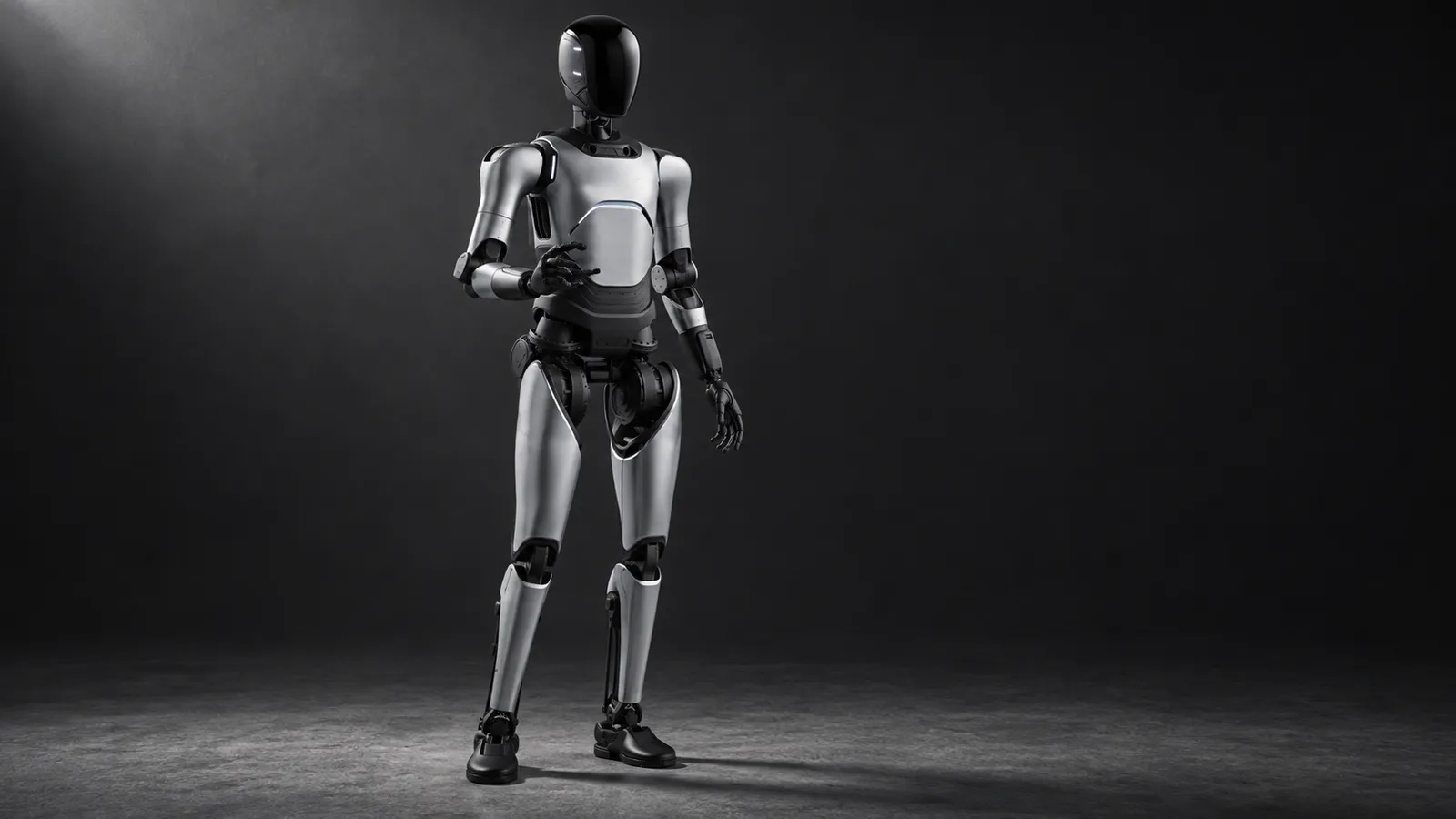
- Height
- 169 cm (both versions)
- Weight
- About 69 kg (Ultra), about 64 kg (Lite)
- Degrees of freedom
- 40 (Ultra, 7-DoF arms, 6-DoF hands); 23 (Lite, 5-DoF arms, no hands)
- Max arm load
- About 2 kg
- Max speed
- 1.2 m/s (Ultra), 0.8 m/s (Lite)
- Battery
- 14.4 Ah, 1.5 h+ walking, 2 h charge, swappable
- Compute
- 16-core CPU; NVIDIA Jetson Orin 64G on Ultra
- Ultra sensors
- 3D LiDAR, RGB-D, RGB and fisheye cameras
Updated
The AgiBot A2 is a 169 cm humanoid built for public-facing work: reception desks, exhibition halls, guided tours and stage performances. AgiBot says the line is "proven through the deployment of over a thousand units in real-world operations". What sets it apart for teleoperation is that AgiBot sells an official VR teleoperation kit for it, with published degrees of freedom and latency figures. Few humanoid makers document that much. The kit solves the hardware side of driving an A2 remotely. It leaves open who the operator is, how they are trained, and what happens to the motion they record.
A2 Ultra or A2 Lite: which one you can teleoperate
Both versions share the 169 cm frame, 6-DoF legs, a 270 N·m peak knee torque, the 14.4 Ah swappable battery and the VR kit. Beyond that they are different robots, per AgiBot's A2 Ultra and A2 Lite pages:
A2 Ultra
A2 Lite
For teleoperation the difference is decisive. The Lite's 5-DoF arms and missing hands limit it to gestures and choreography; a VR operator can drive its body, but not manipulate objects with it. And because the Lite's spec table lists no cameras, check with AgiBot what video the kit provides on a Lite before planning to operate one from another site; without a robot-eye view, an operator is limited to line of sight. Anything involving grasping, or remote operation from a different building, points to the Ultra.
The AgiBot VR Teleoperation Kit
AgiBot's VR Teleoperation Kit page states that it is "Compatible only with AGIBOT A2 Ultra and AGIBOT A2 Lite". It is not an X2 or Genie G1 accessory. The published details:
26 remote-operation DoF
Headset
Finger sync
Video
Recording
Note the gap between the robot and the kit: an A2 Ultra arm has 7 DoF and its hand has 6, but the kit drives 3 hand-gesture DoF per hand. The kit is built for expressive gestures and simple grasps, not for fine finger-level manipulation.
Autonomy first, operator for the rest
On reception and guide work the A2 Ultra is meant to run largely on its own. AgiBot lists autonomous reception, route guidance, obstacle avoidance and facial-recognition greetings as built-in, with its Linksoul platform used to set the knowledge base, wake words, persona, voice and greeting. Day to day, the robot handles the scripted part of the job.
The operator's job is everything the script does not cover: a visitor asking something outside the knowledge base, a child who will not let go of the robot's hand, a VIP who needs a personal tour, a route blocked by a new exhibit. In those moments a person in the VR kit can take over the body, handle the interaction and hand control back. That is the same human-in-the-loop pattern that runs on industrial humanoids, applied to a lobby. Our human-in-the-loop guide for humanoid robots describes how takeovers are structured and logged.
Reading the kit's latency numbers
AgiBot publishes two latency figures for the kit: control commands at 50 ms wired and 100 ms wireless, and what it calls beyond-visual-range video streaming at 150 ms wired and 200 ms wireless. Those are the kit's own numbers on a local link, before any internet distance is added. For a remote operator in another city, the network round trip comes on top.
Gestures, waves, posing and guided walking
Picking up and handing over objects (Ultra)
Walking in crowds
Run the operator station on a wired link wherever the setup allows, and test the full chain from the operator's seat, not the kit's spec sheet. Our teleoperation latency guide gives budgets by task.
Recorded motion versus training data
AimMaster's record-and-play is aimed at building a motion library: record a greeting, a routine or a dance once, then replay it on one robot or a fleet. AgiBot lists dance development and swarm control as supported A2 features, and OTA updates every two to three months. That is valuable on its own, and it is how most A2 performance content is made.
A learning dataset is a different product. To train a policy you need every camera stream, joint states, hand states and the operator's commands, time-aligned and cut into labeled episodes with clear starts, ends and outcomes. AgiBot does not specify a dataset format for the VR kit. Teams that want A2 teleop sessions to become training data should plan the recording layer up front, typically into LeRobot or HDF5, and decide whether the action space is joint targets or end-effector poses before the first session. Our data collection guide covers episode structure in depth.
AgiBot World, GO-1 and the license question
AgiBot's best-known dataset, AgiBot World, has more than a million trajectories from 100 robots, uses the LeRobot v2.1 format, and underpins the GO-1 foundation model. It was not collected on the A2; the repo's demos run on AgiBot's wheeled Genie G1 and other dual-arm platforms. Its license matters for anyone planning to build on it: "All the data and code within this repo are under CC BY-NC-SA 4.0", which is non-commercial and share-alike. Fine for research; a problem for a commercial product unless you have a separate agreement with AgiBot. See our AgiBot Genie G1 page for that robot and its data.
AgiBot's own data service
AgiBot also sells data as a service: custom data collection, custom scenarios, rental of its collection system, and themed data subscriptions, from what it calls the "Largest embodied data factory" running 24/7 with "Hundreds of Robots". That suits teams who want AgiBot to collect data on AgiBot's robots in AgiBot's facilities. Teams who own A2 units and want the work done on their own robot, in their own venue, with their own task protocol, need operators who come to the robot rather than the other way round.
Buying an A2 from outside China
The AgiBot store sells internationally in US dollars. On the A2 Lite listing, shipping is quoted at $500 to $3,000 depending on destination, buyers pay all duties, taxes and import clearance fees, and a valid phone number and email are mandatory for customs, with some countries also requiring a tax ID. The package includes the robot, battery pack and charger, a wireless emergency stop and a wireless remote controller. Budget the VR kit separately: AgiBot lists no price for it, so ask for it in the same quote as the robot.
As of October 2026, foreign-produced advanced robotic devices are on the FCC Covered List under FCC public notice DA 26-786 (July 28, 2026), unless the Department of War grants them a Conditional Approval. The FCC definition covers mobile robots, including humanoids, quadrupeds and autonomous mobile robots, that weigh over 4.4 lb with any base or dock and have a sensor, network connectivity and control software, when they do not qualify as US-made under the federal Buy American test, whatever the nationality of the maker. Covered models cannot receive new FCC equipment authorizations, which most devices need before they can be imported or sold in the US, while the FCC says models it authorized earlier can still be imported, sold and used; US buyers should confirm the current status with the seller.
What a good A2 operator does
How RoboPilots runs the A2 kit
AgiBot sells the kit; we supply trained people to wear it. Several humanoid makers have sent RoboPilots robots to test our operating protocols. For an A2 program we train a dedicated group of operators on your own unit, your venue and your task protocol, whether that is live guiding, motion recording or data collection.
One-week trial
Coverage
Data
Interfaces, specs and sources
- AgiBot VR Teleoperation Kit (A2 only)
- AimMaster record and playback
- Handheld remote controller
- Swarm and dance control software
- Wi-Fi, 4G/5G (Ultra)
Availability: Sales-led, ships internationally. AgiBot A2 Lite is listed at $44,560 on the AgiBot store as of October 2026, plus $500 to $3,000 shipping, with duties and taxes paid by the buyer. A2 Ultra is price on request. The VR Teleoperation Kit has no listed price. US buyers: see the FCC note on foreign-produced robots (DA 26-786).
Specs are the maker's published figures, checked on . RoboPilots is not affiliated with AgiBot; product names are trademarks of their owners.
- AgiBot A2 Ultra product page and specifications
- AgiBot A2 Lite product page and specifications
- AgiBot VR Teleoperation Kit
- AgiBot store: A2 Lite price and shipping
- AgiBot data as a service
- AgiBot World repository and license (GitHub)
- FCC public notice DA 26-786: foreign-produced robots added to the Covered List (July 28, 2026)
Frequently asked questions
- How much does the AgiBot A2 cost?
- As of October 2026 the AgiBot store lists the A2 Lite at $44,560 plus $500 to $3,000 shipping, with duties and taxes paid by the buyer. The A2 Ultra is price on request.
- Does the AgiBot VR teleoperation kit work with the X2?
- No. AgiBot says the VR Teleoperation Kit is compatible only with the A2 Ultra and A2 Lite.
- What is the latency of the AgiBot VR teleoperation kit?
- AgiBot lists 50 ms wired and 100 ms wireless for control commands, and 150 ms wired and 200 ms wireless for video streaming. Internet distance for a remote operator is added on top.
- What is the difference between AgiBot A2 Ultra and A2 Lite?
- The Ultra has 40 DoF with 7-DoF arms, dexterous hands, cameras, LiDAR and a Jetson Orin board. The Lite has 23 DoF with 5-DoF arms, no hands and no listed cameras, and targets performances.
- Can I use AgiBot World data commercially?
- Not under its public license. AgiBot World data and code are released under CC BY-NC-SA 4.0, which does not allow commercial use without a separate agreement.