Robots · Humanoids
Boston Dynamics Atlas teleoperation: from the VR rig to the Large Behavior Model
Boston Dynamics has published how it turns VR demonstrations into Atlas policies, step by step. It is one of the best public descriptions of a humanoid data pipeline, and a clear look at the operators behind it.
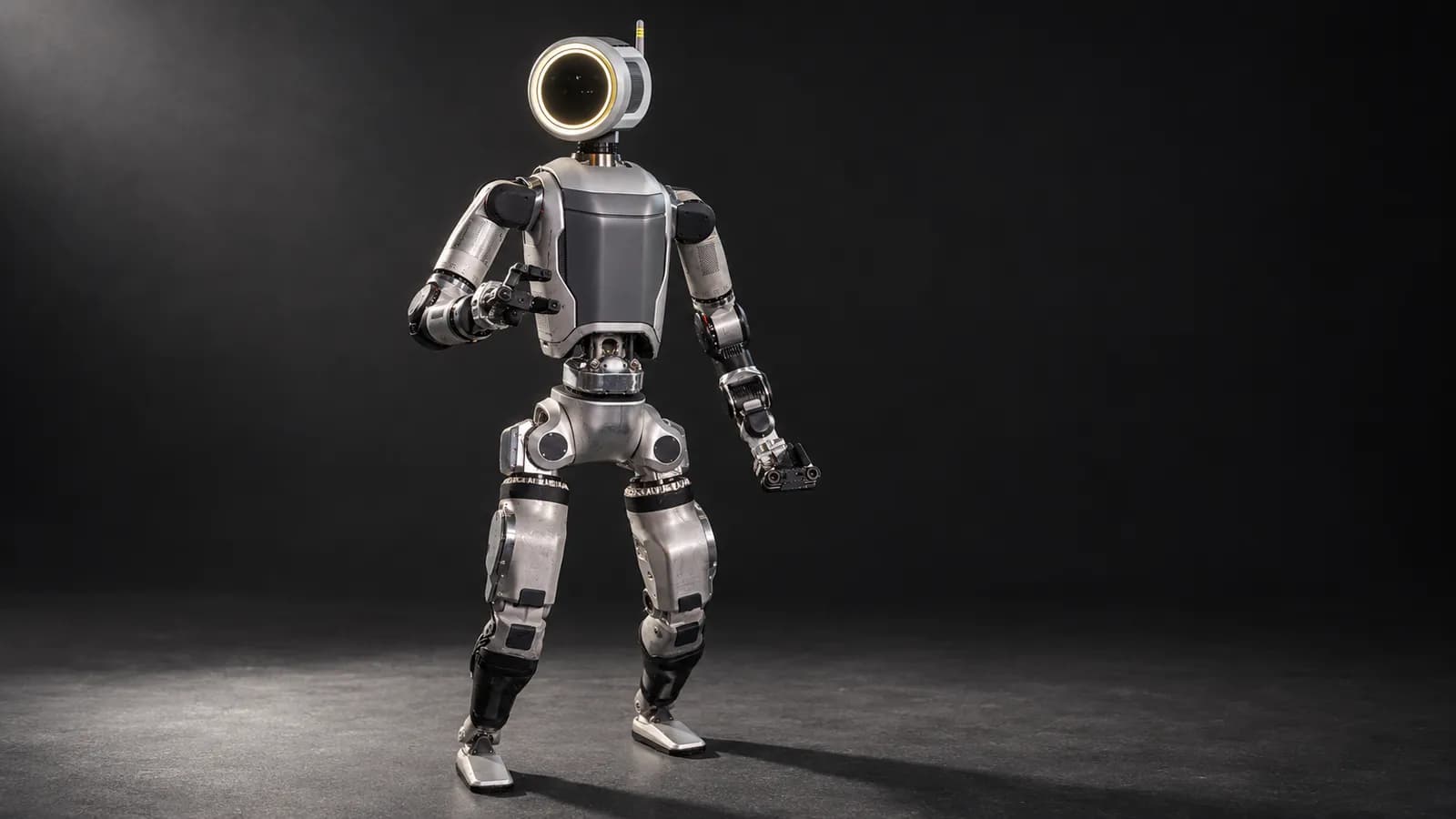
- Height and weight
- 1.9 m, 90 kg
- Degrees of freedom
- 56, with fully rotational joints
- Reach
- 2.3 m
- Payload
- 50 kg instant, 30 kg sustained
- Battery
- 4 h; swaps its own battery at a station
- Protection and temperature
- IP67; -20 to 40 °C
- Control modes
- Autonomous, teleoperated or tablet steering
- Fleet software
- Orbit (MES and WMS integration)
Updated
The electric Atlas is Boston Dynamics' production humanoid: 1.9 m tall, 90 kg, 56 degrees of freedom and a 50 kg instant lift, unveiled as a product at CES in January 2026. It is also the humanoid whose maker has been most open about how operators teach it. Boston Dynamics and Toyota Research Institute have described the VR rig, the data pipeline and the policy architecture in detail, and the head of the Atlas program has talked publicly about who the operators are and how long they take to train. That makes Atlas the best case study there is for anyone setting up humanoid teleoperation, even though very few people can buy one yet.
Can you buy an Atlas?
Not in 2026. In its CES 2026 announcement, Boston Dynamics said production was starting at its Boston headquarters, that "All Atlas deployments are already fully committed for 2026" to Hyundai's Robotics Metaplant Application Center and Google DeepMind, and that it plans to add customers in early 2027. The product page describes the current phase as early adoption with "a select number of early adopters". There is no published price and no public Atlas SDK. If you need a humanoid with operators on it before 2027, skip to the alternatives below.
Three ways to drive Atlas
Boston Dynamics says the product Atlas "can be controlled in three different ways: autonomous mode, teleoperated, or by using a tablet steering interface". Each one has a different job in a deployment:
Autonomous
Teleoperated
Tablet steering
The VR teleoperation rig, step by step
Boston Dynamics and TRI described the rig in their post on Large Behavior Models and Atlas. It sits on top of Atlas' model predictive controller, the same balance and whole-body control layer the robot uses on its own, through a custom VR interface:
Standing upper-body version
Whole-body version
Same view as the policy
The "same information as the policy" rule is the most transferable idea here. If the operator relies on a cue the policy cannot see, such as a side view of the table, the policy learns actions with no visible cause. Show the operator the robot's own camera streams, not a better view.
From demonstrations to a Large Behavior Model
The published pipeline has four stages: collect teleop data on real hardware and in simulation; process, annotate and curate it, with quality-assurance tooling to review, filter and give feedback on episodes; train; and evaluate. The team wrote that "high quality demonstrations were a critical part of getting successful policies".
Model
Inputs
Outputs
Recovery data
Faster than the operator
One caveat on hardware: the research Atlas in that post is listed at 50 degrees of freedom with 7-DoF grippers, while the CES product Atlas is listed at 56. Policies and datasets are tied to the body they were recorded on.
Who the operators are
In a September 2025 IEEE Spectrum interview, Atlas lead Scott Kuindersma gave the clearest description any humanoid maker has offered of its operator team: "The people doing it now are not roboticists; we have a team of 'robot teachers' who are hired for this." He said novice operators are "probably not generating the highest-quality motions for training policies", and that consistently producing good data over several hours "typically takes a couple of weeks of onboarding".
He also placed teleoperation at the top of the data pyramid, "the highest quality, hardest-to-get data", stressed the importance of a large baseline of actual on-robot data, said co-training with simulation had improved real-robot performance, and admitted that "no one knows the exact distribution" of the right mix. Those points are the planning assumptions for any humanoid data program: hire for physical skill and consistency rather than robotics degrees, budget weeks of onboarding per operator, and treat on-robot teleop as the scarce, expensive layer. Our humanoid teleoperator careers page describes the role from the operator side.
What a good operator does on an Atlas-style rig
Moves for the policy, not for the camera
Steps deliberately
Records recoveries on purpose
Uses only the robot's view
Stops before fatigue shows
Where TRI's LBM paper fits
People often cite TRI's Large Behavior Model study as Atlas research. It is related but not the same: the paper trains on almost 1,700 hours of data, including 468 hours of bimanual real-robot teleoperation, 45 hours of simulation teleoperation, 32 hours of UMI data and about 1,150 hours curated from Open X-Embodiment, and evaluates on bimanual Franka FR3 stations, not Atlas. Its headline result, that pretrained LBMs can learn new tasks with 3 to 5 times less data in challenging settings, is the reason the Atlas team adopted the approach. It also found that data normalization choices often mattered more than architecture changes, a reminder that consistent, well-formatted episodes are worth as much as clever models. Our teleoperation data collection guide covers how to keep episodes consistent from the first one.
Control loop and latency for a remote Atlas operator
Because the VR rig drives targets into MPC rather than raw joint commands, the controller on the robot keeps a 90 kg machine balanced even when the operator's signal arrives late or jittery. That is what makes remote operation of a robot this size plausible at all. The remaining question is task precision. Tire handling and bin moves tolerate a few hundred milliseconds of delay; tight assembly and threading do not, and need an operator close to the robot or a policy doing the fine part with the human supervising. Our teleoperation latency guide breaks budgets down by task.
What happens to Atlas in 2026
The 2026 fleet goes to two places. Hyundai's application center is the industrial test bed, and Hyundai Motor Group said at CES that it is preparing to deploy tens of thousands of Boston Dynamics robots in its facilities, with Hyundai Mobis supplying Atlas actuators. The Google DeepMind partnership will combine DeepMind's Gemini Robotics models with Atlas for industrial tasks, starting with automotive, with joint research due to begin in 2026. Neither announcement says anything about outside data access, so expect no public Atlas datasets in the near term.
If you need humanoid operators before 2027
Teams that want to reproduce the Atlas recipe now (VR teleop, recovery demonstrations, a diffusion or flow-matching policy) usually do it on a buyable research humanoid. The full-size Unitree H2 is the nearest in stature and was added to Unitree's open xr_teleoperate stack in v1.6, which records episodes directly. The smaller Unitree G1 has the largest open teleop and dataset ecosystem of any humanoid.
How RoboPilots supplies robot teachers
Kuindersma's description of the job is close to what we staff. Several humanoid makers have sent RoboPilots robots to test our operating protocols. On a customer program we train a dedicated group of operators on your own unit and task protocol, including recovery demonstrations, so the weeks of onboarding happen once and the same people stay on your robot.
One-week trial
Coverage
Data
Interfaces, specs and sources
- VR teleop on BD's MPC controller
- Tablet steering interface
- Autonomous mode (LBM policies)
- Orbit fleet software
- No public Atlas SDK
Availability: Not available to new buyers yet. Boston Dynamics said at CES on January 5, 2026 that all Atlas deployments for 2026 are fully committed, to Hyundai's RMAC and Google DeepMind, and that it plans to add customers in early 2027. No price is published.
Specs are the maker's published figures, checked on . RoboPilots is not affiliated with Boston Dynamics; product names are trademarks of their owners.
- Boston Dynamics Atlas product page and specifications
- Boston Dynamics: new Atlas unveiled at CES, Jan 5, 2026
- Boston Dynamics and TRI: Large Behavior Models and Atlas find new footing
- IEEE Spectrum: Large Behavior Models are helping Atlas get to work, Sep 7, 2025
- Boston Dynamics and Google DeepMind partnership, Jan 5, 2026
- Toyota Research Institute: Large Behavior Models study
- Unitree xr_teleoperate (GitHub)
Frequently asked questions
- Can you buy a Boston Dynamics Atlas?
- Not yet. Boston Dynamics says all 2026 Atlas deployments are committed to Hyundai and Google DeepMind and that it plans to add customers in early 2027.
- How much does Atlas cost?
- Boston Dynamics has not published a price for Atlas. Pricing figures circulating online are third-party estimates, not list prices.
- Is Atlas teleoperated or autonomous?
- Both. Boston Dynamics says Atlas can run in autonomous mode, be teleoperated, or be steered from a tablet. Its autonomous policies are trained on VR teleoperation demonstrations.
- How is Atlas teleoperated in VR?
- An operator wears a VR headset with hand controllers and trackers on the chest and feet, mapped one to one onto the robot, while Atlas's model predictive controller keeps it balanced. The operator sees the same camera and sensor information the policy uses.
- What is the Atlas Large Behavior Model?
- A 450M-parameter diffusion transformer policy, built with Toyota Research Institute, that takes camera images, proprioception and a language prompt and outputs 1.6-second chunks of whole-body actions.