Robots · Humanoids
AgiBot Genie G1 teleoperation: collecting data that fits AgiBot World and GO-1
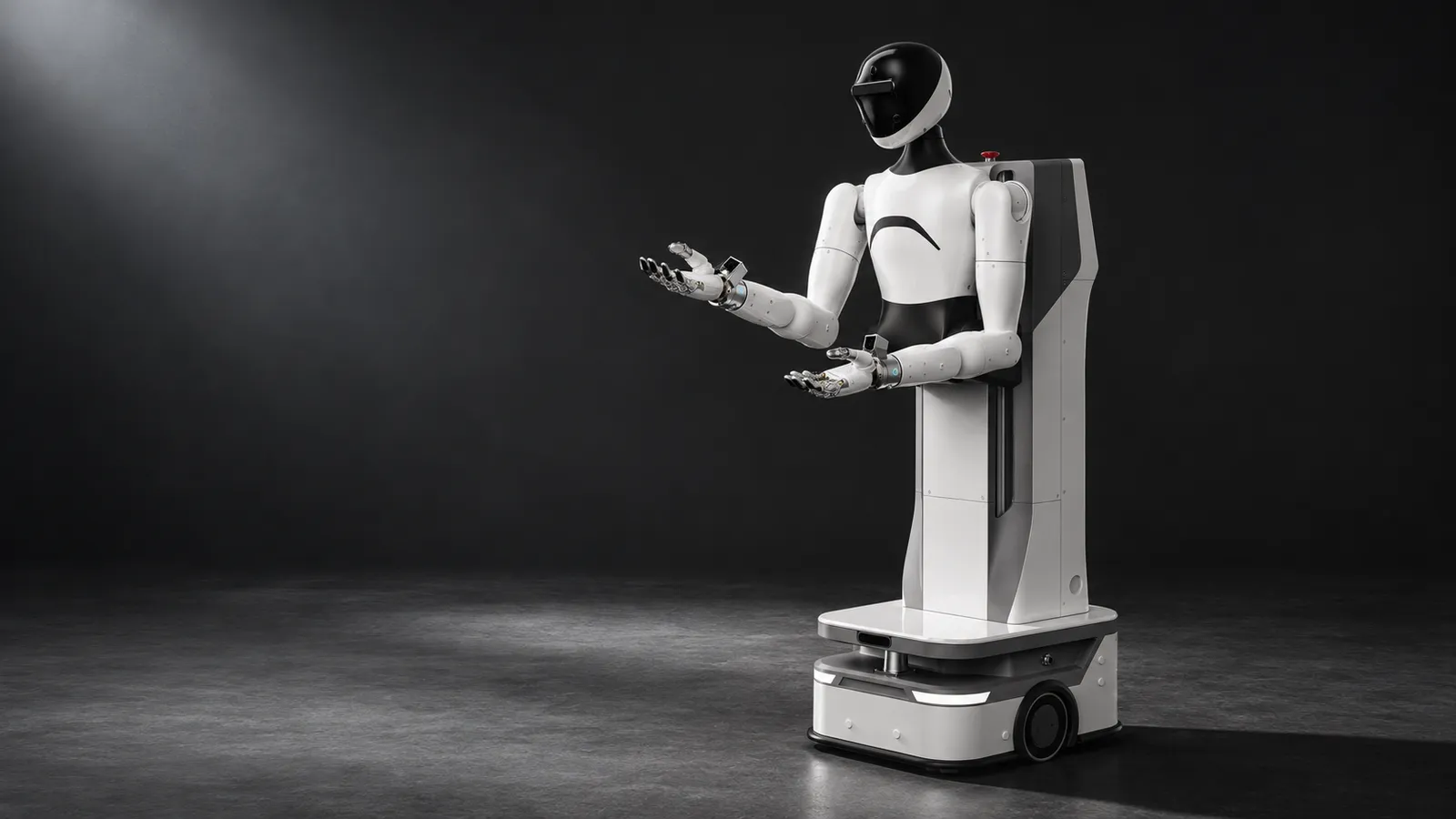
The AgiBot Genie G1 is a wheeled dual-arm robot built to collect teleoperation data. Getting that data into AgiBot World format and onto GO-1 is where most owners get stuck.
- Height and weight
- 130 to 180 cm, 150 kg
- Degrees of freedom
- 20 excluding end effectors (AgiBot also cites 26)
- End effector
- 6-DoF hand, swappable for a two-finger gripper
- Force sensing
- Six-axis force sensors on both arms
- Cameras
- 3 RGB-D and 5 fisheye, plus LiDAR
- Compute
- NVIDIA Jetson AGX Orin 64GB
- Run time
- 4 h+
- Working envelope
- Working height over 2 m; continuous 3 kg in one arm
Updated
The AgiBot Genie G1 is a wheeled, dual-arm humanoid that AgiBot describes as "designed for data collection and model inference". It is not the Unitree G1 or the Galbot G1; three different robots share the name, so search results mix them constantly. The Genie G1 appears throughout AgiBot's own data work, and owners buy it for one reason: to collect teleoperation data that trains manipulation policies, usually starting from AgiBot's own GO-1 model. The hardware makes collection straightforward. The format, calibration and license questions around it are where projects slow down.
Buying an AgiBot Genie G1
AgiBot's Genie G1 page advertises "Large-scale production with immediate delivery" and lists no price; orders go through AgiBot's contact form or sales team. The robot stands 130 to 180 cm on a wheeled base, weighs 150 kg, and has two arms with six-axis force sensors, a 6-DoF hand on each that can be swapped for a two-finger gripper, three RGB-D and five fisheye cameras, LiDAR and a Jetson AGX Orin 64GB. AgiBot's page lists 20 DoF excluding end effectors in its spec table and 26 DoF in a feature section, so confirm the count for your configuration; it changes your action dimensions.
As of October 2026, foreign-produced advanced robotic devices are on the FCC Covered List under FCC public notice DA 26-786 (July 28, 2026), unless the Department of War grants them a Conditional Approval. The FCC definition covers mobile robots, including humanoids, quadrupeds and autonomous mobile robots, that weigh over 4.4 lb with any base or dock and have a sensor, network connectivity and control software, when they do not qualify as US-made under the federal Buy American test, whatever the nationality of the maker. Covered models cannot receive new FCC equipment authorizations, which most devices need before they can be imported or sold in the US, while the FCC says models it authorized earlier can still be imported, sold and used; US buyers should confirm the current status with the seller.
What is built in for data collection
VR or motion-capture teleop
Validation in the loop
Upload and storage
Genie Studio
"Millisecond-latency" describes the local link between the operator rig and the robot. A remote operator in another city adds the network round trip on top, which matters for contact-rich tasks. Our latency guide gives budgets by task.
AgiBot World: what is in it, and the license
The AgiBot World Beta dataset on Hugging Face holds more than a million trajectories from 100 robots, 2,976.4 hours in total, covering 200-plus task types, 87 atomic skills and 100-plus real-world scenarios across five domains. Each episode carries video from every camera, depth as PNG, joint positions and velocities for the two 7-DoF arms, end-effector poses, head and waist joints, and odometry, stored as JSON task files and HDF5 proprioception, with LeRobot-based preprocessing. The card describes the platform as "mobile dual-arm robots" without naming a model, while AgiBot's AgiBot World repository shows its demos on the Genie G1. The accompanying Colosseo paper describes a "standardized collection pipeline with human-in-the-loop verification" across 217 tasks.
The license is the part to read twice. The repository states: "All the data and code within this repo are under CC BY-NC-SA 4.0". That is non-commercial and share-alike. Access on Hugging Face is also gated behind sharing your contact details. Research teams can use it freely within those terms; a company training a model for a product needs a separate agreement with AgiBot, or its own data. A practical pattern is to use AgiBot World to prototype and benchmark under its research terms, then collect your own task data on your own Genie G1 units for anything that ships. The share-alike clause also means derived datasets inherit the same terms, so keep any blend of public and private data out of your production training set unless the license question is settled.
GO-1 and fine-tuning on your own Genie G1 data
GO-1 is AgiBot's vision-language-action model pretrained on AgiBot World: 3B parameters built on InternVL 2.5-2B, also under CC BY-NC-SA 4.0. AgiBot open-sourced it on September 19, 2025, along with GO-1 Air, a lighter version without the latent planner. In the Colosseo paper AgiBot reports that policies pretrained on its dataset average 30 percent better than those pretrained on Open X-Embodiment, and that GO-1 exceeds 60 percent success on complex tasks, 32 percent above the earlier RDT approach; these are AgiBot's own results. The repository's fine-tuning guide puts full fine-tuning at about 70 GB of GPU memory at batch size 16, or about 24 GB when training only the action expert.
What Genie G1 owners run into
The open issues on the AgiBot World repository are a good map of where Genie G1 data projects stall. As of October 2026 none of these had a published fix:
Getting data out of the robot (issue #132)
Action dimensions (issue #152)
Hardware drift (issue #152)
LeRobot 3.0 conversion (issue #149)
Newer robots (issue #163)
A collection protocol that fits GO-1
Those issues point to a short list of rules for any team collecting on a Genie G1 with GO-1 in mind:
Freeze the body you do not train
One gripper per dataset
Lock the cameras
Validate alignment per episode
Fix the format up front
Keep the license separate
Our teleoperation data collection guide covers episode structure and quality checks in more depth.
What a good Genie G1 operator does
Genie Sim, and the G1 versus the G2
AgiBot's Genie Sim is its simulation platform for scene building, data collection and benchmarking. Demonstrations are collected by teleoperating the simulated robot with a PICO VR headset, and recorded rosbags are post-processed into HDF5 episodes. It runs on Isaac Sim 5.1 with ROS 2 Jazzy, and its core code is under the Mozilla Public License 2.0, a more commercial-friendly license than AgiBot World. Note that as of v3.2.0 (June 2026) its Tier 1 robot is the Genie G2 family; the G1 is not named.
The Genie G2 is AgiBot's industrial-grade successor, with automotive-grade components, IP42 protection, high-precision force control and sub-millimeter assembly claims. If you are buying new, ask AgiBot which robot its current GO-1 checkpoints and Genie Sim releases target, because that decides how much of the ecosystem works without conversion. For a humanoid with legs, see the AgiBot A2, which has AgiBot's official VR kit, or the Unitree G1, which has an open teleop stack; the Genie G1 is a data station on wheels.
How RoboPilots runs Genie G1 collection
Several humanoid makers have sent RoboPilots robots to test our operating protocols. For a Genie G1 program, the robot stays at your site and we train a dedicated group of operators on your own unit and your task protocol, including the joint defaults, gripper and camera rules above, before they record an episode.
One-week trial
Coverage
Data
Interfaces, specs and sources
- VR or motion-capture teleop (built in)
- Genie Studio
- AgiBot World / LeRobot format
- GO-1 foundation model
- Genie Sim (PICO VR in simulation)
Availability: Sales-led. AgiBot advertises "Large-scale production with immediate delivery" for the Genie G1 and lists no price; buyers go through its contact form or sales team. AgiBot World data and the GO-1 model are released under CC BY-NC-SA 4.0, which does not allow commercial use without a separate agreement. US buyers: see the FCC note on foreign-produced robots (DA 26-786).
Specs are the maker's published figures, checked on . RoboPilots is not affiliated with AgiBot; product names are trademarks of their owners.
- AgiBot Genie G1 product page and specifications
- AgiBot World repository, license and GO-1 fine-tuning (GitHub)
- AgiBotWorld-Beta dataset (Hugging Face)
- AgiBot World Colosseo paper (arXiv 2503.06669)
- GO-1 model card (Hugging Face)
- Issue #132: converting G1 data to AgiBot World format
- Issue #152: deploying GO-1 on purchased G1 robots
- Issue #149: LeRobot 3.0 conversion misalignment
- Genie Sim (GitHub)
- AgiBot Genie G2 product page
- FCC public notice DA 26-786: foreign-produced robots added to the Covered List (July 28, 2026)
Frequently asked questions
- Is the AgiBot Genie G1 the same as the Unitree G1?
- No. The AgiBot Genie G1 is a wheeled dual-arm data-collection robot from AgiBot. The Unitree G1 is a legged humanoid from Unitree, and Galbot also sells a robot called G1.
- How do I convert my AgiBot Genie G1 data to AgiBot World format?
- An AgiBot contributor has said GO-1 uses the LeRobot format and that Genie Studio collects in it natively, while a general conversion tool was still being implemented. Owners without Genie Studio have exported offline recordings from the robot and converted them themselves.
- Can I use AgiBot World and GO-1 commercially?
- Not under their public license. Both are released under CC BY-NC-SA 4.0, which is non-commercial, so commercial use needs a separate agreement with AgiBot.
- How big is the AgiBot World dataset?
- The Beta release has more than a million trajectories from 100 robots, about 2,976 hours, covering more than 200 task types and 87 atomic skills.
- How much does the AgiBot Genie G1 cost?
- AgiBot does not publish a price. It advertises immediate delivery and handles orders through its sales team.