Robots · Robot arms
Trossen WidowX teleoperation: Core, Pro and Heavy arms, and the Glide Cartesian leader
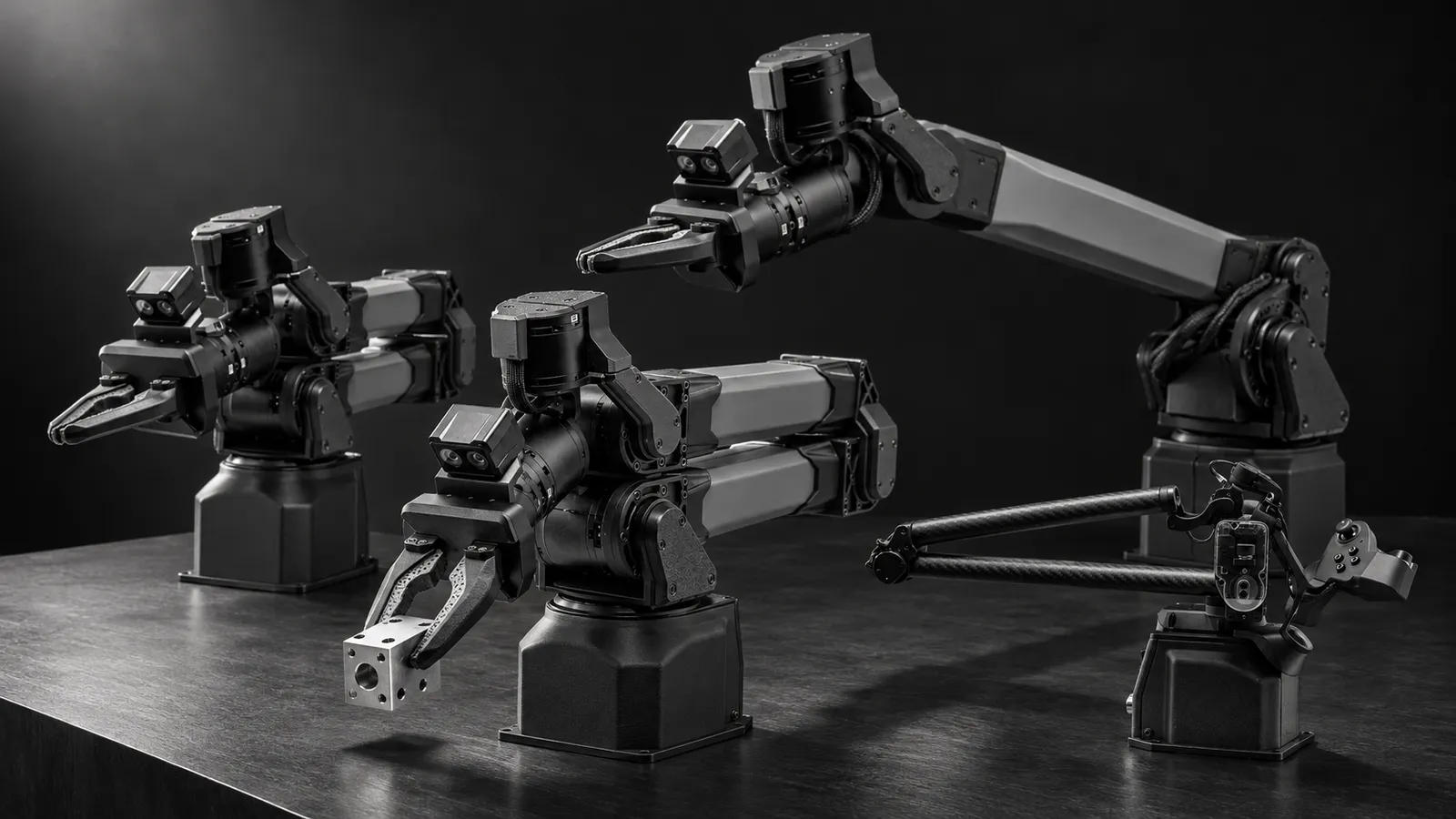
Trossen's new WidowX line comes in three payloads on one controller, with a passive leader arm, Glide, that can drive Trossen arms joint for joint or other arms in Cartesian space. That second mode is the interesting part for teams with mixed fleets.
- Models
- WidowX Core, Pro and Heavy, 6 DOF + gripper (specs marked preliminary by Trossen)
- Payload
- Core 2 kg, Pro 4 kg, Heavy 6 kg (the Workbench page lists 8 kg per Heavy arm)
- Reach
- Core and Pro 700 mm; Heavy 1.4 m
- Controller
- iNerve, built into the base, running above 600 Hz
- Communication
- Industrial Ethernet on locking M12 connectors, no USB; GPIO for E-stop and hardware sync
- Gripper
- Rack-and-pinion, straight-line jaws, 90 mm stroke
- Glide leader
- Passive, encoder-only, carbon fiber with spring-and-cam balance; trigger, buttons, joystick and vibration motor on the handle
- Prices
- Core Follower listed at $2,995 and Glide pair + Cockpit at $6,995 on Trossen Robotics as of October 2026
Updated
The WidowX Core, Pro and Heavy are Trossen Robotics' next-generation research arms: three payloads (2, 4 and 6 kg on the WidowX page) on the same iNerve controller and the same open-source Trossen SDK. Trossen's own arm documentation now calls the WidowX AI "the previous-generation arm". Around the arms sit a passive leader called Glide, a Cockpit operator stand, a fixed bimanual Workbench and a mobile manipulator called Rivet. For teams collecting demonstrations, the headline is not the arm. It is Glide, a leader that can drive arms that are not WidowX at all.
The line at a glance
WidowX Core
WidowX Pro
WidowX Heavy
All three run the iNerve controller in the base, which Trossen says runs above 600 Hz, and connect over industrial Ethernet on locking M12 connectors with no USB in the loop, plus GPIO for an E-stop and hardware sync. Trossen's arm specifications mark the figures as preliminary and do not list repeatability. If your task needs a precision number, ask for it in writing before you design around it.
Glide: a passive leader with two modes
Glide is a carbon-fiber leader arm with "passive, encoder-only joints", balanced by springs and cams instead of motors. Trossen's argument is that because nothing is motorized, there is "nothing to fight your hand", no gravity-compensation error leaks into the data, and the operator tires less. Deep-groove bearing pairs in every joint are meant to cut stiction and jitter in recorded demonstrations. The handle carries a trigger, buttons, a joystick and a vibration motor. Glide is listed at $2,495 per arm, $4,990 for a left/right pair, and $6,995 for a pair with the Cockpit stand, on Trossen Robotics as of October 2026.
Joint-space mode
Cartesian-space mode
Cartesian mode is what makes Glide relevant beyond Trossen's own arms. A lab with, say, a UFACTORY xArm 6 and a WidowX bench could in principle put one kind of leader in front of every operator. It also changes the data. In joint mode, the follower copies the operator's arm shape. In Cartesian mode, only the hand pose is copied, and the follower picks its own elbow. That means:
Glide is not the only leader in the line. The WidowX Core Leader is a dedicated leader arm that Trossen says controls any WidowX follower in real time. The choice is about the operator and the fleet. A Core Leader is a copy of the arm, so it suits a bench of WidowX followers and nothing else. Glide is unmotorized and offers the Cartesian mode, so it suits mixed fleets and long shifts. If your lab will only ever run WidowX followers, either works; if anything else is on the roadmap, Glide keeps one operator station for all of it.
Control rate and latency
There are three rates to keep apart on this line. The controller runs above 600 Hz. The open-source Trossen SDK records joint states at up to 200 Hz, and its example configuration runs teleoperation at 1,000 Hz with cameras polled at 30 Hz. Your policy, whether ACT, Diffusion Policy, smolVLA or π0, will typically be trained on a resampled dataset at a much lower rate. Record high, decide the training rate once, and resample the whole dataset the same way.
A fast local loop does not remove network delay for a remote operator; it just keeps the follower smooth while the commands arrive late. Keep the leader-to-follower loop on one machine next to the arms, carry the remote operator's input to it over a VPN, and clamp per-step motion on the follower side. In Cartesian mode, also limit end-effector velocity, because a late burst of handle poses can become a fast sweep. Budgets by task are in our latency guide.
Data: MCAP first, LeRobot by conversion
Trossen's 2026 lineup page describes the Trossen SDK as "the open-source data layer", with synchronized multimodal episode recording, MCAP episodes inspected in Foxglove, and a "supported LeRobot conversion path". The SDK's README is specific: episodes are written as one TrossenMCAP file each, and a converter produces LeRobot v2 datasets (Parquet plus MP4) with per-episode statistics. It supports RealSense, Stereolabs ZED (on NVIDIA Jetson only) and any V4L2 USB camera, and warns that RealSense depth "significantly increases USB bandwidth usage".
Two things to plan for. First, unlike the WidowX AI, this line does not document a drop-in LeRobot plugin: the documented route is SDK recording, then conversion. Second, the converter targets LeRobot v2, which is the version Trossen's OpenPi recipe trains on, but not the v3 format newer LeRobot tools write by default. Pick the format your trainer needs before the first episode. We deliver data as LeRobot, RLDS or HDF5, and keep the raw MCAP if you want it.
MCAP has a real advantage for teleoperation work: every stream keeps its own timestamps, so you can see exactly how far the camera frames lag the commands, and inspect it in Foxglove before anything is converted. Our data collection guide covers how we QA episodes.
Workbench, Rivet and the Cockpit
Workbench
Rivet
Cockpit
What a good operator does on Glide
Which Trossen line should you buy?
Choose the WidowX AI if you want a released LeRobot plugin, OpenPi recipes and public datasets today, or if you are matching an existing Stationary AI or Mobile AI cell. Choose Core, Pro or Heavy for more payload, a lower entry price per follower, the Glide leader, and the Workbench and Rivet stations. If you are replacing a discontinued WidowX 250, the Core is the entry point of the new line.
How RoboPilots runs WidowX and Glide teleoperation
The arms and the Cockpit stay with you. We agree the mode (joint or Cartesian, and which followers), set up the recording host on your side of a VPN, and train a dedicated group of operators on your unit and your task protocol before the first recorded episode.
One-week trial
Coverage
Data
Interfaces, specs and sources
- Glide passive leader (joint or Cartesian)
- WidowX Core Leader
- Trossen SDK (C++, MCAP recording)
- LeRobot v2 conversion
- Workbench and Rivet stations
- ROS 2
Specs are the maker's published figures, checked on . RoboPilots is not affiliated with Trossen Robotics; product names are trademarks of their owners.
- Trossen Robotics: WidowX Core, Pro and Heavy
- Trossen Robotics: Glide and Cockpit
- Trossen Robotics: Workbench
- Trossen Robotics: Rivet
- Trossen Robotics: 2026 product lineup
- Trossen Arm docs: arm specifications (WidowX, Glide, WidowX AI)
- Trossen Arm docs: system specifications (Rivet, Cockpit)
- trossen_sdk: recording, MCAP and LeRobot conversion (GitHub)
Frequently asked questions
- What is the Trossen Glide leader arm?
- A passive, encoder-only carbon-fiber leader arm balanced by springs and cams. It controls Trossen arms in joint space and kinematically different arms, such as a UR3e in Trossen's example, in Cartesian space through the Trossen SDK.
- Can Glide control a non-Trossen robot arm?
- Trossen says yes, in Cartesian-space mode for kinematically dissimilar arms. The follower solves its own inverse kinematics, so check workspace mapping and which followers your SDK version supports.
- What is the difference between the WidowX AI and WidowX Core, Pro and Heavy?
- The Core, Pro and Heavy are Trossen's next-generation line, with 2 to 6 kg payloads, an iNerve controller running above 600 Hz and the Glide leader. Trossen's docs call the WidowX AI the previous generation, but it has the deeper LeRobot and OpenPi tooling today.
- Does the WidowX Core work with LeRobot?
- Through conversion. The Trossen SDK records MCAP episodes and converts them to LeRobot v2 datasets. A drop-in LeRobot plugin for this line is not documented.
- What is the repeatability of the WidowX Pro?
- Trossen does not publish it on the WidowX page or in its preliminary arm specifications. Ask Trossen for the figure before designing a precision task around it.