Robots · Robot arms
WidowX 250 teleoperation: BridgeData-compatible data on a discontinued arm, and what replaces it
Trossen has discontinued the WidowX 250 S, but it remains the arm behind BridgeData V2 and a large share of open robot-learning work. If you own one, here is how to keep collecting compatible data; if you are buying, here is what Trossen sells now.
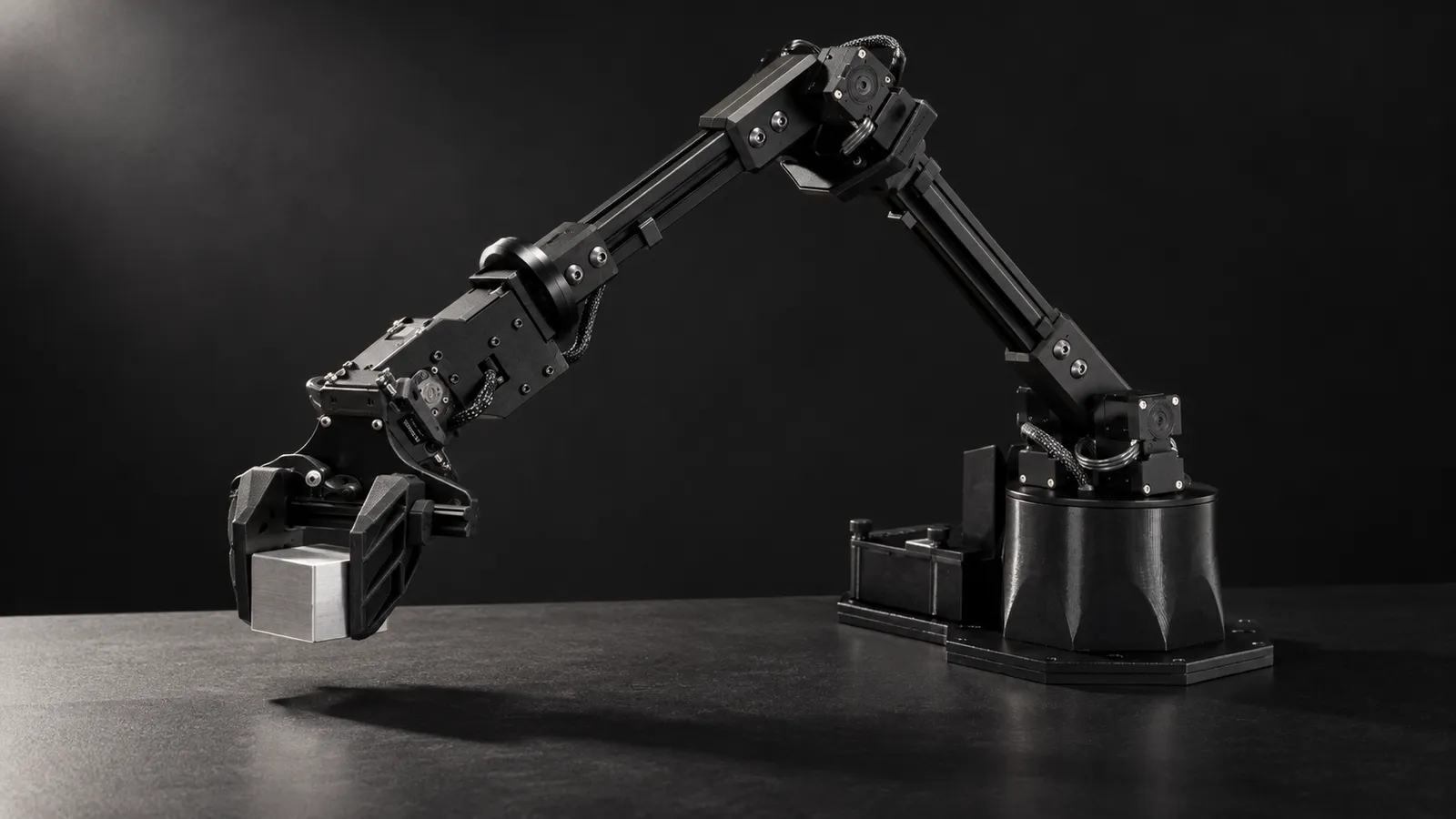
- Status
- Discontinued by Trossen Robotics
- Degrees of freedom
- 6 on the WidowX 250 S / 6DOF; 5 on the original WidowX-250
- Reach / span
- 650 mm / 1,300 mm
- Working payload
- 250 g within max reach; at most 50% extension recommended at 250 g
- Repeatability / accuracy
- 1 mm / 5 to 8 mm
- Servos
- 9 DYNAMIXEL servos on the 6DOF arm (doubled shoulder and elbow), all at 1 Mbps
- Interface
- DYNAMIXEL U2D2 over USB
- ROS 2
- Interbotix X-Series driver, Galactic (Ubuntu 20.04) and Humble (Ubuntu 22.04)
Updated
The WidowX 250 S is a 6-joint Interbotix arm built from DYNAMIXEL servos: 650 mm of reach, a 250 g working payload, 1 mm repeatability. It is also the robot behind BridgeData V2, 60,096 trajectories across 24 environments that a whole generation of generalist policies has been trained and evaluated on. Trossen has since discontinued it. That leaves two kinds of reader: labs that still run 250s and want more data that matches Bridge, and teams deciding what to buy instead.
WidowX 250, 250 S, 6DOF: which arm you have
The naming trips people up. Trossen's spec pages list the original WidowX-250 as a 5-DOF arm with eight servos, and the WidowX-250 6DOF (sold as the 250 S) as 6 DOF with nine, adding a forearm roll. Reach, span, payload and repeatability are the same. BridgeData V2 was collected on the 6DOF arm. If you are adding data to a Bridge-style project, check the joint count first, because a 5-DOF arm cannot reproduce 6-DOF wrist motion.
Two spec details matter for teleoperation. The 250 g payload is rated inside max reach, and Trossen recommends no more than 50% extension at that load, so long reaches with a heavy object strain the shoulder servos. And accuracy is listed at 5 to 8 mm against a 1 mm repeatability: the arm goes back to the same place reliably, but not necessarily to the place its model predicts. Teleoperation hides this, because the operator closes the loop by eye; scripted waypoints expose it.
How the WidowX 250 is teleoperated
VR controller, the BridgeData way
Leader arm
ROS 2 and the Interbotix SDK
Control rate: Bridge runs at 5 Hz, in end-effector space
This is the detail that matters most for compatibility. BridgeData V2 is recorded at 5 Hz, with an average trajectory of 38 steps. The LeRobot port, IPEC-COMMUNITY/bridge_orig_lerobot, makes the action space explicit: a 7-value end-effector action (x, y, z, roll, pitch, yaw, gripper) at 5 fps, with four 256×256 camera streams, across 53,192 episodes. That is very different from a modern leader/follower dataset recorded as joint positions at 30 Hz.
If you want to stay Bridge-compatible
If you are building your own policy
For remote operators, 5 Hz is forgiving: each step is 200 ms, so a 150 ms round trip is less than one step of delay, and Bridge-style pick-and-place in toy kitchens stays comfortable well beyond the latency a 30 Hz bimanual task can absorb. The VR stack, though, expects the headset on USB at the robot, so a remote setup has to carry the controller pose over the network to the robot host. Our latency guide covers the trade-offs.
Policy evaluation is a teleoperation job too
Because so much published work was trained or tested on Bridge data, a WidowX 250 is also a natural evaluation rig: a lab trains a policy and runs it on the same kind of arm, in a Bridge-like scene, to see how it compares. The rig matters less than the procedure around it. bridge_data_robot supports this with its server-client mode, where `widowx_env_service --server` runs on the robot host and the policy client runs on the same machine or another one. Evaluation still needs people. Someone sets each scene to the protocol, starts the rollout, stops it when the arm heads for trouble, and scores the result against a written success definition. That work suits a remote operator with a person on site for resets, and it benefits from the same discipline as data collection: identical scenes, identical scoring, and a log of every intervention.
Data formats and LeRobot
LeRobot has no built-in WidowX 250 driver: its built-in robots are the SO-series, Koch, OpenArm, OMX and a few others, and Trossen's LeRobot plugin registers WidowX AI types. Teams that want LeRobot recordings from a 250 write a small Robot class around the Interbotix SDK (connect, read joints, send targets), after which the usual LeRobot recording and training tools work. Bridge itself ships as raw JPEG, PNG and pickle files, with a preprocessed RLDS version for TFDS loaders. Other labs have published Bridge-compatible WidowX-250 data the same way, such as bridge_data_msr from Microsoft Research, 822 trajectories with three RGB views and depth.
We deliver WidowX episodes as LeRobot, RLDS or HDF5, and for Bridge-style projects we match the action convention and camera layout you specify. The data collection guide has the general QA checklist.
A Bridge-style collection protocol
BridgeData's value comes as much from how it was collected as from its size: many scenes, many skills, a language instruction per trajectory, and deliberate camera variation. If new data is meant to sit next to it, the protocol has to copy those choices, not only the robot.
Scenes and skills
Language
Camera variation
Demos versus scripted data
What a good WidowX 250 operator does
Keeping a 250 fleet healthy
WidowX 250 discontinued: what replaces it?
Trossen's WidowX 250 page names no direct successor. Trossen sells two current lines: the WidowX AI and the newer WidowX Core, Pro and Heavy, which Trossen lists at 2, 4 and 6 kg of payload on Ethernet-connected arms with an iNerve controller, plus the Glide passive leader. Against the 250 S, that is a move from a USB servo bus and a 250 g payload to a different class of arm, recording joint-space leader/follower data at higher rates. Neither line is the same embodiment as BridgeData. If your evaluation depends on staying in Bridge's distribution, keep a 250 running for that work and collect new tasks on the new arms. For bimanual work, see our page on the Stationary AI, Trossen's current ALOHA-style cell.
How RoboPilots runs WidowX 250 data collection
Your arms stay in your lab. We agree the input (VR in the Bridge style, or a leader arm), set up the robot host on your side of a VPN, and train a dedicated group of operators on your unit and your task protocol, including the action convention, before the first recorded episode.
One-week trial
Coverage
Data
Interfaces, specs and sources
- Interbotix X-Series ROS 2 (Galactic, Humble)
- Interbotix Python / ROS SDK
- Meta Quest VR (BridgeData stack)
- Leader arm (ALOHA WidowX)
- DYNAMIXEL U2D2
- No built-in LeRobot driver
Availability: Discontinued: Trossen's WidowX 250 product page reads "THIS PRODUCT HAS BEEN DISCONTINUED". Trossen's current lines are the WidowX AI and the WidowX Core, Pro and Heavy.
Specs are the maker's published figures, checked on . RoboPilots is not affiliated with Trossen Robotics (Interbotix); product names are trademarks of their owners.
- Trossen Robotics: WidowX 250 S (discontinued)
- Interbotix docs: WidowX-250 6DOF specifications
- Interbotix docs: WidowX-250 (5DOF) specifications
- Interbotix docs: X-Series ROS 2 interface
- BridgeData V2 project page
- Trossen Robotics: WidowX Core, Pro and Heavy (current line)
- bridge_data_robot: WidowX control and VR collection (GitHub)
- IPEC-COMMUNITY/bridge_orig_lerobot (Hugging Face)
- TFDS: bridge_data_msr
- LeRobot built-in robots (GitHub)
Frequently asked questions
- Is the WidowX 250 discontinued?
- Yes. Trossen's product page for the WidowX 250 S says the product has been discontinued. Trossen's current arms are the WidowX AI and the WidowX Core, Pro and Heavy.
- Which WidowX was used for BridgeData V2?
- The WidowX 250 6DOF, teleoperated with a VR controller. BridgeData V2 has 60,096 trajectories across 24 environments, recorded at 5 Hz.
- Does LeRobot support the WidowX 250?
- Not with a built-in driver, and Trossen's LeRobot plugin targets the WidowX AI. Teams write a small Robot class around the Interbotix SDK to record LeRobot datasets from a 250.
- What is the WidowX 250 payload?
- Trossen specifies a 250 g working payload within maximum reach and recommends no more than 50% arm extension when handling 250 g.
- Does the WidowX 250 work with ROS 2?
- Yes. The Interbotix X-Series ROS 2 interface supports ROS 2 Galactic on Ubuntu 20.04 and Humble on Ubuntu 22.04.