Robots · Robot arms
ALOHA Stationary AI teleoperation: bimanual leader arms, 30 Hz episodes and the move from ALOHA 2
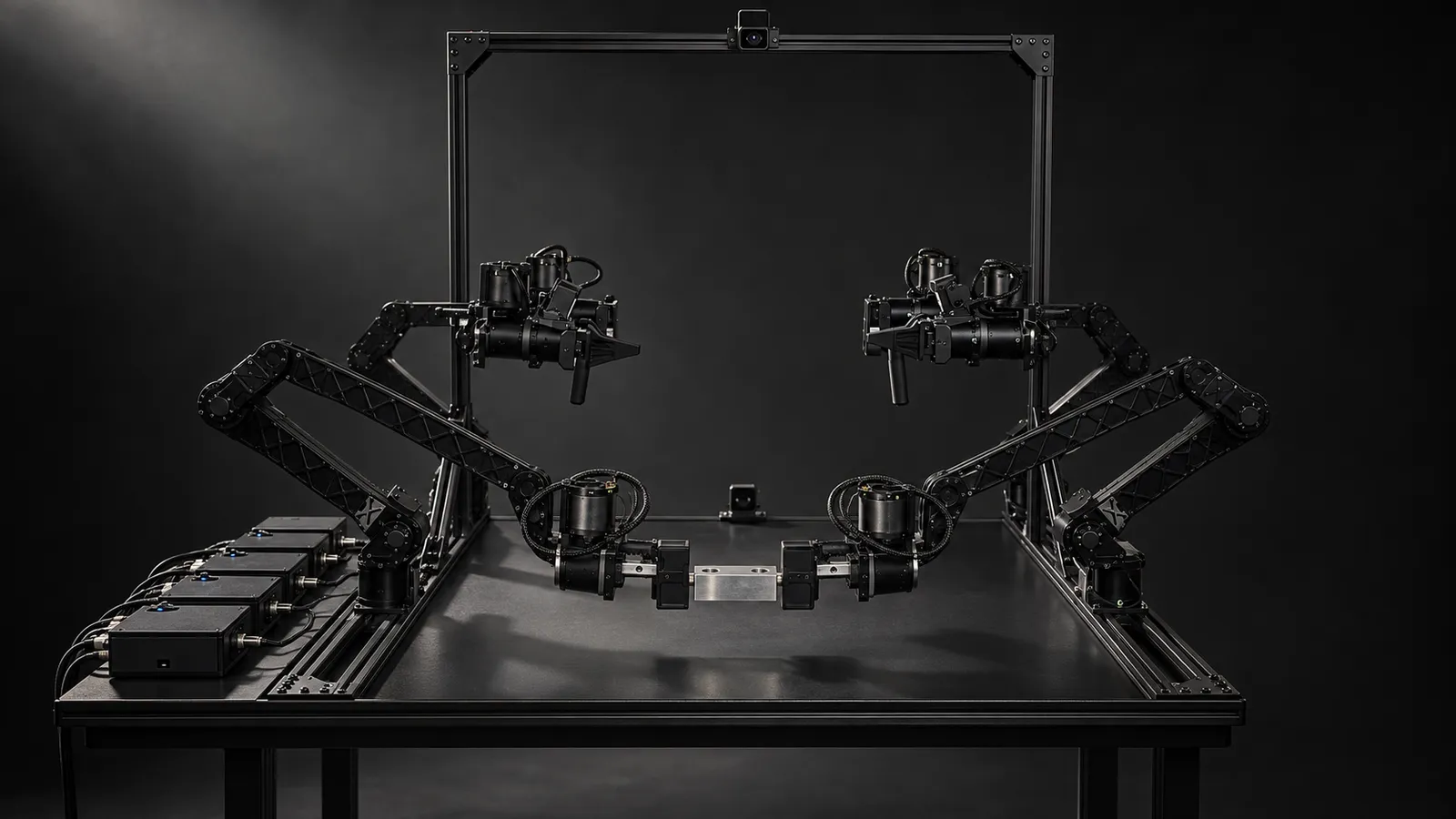
Trossen's Stationary AI is the current ALOHA-style bimanual cell: four WidowX AI arms, four wrist and scene cameras, and a fixed frame. Here is how to run it for clean two-handed demonstrations, and what changed from the ViperX-based ALOHA kits.
- Arms
- 2 leader/follower WidowX AI pairs (4 arms)
- Cameras
- 4 × Intel RealSense D405
- Interface
- 10-inch touchscreen
- Compute
- High-performance desktop included; RTX 5090 workstation optional
- Table
- Not included; at least 48 in wide × 30 in deep recommended
- Recording rate
- 30 Hz default loop in the lerobot_trossen plugin
- Price
- Listed at $23,995.95 on Trossen Robotics as of October 2026
- Production time
- 2 to 3 weeks on average
Updated
ALOHA started as "a low-cost open-source hardware system for bimanual teleoperation", and the original project introduced ACT, the action-chunking policy that made two-armed imitation learning practical for many labs. Trossen Robotics built and sold the ALOHA kits, and its current version is the Stationary AI: two leader/follower pairs of WidowX AI arms, four RealSense D405 cameras and a touchscreen on a fixed frame, listed at $23,995.95 on Trossen Robotics as of October 2026. Bimanual data is the most demanding kind of teleoperation to collect well. The operator uses both hands at once, every episode has twice the ways to fail, and resets take longer.
From ALOHA 2 to Stationary AI: what changed
Many teams searching for "ALOHA" own, or learned on, the earlier kit. Trossen's ALOHA 2.0 specifications describe that stationary cell as two WidowX 250 S leaders and two ViperX 300 S followers (ALOHA versions), four RealSense D405 cameras, a modular aluminum frame and gravity compensation on the leaders through retractors and springs. The ViperX 300 S page now reads "THIS PRODUCT HAS BEEN DISCONTINUED". The Stationary AI replaces both arm types with the WidowX AI, so the leader and follower are the same arm in different configurations.
Software
Data format
Joint layout
Rate
Do not pool old and new ALOHA data without a plan. lerobot/aloha_static_coffee is 50 episodes at 50 fps, recorded on ViperX followers. TrossenRoboticsCommunity/stationary-block-transfer-lerobot-v3 is 60 episodes, 26,940 frames at 30 fps, recorded on WidowX AI followers, in LeRobot format v3.0. Both have 14-value states and four cameras named the same way, which makes them look compatible. They are not the same robot, and the frame rates differ.
How the bimanual leader/follower setup works
The operator stands or sits at the two leader arms, one per hand, and the followers mirror them joint for joint. In the plugin, the bimanual leader and follower each take a left and a right IP address, observations are prefixed per arm, and the state and action are 14 values: six joints plus the gripper carriage on each side. The cameras follow the ALOHA convention, `cam_high`, `cam_low`, `cam_left_wrist` and `cam_right_wrist`, which is also what Trossen's OpenPi recipes expect.
The fixed frame is the point of this kit. Trossen positions the Stationary AI for "a well-controlled lab environment where variables like arm and camera placement are consistent from session to session". It even gives a table recommendation, a maple-top packing table at least 48 by 30 inches, arguing that light, matte wood gives consistent texture and contrast, and that black or white tables may need more demonstrations and tuning. Whatever surface you choose, keep it for the life of the dataset.
Control rate and latency with two arms
The plugin's bimanual follower shares one `loop_rate` (default 30 Hz) and one `min_time_to_move_multiplier` (default 3.0) across both arms, and its per-arm `left_arm_max_relative_target` and `right_arm_max_relative_target` default to None. At 30 Hz a step is about 33 ms. A remote operator on a 150 ms round trip is roughly five steps behind on both arms at once, and bimanual tasks are full of moments where that matters: a handover, holding a bag open with one hand while the other drops something in, folding.
Cap both arms
Keep the loop beside the cell
Choose tasks for the latency you have
Data: what a Stationary AI episode looks like
A Stationary AI episode recorded through the plugin is a LeRobot dataset with four 640×480 camera streams, a 14-value state and a 14-value joint-position action. Trossen's bimanual recording example runs 25 episodes of 60 s. Velocity and effort observations are off by default and worth deciding on before the first episode, especially for contact-rich two-handed work.
If π0 or π0.5 is the target, read the dataset-version section of our WidowX AI page first: Trossen's OpenPi recipe trains on LeRobot v2 data, while the plugin records v3. If you are converting a legacy HDF5 archive, Trossen's 2024 LeRobot announcement described a LeRobot script for converting HDF5 datasets to Parquet; convert, then check joint names and fps before mixing anything. We deliver bimanual episodes as LeRobot, RLDS or HDF5; the data collection guide covers QA.
The original ALOHA work is still a good yardstick for episode design. Its project page reports 50 demonstrations per task, episodes of 600 to 1,000 steps, four 480×640 camera streams (two fixed, two on the wrists), object positions randomized along a 15 cm line, and an ACT chunk size of 90. Those numbers are not targets for your task, but they show how modest the data can be when it is consistent: a fixed cell, a fixed protocol, small planned variation.
What a good bimanual operator does
The person on site matters more on a bimanual cell than on a single arm. Two-handed tasks usually involve more objects, cloth, containers and lids, and a reset is rarely a single block back on a mark. Write the reset into the task protocol, photograph the start state, and size the on-site role before you size the operator team.
Write the bimanual task protocol down
On a single arm, a verbal briefing sometimes survives. On a bimanual cell it does not, because there are too many choices an operator can make differently. A protocol that fits on one page saves more episodes than any tuning:
Start state
Roles
Success and failure
Time limit
Reset checklist
Variation schedule
Stationary AI, Mobile AI or two Solo kits?
The Mobile AI is the bimanual kit on a wheeled base, for tasks that happen away from a fixed bench. The single-arm Solo AI is covered on our WidowX AI page. Trossen notes that a Stationary AI can be used as two Solo AIs for field collection, but two Solos cannot be turned into a Stationary AI, because the fixed frame and accessories are not sold separately. If your tasks are bimanual and happen on a bench, the Stationary AI is the one to buy; its fixed geometry is what makes episodes repeatable. If you want the newer arms instead, Trossen's WidowX Core, Pro and Heavy line pairs with the Glide passive leader.
How RoboPilots runs a Stationary AI cell
The cell stays in your lab. We agree the input path, set up the recording host on your side of a VPN, and train a dedicated group of operators on your unit and your bimanual task protocol, including which hand does what, before the first recorded episode.
One-week trial
Coverage
Data
Interfaces, specs and sources
- Two WidowX AI leader/follower pairs
- lerobot_trossen bimanual types
- OpenPi (Pi0 / Pi0.5)
- Touchscreen data collection UI
- ROS 2
- Legacy ALOHA tools (HDF5)
Specs are the maker's published figures, checked on . RoboPilots is not affiliated with Trossen Robotics; product names are trademarks of their owners.
- Trossen Robotics: Stationary AI ALOHA kit
- Trossen ALOHA 2.0 docs: specifications
- Trossen ALOHA 2.0 docs: data collection (HDF5)
- Trossen Robotics: ViperX 300 S (discontinued)
- Trossen Robotics: 2024 LeRobot support announcement
- lerobot_trossen plugin (GitHub)
- Trossen Arm docs: LeRobot plugin configuration
- ALOHA and ACT project page
- lerobot/aloha_static_coffee dataset (Hugging Face)
- TrossenRoboticsCommunity/stationary-block-transfer-lerobot-v3 (Hugging Face)
Frequently asked questions
- Is the Trossen Stationary AI the same as ALOHA 2?
- It is its successor. ALOHA 2 kits used WidowX 250 S leaders and ViperX 300 S followers; the Stationary AI uses two WidowX AI leader/follower pairs, four RealSense D405 cameras and a touchscreen, and records through LeRobot.
- How much does the ALOHA Stationary AI kit cost?
- It is listed at $23,995.95 on Trossen Robotics as of October 2026. The table is not included, and a high-performance workstation is an optional add-on.
- Can I mix original ALOHA datasets with Stationary AI data?
- Not directly. Original ALOHA data in LeRobot is 50 fps on ViperX followers, while Stationary AI data records at 30 Hz by default on WidowX AI arms. Resample and map joints deliberately, or train on them separately.
- Does the Stationary AI work with LeRobot?
- Yes, through Trossen's lerobot_trossen plugin, which registers bimanual leader and follower types. It is a maker plugin, not part of LeRobot's built-in robots.
- What table should I use for an ALOHA kit?
- Trossen recommends a table at least 48 inches wide and 30 inches deep and suggests a matte, light maple top for consistent visuals. Black or white surfaces work but may need more demonstrations.