Robots · Humanoids
Agility Digit teleoperation: who handles the exceptions on a deployed humanoid
Digit is the Western humanoid with the longest record of paid commercial work. Agility has said little about remote operation, so this page sticks to what is published and to what any deployed fleet needs around it.
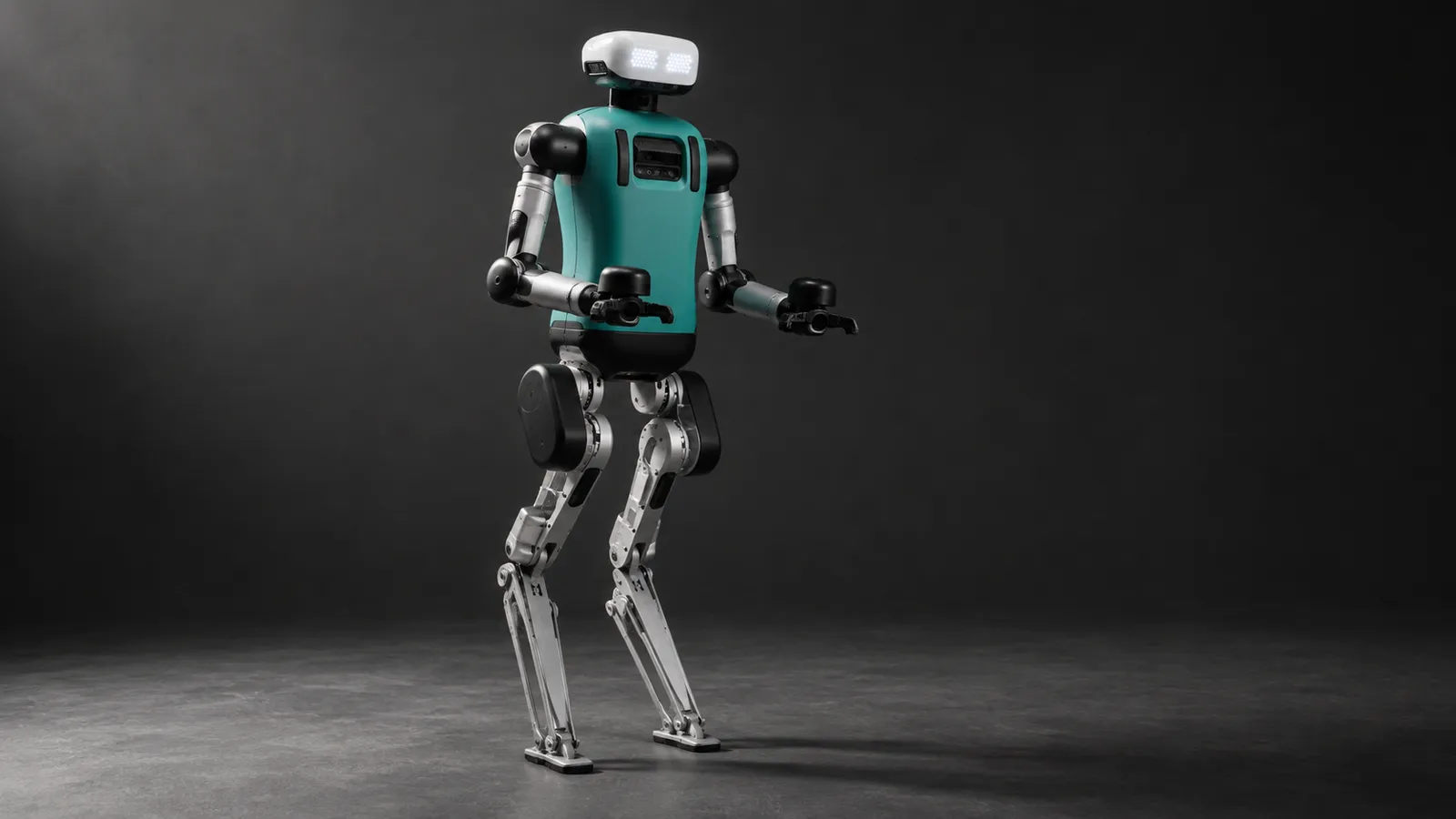
- Height and weight (Digit 5)
- 1.81 m, 129 kg
- Reach
- 2.2 m
- Payload
- Repeated lifts up to 22.7 kg (50 lb)
- Battery
- 90 min run time, 9 min charge (10:1 run-to-charge)
- End-effectors
- Swappable, ISO-standard mounting flanges
- Safety
- Human detection, visual and audio cues, independent safety controller
- Fleet software
- Agility Arc (uptime, throughput, MTBI; WMS and MES links)
- Operating record
- Digit 4: more than 65,000 hours across customer sites
Updated
Agility's Digit is a bipedal humanoid built for one kind of work, moving totes and materials in warehouses and factories, and it has done that work for customers longer than any other humanoid. Agility says Digit 4 has logged more than 65,000 hours across sites including GXO, Schaeffler, Amazon and Toyota Motor Manufacturing Canada, and that Digit has nearly three years of continuous commercial deployment. Teams searching for "Digit teleoperation" are usually asking a deployment question, not a research one: when a production humanoid gets stuck at 3 a.m., who gets it moving again?
Can you get a Digit?
Yes, through Agility's sales team, and only as a commercial deployment. There is no store and no public price. Agility's first well-documented commercial model was Robots-as-a-Service: in 2024 GXO and Agility announced what was described as the first humanoid RaaS contract, expanding Digit's work at a GXO facility outside Atlanta, per the Agility Robotics entry on Wikipedia. Agility unveiled Digit 5 on September 15, 2026, citing more than $300 million in multi-year orders as of May 2026. Early access to Digit 5 is expected in the first half of 2027 and general availability by the end of 2027, and for the first time Agility plans deployments outside North America, starting with the EU and UK.
The company is also going public through a merger with Churchill Capital Corp XI; Agility's newsroom records the SEC declaring the S-4 registration effective on October 13, 2026.
How Digit got here
Agility spun out of Oregon State University's Dynamic Robotics Lab in 2015 and first sold Cassie, a two-legged research robot. Digit, a full-size humanoid with a torso, arms and perception, followed in 2019. Ford bought a later version in 2020 to explore last-mile delivery, and in 2021 Agility refocused Digit on warehouse and logistics material handling. The current Digit generation debuted at ProMat in 2023, shortly before Agility announced RoboFab, its humanoid factory in Salem, Oregon. Amazon began testing Digit in late 2023, and GXO put it to work at its Spanx facility near Atlanta before signing the 2024 RaaS contract. That history matters for operators: Digit has spent years on one narrow, repetitive job, which is exactly the kind of work where exceptions are predictable enough to write procedures for.
What Digit 5 changes
Reach and payload
Charging
Tools
Safety
Is Digit teleoperated?
Agility has not publicly described a teleoperation or remote-assistance mode for Digit. Its Digit 5 materials describe autonomous workflows expanded by its "physical AI stack", fleet management through Arc, system health and diagnostics flowing to the cloud, and "a service ecosystem that was developed to maximize uptime". There is no public SDK, VR stack or developer program. We will not guess at what Agility runs internally; this page is about the layer any operator of a warehouse humanoid fleet has to plan for, whoever supplies it.
Arc and the exception problem
Arc is Agility's cloud platform for deploying and managing Digit fleets. It reports uptime, throughput and Mean Time Between Incidents, and connects to existing warehouse and manufacturing execution systems. The last metric is the one that shapes staffing. Every incident is a moment when the robot cannot continue on its own: a tote is crushed or mislabeled, a conveyor is jammed, a pallet is stacked off pattern, a person is standing in the robot's path. A fleet that runs 20 hours a day across several sites will have incidents on every shift, and someone has to clear each one.
On-site associates
Remote supervisors
Remote operators
Engineers
The split between those roles is a design decision for each site, and it changes as the robots improve: early in a deployment, more incidents need a person; later, the remote desk handles more and the site handles less. Our human-in-the-loop guide for humanoid robots describes how teams structure that exception desk and turn its sessions into correction data.
What an exception desk does on a tote-handling fleet
Why Digit 5 raises the staffing question
The 10:1 run-to-charge ratio is the change that matters most for the people around the robot. At 2:1 a robot spends a third of its day charging, and the gaps give a site natural slack. At 10:1 charging drops to under a tenth of each cycle, and Agility's product page lists 20 working hours in every 24. More hours of work means more incidents per robot per day, spread over every shift, including nights and weekends when a site has the fewest people. Wider workflows add to it: depalletizing and machine tending have more ways to go wrong than moving empty totes. The result is that exception coverage, not robot count, often becomes the limit on how many hours a fleet really runs.
Questions to ask any warehouse humanoid vendor
The answers decide how much of the exception desk you staff yourself. Our guide to robot teleoperation as a service covers how outsourced operator teams are usually contracted.
Latency for supervision versus control
Exception handling is mostly supervisory: read the state, choose an action, confirm. That tolerates far more network delay than direct teleoperation, so a remote desk can sit in another region or time zone and still be effective, as long as the robot's own controllers handle balance and motion. Direct remote control of a full-size biped carrying 50 lb is a different matter, and needs a short round trip plus local safety limits. Our teleoperation latency guide covers where each kind of task falls.
Digit compared with humanoids built for data collection
Digit and research humanoids answer different needs. Digit is a closed industrial product sold with fleet software and service, aimed at a defined set of logistics workflows. You do not program it yourself or record your own teleop datasets on it. If your goal is to train your own whole-body or manipulation policies, you need an open platform with an SDK and a teleop stack, such as the Unitree G1, on which Unitree's open xr_teleoperate records episodes directly, or a full-size Unitree H2 for adult-height reach. If your goal is to run humanoids in a warehouse this year with a vendor behind them, Digit is one of very few options with a commercial record. Our warehouse and factory page covers the wider automation picture.
How RoboPilots can support a humanoid fleet
We do not have a partnership with Agility, and nothing here implies one. What we offer any humanoid program is the people layer. Several humanoid makers have sent RoboPilots robots to test our operating protocols. For a customer fleet we train a dedicated group of operators on your own units, your sites and your incident protocol, and keep the same group on your program.
One-week trial
Coverage
Data
Interfaces, specs and sources
- Agility Arc fleet cloud
- Warehouse and MES integration
- Swappable ISO-flange end-effectors
- No public SDK or teleop stack
Availability: Sales-led, no public price. Digit 4 is deployed commercially at customer sites in North America (Agility names GXO, Schaeffler, Amazon and Toyota Motor Manufacturing Canada). Digit 5 was unveiled on September 15, 2026, with early access expected in the first half of 2027 and general availability by the end of 2027, adding the EU and UK to the US and Canada. GXO signed a Robots-as-a-Service contract in 2024.
Specs are the maker's published figures, checked on . RoboPilots is not affiliated with Agility Robotics; product names are trademarks of their owners.
Frequently asked questions
- How much does Agility Digit cost?
- Agility does not publish a price. Digit is sold through Agility's sales team as a commercial deployment, and GXO signed what was described as the first humanoid Robots-as-a-Service contract with Agility in 2024.
- Is Agility Digit teleoperated?
- Agility has not publicly described a teleoperation or remote-assistance mode for Digit. Its materials describe autonomous workflows, fleet monitoring through Agility Arc, and a service ecosystem for uptime.
- Where is Digit deployed?
- Agility says Digit 4 has logged more than 65,000 hours at customer sites in North America, including GXO, Schaeffler, Amazon and Toyota Motor Manufacturing Canada.
- When is Digit 5 available?
- Agility expects early access to Digit 5 in the first half of 2027 and general availability by the end of 2027, with the EU and UK added to the United States and Canada.
- What is Agility Arc?
- Agility's cloud platform for deploying and managing Digit fleets. It reports uptime, throughput and Mean Time Between Incidents and connects to warehouse and manufacturing execution systems.