Robots · Humanoids
Fourier GR-1 teleoperation: the two-person VR stack, ActionNet data and GR00T
Fourier ships one of the most complete official teleop stacks of any humanoid maker, and it tells you to run it with two people. Here is how it works, what it records, and where the license lines are.
- Dimensions
- 1,650 × 524 × 325 mm
- Weight
- About 52 kg net
- Degrees of freedom
- Up to 44 (7 per arm, 6 per hand, 6 per leg, 3 head, 3 waist)
- Payload
- About 3 kg per hand
- Walking speed
- 5 km/h
- Max joint torque
- 230 N·m
- Battery
- 483 Wh; about 60 min, about 45 min walking
- Host computer
- Intel i7-13700H, Ubuntu 20.04 with ROS 2
Updated
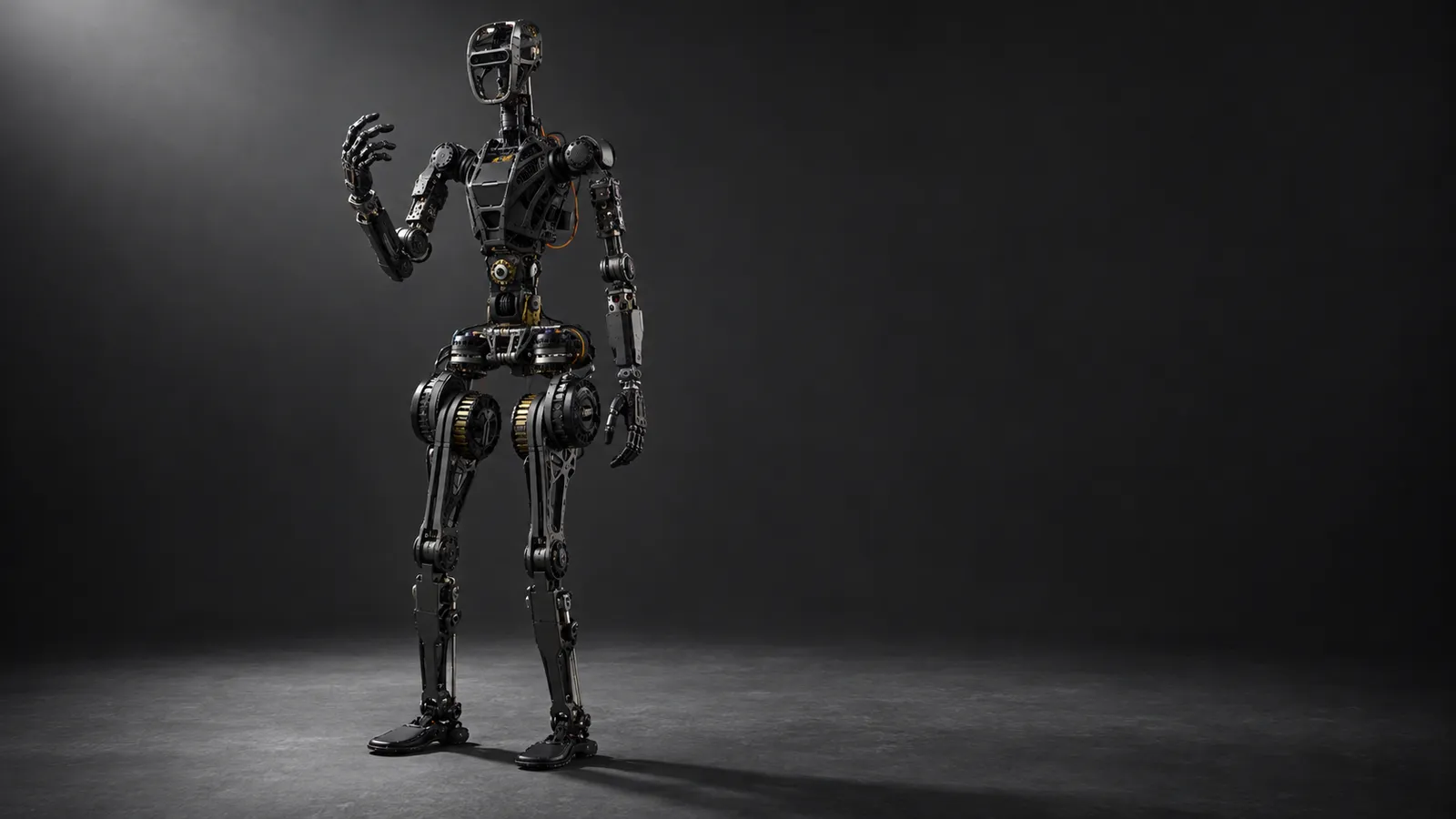
The Fourier GR-1 is a full-size humanoid with up to 44 degrees of freedom, 7-DoF arms and 6-DoF hands, and it has a place in robot-learning history: NVIDIA deployed its GR00T N1 foundation model on the GR-1 for language-conditioned bimanual manipulation. Fourier also publishes its own VR teleoperation system and a large teleop dataset recorded on its robots. For a team buying a GR-1 or its successors, the tools are there. What the tools assume is a trained crew, and that is where most programs need help.
Getting a GR-1, and which Fourier robot to pick
Fourier sells its humanoids through sales and distributors and does not publish prices on its own sites. The GR-1 documentation lives on Fourier's older support site, alongside the GR-2, GR-3 and N1. The four are different robots for different jobs:
GR-1
GR-2
GR-3
N1
For bimanual manipulation data, the GR-1 and GR-2 are the relevant pair. The GR-1 has the most mature teleop path today; the GR-2 has more torque, longer battery life and optional 12-DoF hands, but its teleop support is still marked experimental. If your project is about human-robot interaction rather than manipulation data, the GR-3 is the one to ask Fourier about: it is built for conversation and companionship, and remote headset operation is part of its published feature set.
As of October 2026, foreign-produced advanced robotic devices are on the FCC Covered List under FCC public notice DA 26-786 (July 28, 2026), unless the Department of War grants them a Conditional Approval. The FCC definition covers mobile robots, including humanoids, quadrupeds and autonomous mobile robots, that weigh over 4.4 lb with any base or dock and have a sensor, network connectivity and control software, when they do not qualify as US-made under the federal Buy American test, whatever the nationality of the maker. Covered models cannot receive new FCC equipment authorizations, which most devices need before they can be imported or sold in the US, while the FCC says models it authorized earlier can still be imported, sold and used; US buyers should confirm the current status with the seller.
How Fourier's teleoperation system works
Fourier's teleoperation repository, which it calls the Fourier Advanced Robot Teleoperation System, controls GRX robots in real time from a VR headset with hand tracking. It is built on the open-source Open-TeleVision project, and both are released under Apache-2.0. Open-TeleVision in turn builds on ACT, DETR, dex-retargeting and vuer, each with its own license, so check those before shipping a commercial product on top. The essentials:
Robots
Headsets
Hands
Cameras
Host
The two-person rule
Fourier's teleoperation docs recommend two people for teleoperation and especially for data collection. The pilot wears the headset, matches the robot's start pose and drives it with their hands. The operator watches the robot's position in the browser visualization and runs the session from the keyboard: Space starts and stops teleoperation and, in data-collection mode, starts and stops recording; x discards the current episode. A red dot in the pilot's view shows when recording is live.
The split is sensible. A pilot inside a headset cannot see the robot's surroundings or judge whether an episode was clean, and a second person who can keep or discard each take is what keeps a dataset honest. It also means a GR-1 collection shift costs two trained people, not one, and both need to know the task protocol. Plan staffing on that basis from the start.
Before every session, Fourier's safety notes apply: calibrate the robot, remove all pins before running the script, and leave open space around it, because in data-collection mode it moves to its start position on its own.
Staffing a pilot-and-operator crew
The two roles need different skills. The pilot needs body control and stamina: holding steady arm poses in a headset for an hour is tiring, and motion quality drops before the pilot notices. The operator needs judgment and attention to detail: spotting a grasp that technically succeeded but looked nothing like the protocol, keeping the robot's surroundings clear, and making the keep-or-discard call the same way every time. A practical pattern is to rotate, so each person pilots for a block and then operates, which spreads fatigue and gives both people a shared sense of what a clean episode looks like.
A rotation like that also makes throughput easy to plan. Two people, one robot and one battery cycle give a fixed number of recording minutes per shift, and the trial week turns that into clean episodes per hour. Our humanoid teleoperator careers page describes the role from the operator's side.
Known quirks worth planning around
Start-pose sensitivity
Gravity compensation
Keyboard input
Certificates and alignment
Evaluation
Latency for a remote GR-1 pilot
Fourier's stack is designed around a pilot near the robot: Vision Pro over local Wi-Fi or a Quest on a USB cable to the host. Putting the pilot in another city means carrying the headset stream and the robot cameras over a wide-area network, which adds round-trip time on top of rendering. Upper-body pick-and-place and handovers tolerate a regional link; fine bimanual work and anything using gravity compensation degrade quickly. The second person, the operator, can sit with the robot or remotely as long as they have the visualization and a reliable stop. Our teleoperation latency guide gives budgets by task.
ActionNet, fourier-lerobot and the license lines
Fourier's ActionNet dataset on Hugging Face is about 2.74 TB of teleop data from GR1-T1 and GR1-T2 (32 joint values) and GR2 (29 joint values). Each episode is an HDF5 file of hand state, end-link poses and full joint positions with shared timestamps, plus RGB video as H.264 MP4 and depth as Z16 MKV from a top-mounted camera, and a natural-language prompt per task. A conversion script produces LeRobot v2 datasets. Access is gated behind sharing contact details, and the license is CC BY-NC-SA 4.0: non-commercial and share-alike.
The companion fourier-lerobot repository is a LeRobot fork under Apache-2.0 that adds a Fourier training pipeline for Diffusion Policy, ACT and iDP3. So the code is commercially usable while the dataset is not. A company can train on its own GR-1 episodes with Fourier's tooling, but should keep ActionNet out of anything it ships unless it has a separate agreement with Fourier. Recording your own episodes in the same HDF5 layout keeps them convertible with Fourier's scripts. Our data collection guide covers episode structure and quality checks.
The GR00T connection is real but specific: NVIDIA's GR00T N1 paper reports deploying the model on the Fourier GR-1 for language-conditioned bimanual manipulation with "strong performance with high data efficiency". That makes the GR-1 a natural target for teams fine-tuning GR00T-family models on their own demonstrations.
What a good GR-1 pilot does
How RoboPilots runs Fourier teleoperation
Fourier's stack needs a pilot and an operator, and we supply both. Several humanoid makers have sent RoboPilots robots to test our operating protocols. For a GR-1, GR-2 or GR-3 program we train a dedicated pilot-and-operator team on your own unit and task protocol, and keep the same people on your robot.
One-week trial
Coverage
Data
Interfaces, specs and sources
- Fourier teleoperation (F.A.R.T.S.)
- Apple Vision Pro / Meta Quest 3
- GRx SDK and fourier-grx-client
- ROS 2 on Ubuntu 20.04 host
- fourier-lerobot (DP, ACT, iDP3)
- ActionNet HDF5
Availability: Sales-led, for research and commercial customers. Fourier does not publish a price for the GR-1, GR-2, GR-3 or N1 on its own sites; buyers go through Fourier sales or distributors. For the open-source N1, Fourier said in April 2025 that pricing "remains flexible". US buyers: see the FCC note on foreign-produced robots (DA 26-786).
Specs are the maker's published figures, checked on . RoboPilots is not affiliated with Fourier; product names are trademarks of their owners.
- Fourier GR-1 introduction and specifications
- Fourier GR-2 introduction and specifications
- Fourier GR-3 introduction and specifications
- Fourier teleoperation documentation
- FFTAI/teleoperation repository and issues (GitHub)
- Open-TeleVision repository (GitHub)
- Fourier ActionNet dataset (Hugging Face)
- FFTAI/fourier-lerobot (GitHub)
- GR00T N1 paper (arXiv 2503.14734)
- Yicai Global: Fourier unveils open-source N1, Apr 2025
- FCC public notice DA 26-786: foreign-produced robots added to the Covered List (July 28, 2026)
Frequently asked questions
- Can the Fourier GR-1 be teleoperated with Apple Vision Pro?
- Yes. Fourier's open-source teleoperation system supports Apple Vision Pro over Wi-Fi and Meta Quest 3 over USB-C, with hand tracking mapped onto the GR-1 arms and hands.
- How many people does Fourier teleoperation need?
- Fourier recommends two: a pilot who wears the headset and drives the robot, and an operator who watches the robot and starts, stops or discards recordings from the keyboard.
- Can I use the Fourier ActionNet dataset commercially?
- Not under its public license. ActionNet is released under CC BY-NC-SA 4.0, which is non-commercial. Fourier's teleoperation code and fourier-lerobot repository are Apache-2.0.
- What is the difference between Fourier GR-1 and GR-2?
- The GR-2 is taller and heavier, with FSA 2.0 actuators, higher peak torque, up to 53 DoF with optional 12-DoF hands, and about two hours of battery. Its support in Fourier's teleop stack is still experimental.
- How much does the Fourier GR-1 cost?
- Fourier does not publish a price for the GR-1 or its other humanoids. Pricing comes from Fourier sales or its distributors.