Robots · Drones
Skydio Dock for X10 remote operations: dock hives, remote pilots and BVLOS procedures
The Dock for X10 removes the pilot from the site, not from the operation. This is how a remote operations center runs Skydio docks shift after shift, and what has to be in place before the first flight.
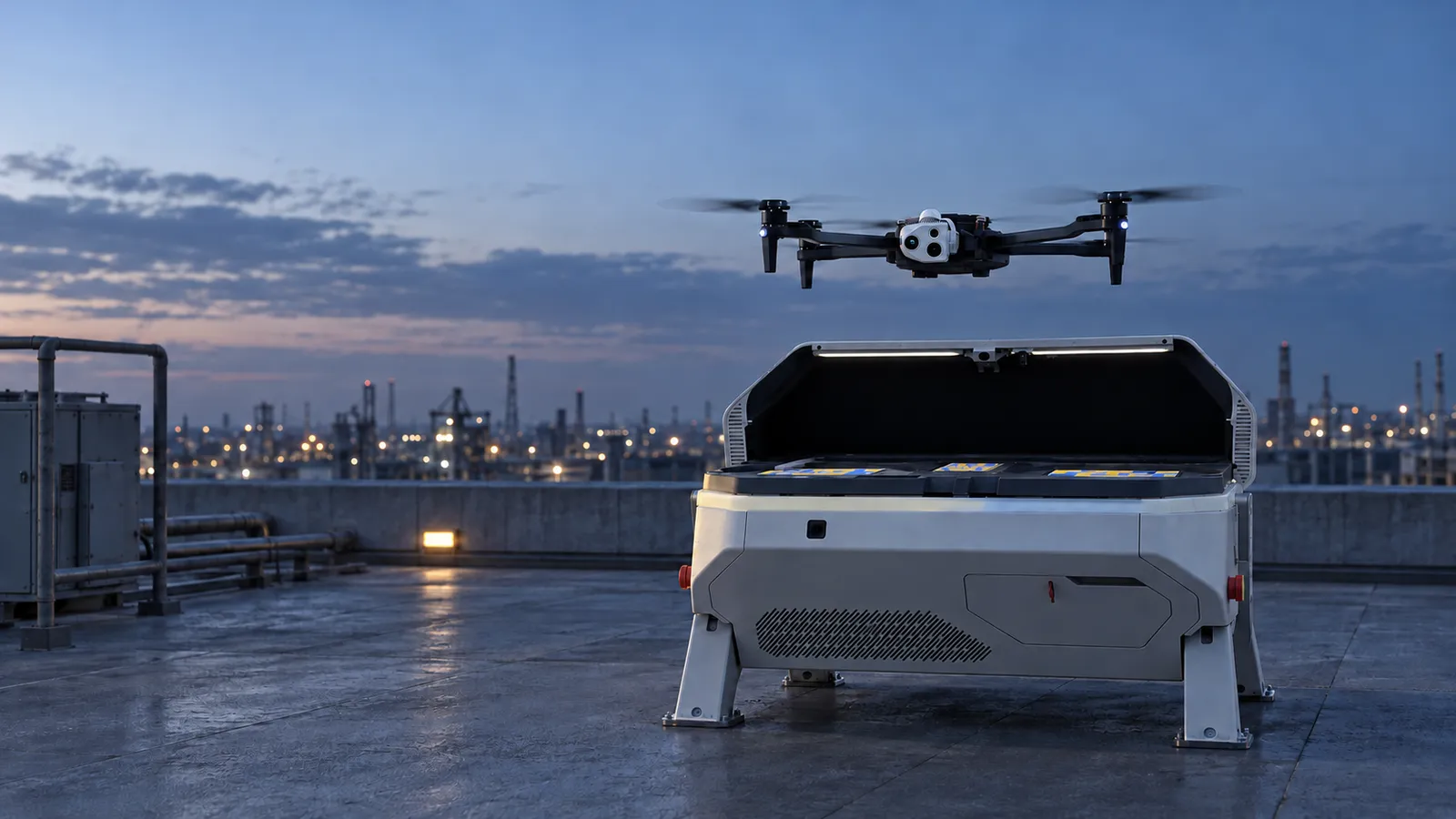
- Time to airborne
- 20 seconds
- Operating temperature
- -4°F to 122°F (-20°C to 50°C)
- Launch and land wind limit
- Up to 27 mph (12 m/s)
- Ingress protection
- IP56 (closed)
- Recharge
- About 35 min from 15% to 95% at 25°C (up to 73 min in extreme temperatures)
- Size and weight
- 34.1 x 37.7 x 55.5 in, 232 lb (with base)
- Power and network
- 100–240V AC (220V recommended below 0°C); 20 Mbps upload minimum, 100 Mbps recommended
- Compatible aircraft
- Skydio X10
Updated
The Skydio Dock for X10 is a weatherproof box that stores, charges and launches an X10, gets it airborne in about 20 seconds and syncs its data when it lands. It is on the Blue UAS Cleared List, which is why US agencies and utilities that cannot buy foreign-made docks look at it early. A dock does not fly itself into a useful program, though. Someone still has to approve each launch, watch the airspace, handle the call that changes mid-flight, and make sure the footage reaches the people who need it.
What the dock does, and what the remote pilot still does
The dock
The aircraft
The remote pilot
Dock-based flights are flown through Remote Flight Deck, the browser application included in Ops Center and in DFR, Asset and Security Command. The pilot sees live video, telemetry, the dock's weather readings and the airspace picture in one place.
Dock hives: coverage and continuity
Skydio calls a group of 2 to 6 docks at one site a hive. The point is not more drones in the air at once. It is continuity: while one X10 recharges, another is ready, and a long incident can be covered by launching a replacement before the active aircraft returns. Skydio's DFR FAQ describes exactly that swap, plus retasking one or several drones as a situation evolves.
Spacing and site
Handoffs
Deconfliction
One pilot, several docks: what the rules allow today
Skydio is direct about this. Its dock FAQ says the software has no limit on how many docks you can monitor and one operator can oversee several, but "FAA rules currently allow a remote pilot to control only one drone at a time", while pilots can prepare missions across docks in parallel. That matches 14 CFR 107.35, which bars one person from acting as remote pilot for more than one aircraft at once unless a waiver says otherwise.
So a remote operations center running Skydio docks today works like this. One pilot monitors a set of docks: health, weather, scheduled missions and alarms. When a launch happens, that aircraft has a pilot in command until it lands. A second launch elsewhere goes to a second pilot. The supervision ratio rises only when your approvals say it can. Staffing a 24/7 dock network is therefore a question of peak simultaneous flights, not of dock count.
A useful planning number for any dock program is the busiest hour of the week: how many launches overlap. That sets the minimum number of pilots on shift, regardless of how many docks you install.
Mission planning for docked flights
Docked flights come in three kinds, and each needs its own plan. Scheduled missions (a nightly perimeter patrol, a weekly substation thermal pass) are built once in the browser as Waypoint or Map Capture missions, with geofences and airspace boundaries set before takeoff. Triggered missions launch from an alarm, a dispatch system or a 911 call through Skydio's integrations, so the plan is a response template: where to fly first, what altitude, what to look at, and when to hand off to a human decision. On-demand flights are the pilot's own, launched to look at something specific. Programs can also schedule missions through the Cloud API, including running a template immediately on an online aircraft. Whatever the kind, every template should name its site, asset and expected outputs, because that is what the data will be filed under.
Weather and the go/no-go call
The dock and the aircraft have different limits, and the pilot has to know both. The technical specs list a launch and land wind limit of 27 mph and an X10 rain limit of 0.25 in/hr (light to moderate), while the dock itself tolerates heavy rain on standby and withstands winds up to 100 mph when bolted down. A dock that survives a storm is not a dock that can launch into one. The integrated weather sensors feed Ops Center or Skydio Command for exactly this decision. Good practice is a written go/no-go table per site, checked before each launch rather than judged from the video.
Connectivity: the dock's backhaul is the pilot's link
Skydio asks for at least 20 Mbps upload at each dock, 100 Mbps for faster media sync, over Cat6, 5G backhaul or Starlink. In flight, the X10 talks to the dock over Skydio Connect, and an External Radio placed up to 300 ft from the dock can extend coverage. With Connect Fusion, the aircraft blends point-to-point and 5G. For a remote pilot, every one of those hops adds delay and a point of failure, so the onboard autonomy handles close obstacles and the pilot works at the level of where to go and what to look at. Our latency guide covers why supervised control survives a delayed link when direct stick control does not.
Data delivery from a docked X10
Automatic sync
Integrations
API
Outputs
Dock or field-launched X10?
The same X10 can be flown remotely without a dock: a field crew launches it, and a remote pilot flies it through Ops Center. The dock earns its cost where flights repeat at one place (a substation, a campus, a city sector), where response time matters, and where nobody can be on site at 3 a.m. Field launches suit linear assets, one-off surveys and sites without power and network. Many programs run both. The dock's site work is real: 100–240V power, a Cat6 run in conduit, a level mount, and an installation Skydio says typically takes 1 to 3 days with a field technician on site, plus two days of training.
Regulation and the Blue UAS angle
As of October 2026, the facts we could verify:
Blue UAS
Foreign docks
BVLOS
The waiver sets the procedures: altitude limits, whether a visual observer is needed, how traffic is detected and what the pilot does about it. Some agencies, per Skydio, hold waivers that allow flight without visual observers. Where yours does not, the visual observer's position, radio protocol and handoff to the remote pilot belong in the site plan. None of this is legal advice.
What a good dock pilot does
How RoboPilots staffs Skydio docks
Your docks, aircraft and Skydio software stay yours. We train a dedicated group of Part 107 certified remote pilots on your docks, your sites and your waiver conditions before they fly live, and keep the same group on your program.
One-week trial
24/7 coverage
Procedures
Data
For the aircraft itself, see the Skydio X10 page. For the role, see remote drone pilot careers.
Interfaces, specs and sources
- Remote Flight Deck (browser)
- Ops Center
- DFR / Security / Asset Command
- Skydio Cloud API (docks, missions)
- Skydio Extend integrations
- Connect External Radio, 5G/LTE, Starlink
Availability: Sold in the US by Skydio, installed by Skydio field technicians. As of October 2026 the Dock for X10 is on the Blue UAS Cleared List (added July 2026, per Skydio).
Specs are the maker's published figures, checked on . RoboPilots is not affiliated with Skydio; product names are trademarks of their owners.
- Skydio Dock for X10 product page
- Skydio Dock for X10 technical specifications
- Skydio Dock for X10 FAQs
- Skydio DFR FAQs
- Skydio Ops Center
- Skydio Cloud API documentation
- Skydio: X10, Dock and R10 join the Blue UAS Cleared List (July 2026)
- DroneXL: DFR programs and FCC DA 26-758 (August 2026)
- 14 CFR 107.35, operation of multiple small UAS (LII)
- PickDrones: Part 108 BVLOS final rule at OIRA (September 2026)
Frequently asked questions
- What temperatures can the Skydio Dock operate in?
- Skydio rates the Dock for X10 from -4°F to 122°F (-20°C to 50°C). An internal HVAC system holds the aircraft at operating temperature, and Skydio recommends 220V power below freezing.
- How fast does the X10 launch from the dock?
- Skydio says the dock gets the X10 airborne in about 20 seconds, using an automated pre-flight sequence.
- Can several Skydio docks work together?
- Yes. Skydio calls a group of 2 to 6 docks at one site a hive. Hives give continuous coverage, because one aircraft can launch to take over before another returns to recharge.
- What connectivity does the Skydio Dock need?
- At least 20 Mbps upload, with 100 Mbps recommended, over Cat6, 5G backhaul or Starlink. A Skydio Connect External Radio can be placed up to 300 feet from the dock to extend aircraft coverage.
- Can the Skydio Dock fly BVLOS from day one?
- Only with FAA approval. Skydio markets BVLOS from the first flight, but its own DFR FAQ says any autonomous DFR operation beyond visual line of sight requires an FAA waiver, and it recommends starting the process early.
- Can one remote pilot fly several Skydio docks at once?
- One pilot can monitor several docks, but Skydio notes that FAA rules currently allow a remote pilot to control only one drone at a time unless a waiver allows more. Pilots can prepare missions across docks in parallel.