Robots · Drones
DJI Matrice 4 Series remote operations: flying a 4T or 4E from a browser without a dock
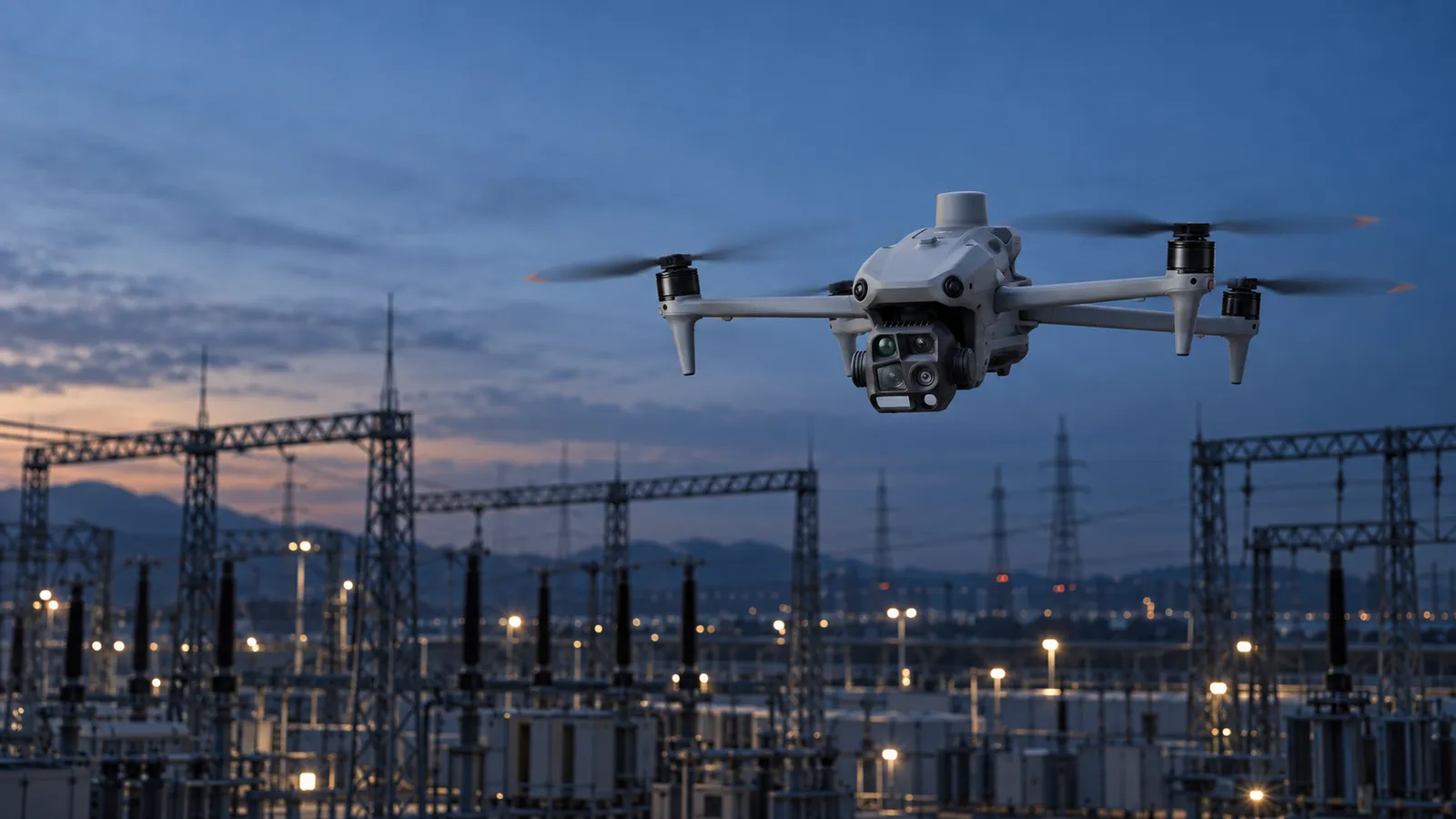
The Matrice 4T and 4E are DJI's compact enterprise aircraft for thermal response and mapping. With FlightHub 2 live control, a field technician can launch one and a pilot hundreds of miles away can fly the mission.
- Versions
- 4T (thermal, NIR light) and 4E (4/3 mapping camera)
- Takeoff weight
- 1219 g with standard propellers
- Max flight time
- 49 min (42 min hover), no wind
- Cameras
- 4E: 20 MP 4/3 wide; 4T: 48 MP wide plus 640 × 512 thermal; both: 48 MP 70 mm and 168 mm tele
- Laser rangefinder
- Up to 1800 m (20% reflectivity target)
- Video link
- O4 Enterprise; 1080p/30fps live view; 130 ms latency; 25 km max (FCC)
- RTK (fix)
- 1 cm + 1 ppm horizontal; 1.5 cm + 1 ppm vertical
- Operating temperature
- -10 to 40 °C; not waterproof
Updated
The Matrice 4 Series is DJI's compact enterprise line: the 4T for electricity, emergency response, public safety and forestry, the 4E for surveying, mapping, construction and mining. It weighs about 1.2 kg, flies up to 49 minutes, and carries a laser rangefinder on both versions. It is normally flown by a pilot standing next to it. What makes it relevant to remote operations is that DJI's FAQ confirms it supports FlightHub 2 live flight control, with aircraft and payload controlled at the same time. That lets you split the job: a technician on site handles the aircraft, and a remote pilot runs the flight.
Matrice 4T or 4E: pick by the data you need
Matrice 4T
Matrice 4E
Shared
How a remote pilot flies a Matrice 4 without a dock
The aircraft never talks to the cloud on its own. DJI's Cloud API architecture is explicit that a drone connects through a gateway, either a dock or a remote controller running DJI Pilot 2. For a handheld Matrice 4 that gateway is the DJI RC Plus 2 Enterprise in someone's hands on site. The chain looks like this:
Aircraft to controller
Controller to cloud
Cloud to remote pilot
Control is handed over, not shared. DJI's public Cloud API docs describe the remote control flow for controller-connected aircraft using the Mavic 3 Enterprise as the example: the cloud asks for authorization, the person holding the controller accepts it in DJI Pilot 2, and that person can take control back with the authority button. Expect the same pattern on the Matrice 4 and confirm it in your own workspace before the first live flight. DJI's FAQ is plain that the Matrice 4 does not support dual control, so there is never a second set of sticks. That makes the on-site person the immediate fallback and the remote pilot the one flying the mission, and the procedure has to say exactly when control moves between them.
The controller is the link. If the RC Plus 2 loses its internet connection, the remote pilot loses the aircraft; if its battery runs down (DJI quotes about 3.8 hours internal), so does everyone. Treat the controller as flight-critical equipment: charged, mounted somewhere it keeps a clean line to the aircraft, and on a cellular connection you have tested at that site.
A split-crew flight, step by step
1. Site check
2. Preflight
3. Launch
4. Mission
5. Recovery
What works over the link, and what does not
Add the 130 ms radio hop to the controller's cellular uplink, the cloud and the pilot's own connection, and the remote pilot is always watching slightly old video. Our latency guide covers budgets by task. For the Matrice 4 specifically:
Good fit
Poor fit
Weather
Running a Matrice 4 fleet from a remote operations center
One-to-many supervision
Mission planning
Takeover
Airspace and visual observers
Data delivery
What a good Matrice 4 pilot does differently
Matrice 4, Matrice 4D or Mavic 3 Enterprise?
If the same site gets flown on a schedule, the docked version is usually the better economics: the Matrice 4D and 4TD live in a DJI Dock 3 and need nobody on site at all. The handheld 4T and 4E make sense for response work that moves around, sites too varied or too temporary for a dock, and programs that cannot or do not want to buy docks now that dock sales face the FCC proposal. Mixed fleets with the older Mavic 3 Enterprise should plan for two sets of controllers: DJI notes the RC Plus 2 does not support the Mavic 3 Enterprise Series.
US regulatory notes, as of October 2026
FCC
Tariffs
BVLOS
This summarizes public reporting and regulation text; it is not legal advice.
How RoboPilots runs Matrice 4 programs
Your aircraft, controllers and FlightHub 2 workspace stay yours. We train a dedicated group of Part 107 remote pilots on your aircraft, your sites and your procedures, including the handover routine with your field technicians, before they fly a live mission, and they work inside the approvals your program holds.
One-week trial
Coverage
Data
Interfaces, specs and sources
- DJI FlightHub 2 live flight control
- DJI Pilot 2 on RC Plus 2 Enterprise
- DJI Cloud API
- Mobile SDK
- Payload SDK
- 4G via DJI Cellular Dongle 2
Availability: As of October 2026 the Matrice 4 Series is still sold in the US: DJI showed it at Commercial UAV Expo 2026, and the products there were authorized by the FCC before the 22 December 2025 Covered List action. The thermal 4T falls in a category the FCC's proposed DA 26-758 would cut off after a wind-down; the proposal was not final and would not ground aircraft already owned. DJI says the aircraft cannot be used in every country, so check with a dealer.
Specs are the maker's published figures, checked on . RoboPilots is not affiliated with DJI; product names are trademarks of their owners.
- DJI Matrice 4 Series product page
- DJI Matrice 4 Series FAQ
- DJI Matrice 4 Series specifications
- DJI FlightHub 2 FAQ
- DJI Cloud API: product architecture (GitHub docs)
- DJI Cloud API: remote control via DJI Pilot 2 (GitHub docs)
- 14 CFR §107.31, visual line of sight (Cornell LII)
- DroneXL: DJI at Commercial UAV Expo, Covered List and tariffs (Sep 2026)
- DroneXL: DJI's DFR dock playbook and the FCC proposal (Aug 2026)
- PickDrones: Part 108 BVLOS rule at OIRA (Sep 2026)
Frequently asked questions
- What is the difference between the Matrice 4T and 4E?
- The 4T adds a 640 × 512 thermal camera and an NIR auxiliary light and uses a 48 MP wide camera; it is aimed at public safety, utilities and forestry. The 4E has a 20 MP 4/3 wide camera with a mechanical shutter and no thermal, and is DJI's choice for precise mapping with RTK.
- Does the Matrice 4 support FlightHub 2 live flight control?
- Yes. DJI's FAQ says the Matrice 4 Series supports FlightHub 2, including live flight control with the aircraft and payload controlled at the same time. The aircraft connects through the RC Plus 2 Enterprise, which needs an internet connection.
- Does the Matrice 4 support dual control?
- No. DJI's FAQ says dual control is not supported. When a remote pilot flies through FlightHub 2, control is authorized from the on-site controller, and the person holding it can take control back.
- Can the Matrice 4E map without ground control points?
- DJI says the 4E's wide-angle camera supports mapping without GCPs, while the tele cameras do not. DJI also notes that RTK on the 4T does not guarantee mapping precision.
- Does the Matrice 4 come with the 4G module?
- No. DJI's FAQ says the enhanced 4G module is not included as standard. 4G uses the DJI Cellular Dongle 2, and network RTK can also run over the controller's Wi-Fi.
- Is the Matrice 4T still sold in the US?
- As of October 2026, yes, because it was authorized before the FCC's December 2025 Covered List action. A proposed FCC notice could end sales of thermal-equipped foreign drones after a wind-down, but it was not final and would not ground owned aircraft.