Robots · Drones
DJI Mavic 3 Enterprise remote operations: running a small-drone fleet across dozens of sites
The Mavic 3E and 3T fold into a backpack and fly 45 minutes. Programs that run them across many sites live or die on consistency. Here is how a remote operations desk keeps a scattered fleet producing the same data.
- Versions
- 3E (mapping), 3T (thermal), 3T Advanced (upgraded thermal)
- Max takeoff weight
- 1050 g
- Max flight time
- 45 min (38 min hover), standard battery
- Cameras
- 3E: 20 MP 4/3 wide, mechanical shutter; 3T: 48 MP wide plus 640 × 512 thermal; both: 12 MP tele, 56× hybrid zoom
- Video link
- O3 Enterprise; about 200 ms latency; 1080p/30fps; 15 km max (FCC)
- RTK (with module)
- 1 cm + 1 ppm horizontal; 1.5 cm + 1 ppm vertical
- Operating temperature
- -10 to 40 °C; not waterproof
Updated
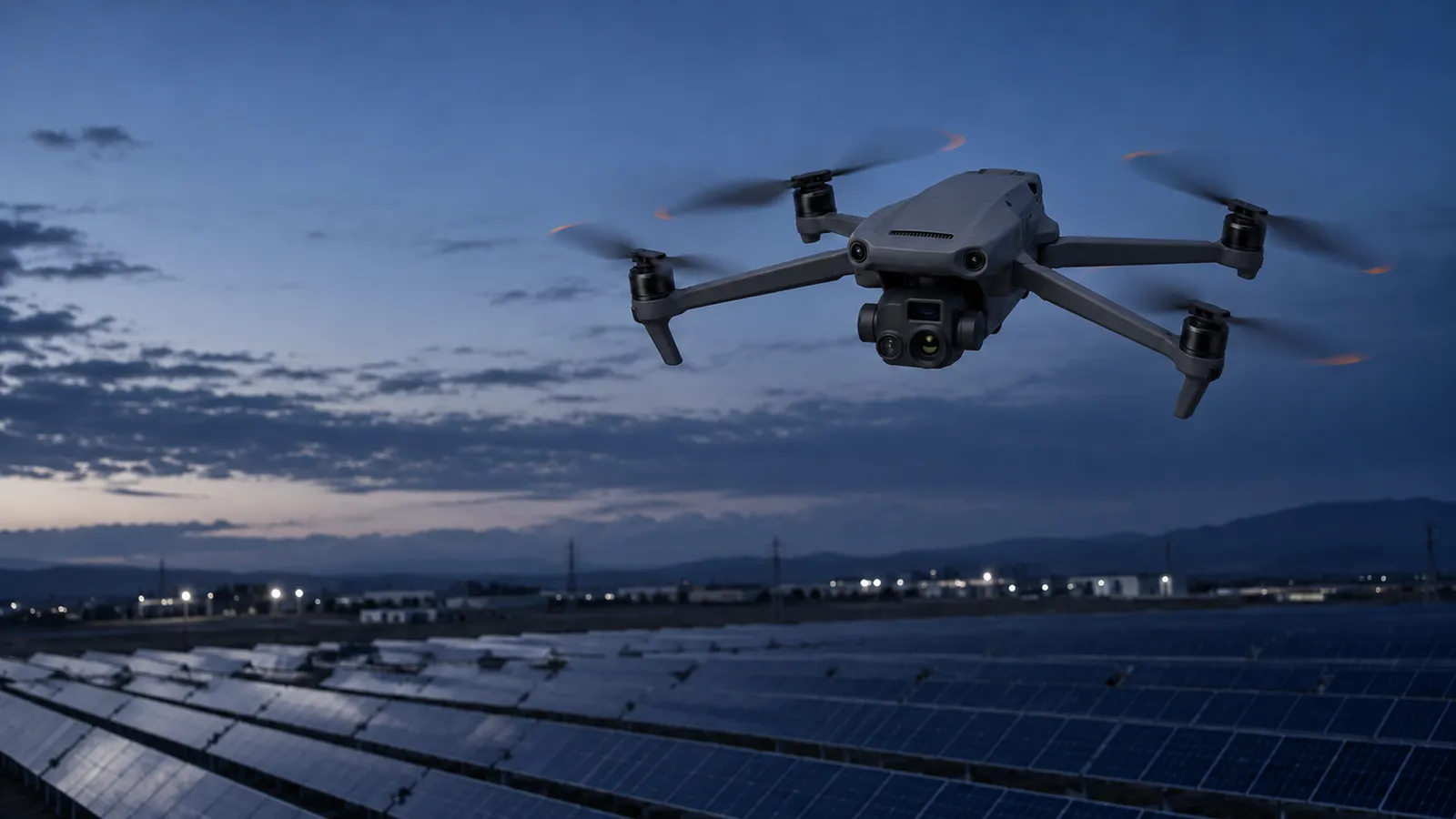
The DJI Mavic 3 Enterprise is a 1,050 g folding drone with a 45-minute flight time, sold in three versions: the 3E with a 20 MP 4/3 mechanical-shutter camera for mapping, the 3T with a 640 × 512 thermal camera, and the 3T Advanced with an upgraded thermal module. It is small enough to issue to field staff at many sites, and when a program does that, the aircraft is the easy part. The hard part is getting dozens of people at dozens of sites to fly the same missions the same way, and to hand in data that can be compared month to month.
Remote operations on an aircraft without a dock
The Mavic 3 Enterprise flies with the DJI RC Pro Enterprise running DJI Pilot 2, and the controller is its gateway to the cloud. DJI's FAQ confirms FlightHub 2 and Mobile SDK support. The Cloud API lists the Mavic 3 Enterprise Series with the RC Pro and Pilot 2 as a supported combination, and this aircraft is notable in DJI's public docs for one reason: it is the model named in the Cloud API's pilot-side remote control feature.
In that remote control flow, a web platform asks the controller to authorize cloud control, the person holding it accepts in Pilot 2, and the platform can then send camera, gimbal and payload commands, look at a point, capture, record and take infrared temperature readings, while OSD and obstacle-sensing data stream back. Flight control commands require flight control authority, and the on-site user can take authority back with a button at any time. DJI's docs note that on this model there is no separate flight and payload authority: whoever has control has both.
No dual control. DJI's FAQ says the Mavic 3 Enterprise does not support dual control, so there is one controller and one person holding it. When a remote specialist operates through the cloud, the person on site is the fallback, and the handover is a procedure, not a second set of sticks.
What the link supports
O3 Enterprise carries 1080p at 30 fps to the controller with about 200 ms latency and up to 15 km range under FCC rules in unobstructed conditions. Anything remote adds the controller's uplink, the cloud and the operator's connection on top. At that total, a remote operator can comfortably run the camera (framing, zoom, thermal readings) and supervise planned routes, but close manual flying from a browser is a poor idea. Our latency guide explains why, by task. A sensible split on this aircraft: the person on site flies or launches the route, and the remote specialist runs the camera and checks the data. Where a site has weak cellular coverage, the remote role falls back to planning before the flight and QA after it, which still catches most problems before anyone drives home.
Mapping with the 3E, inspection with the 3T
3E mapping
3T inspection
RTK sources
Top-port trade-off
Data: making a scattered fleet produce one dataset
Through the Cloud API, Pilot 2 can upload photos and videos from the controller to your object storage, automatically or manually, with OSS and S3 supported, according to DJI's media management docs. That makes the difference between data that arrives when someone remembers to copy an SD card and data that lands, tagged, the same day.
Per-site templates
Consistent tagging
Same-day QA
Outputs
Standardizing a multi-site program
Small-drone programs usually fail quietly: nothing crashes, but the data from site 14 never quite matches the data from site 3. The fixes are boring and they work.
A site pack for every location
One firmware baseline
Battery and maintenance logs
Incident and near-miss reporting
Refresher flights
Running a Mavic 3 Enterprise fleet from a remote operations center
One-to-many supervision
Mission planning
Takeover
Airspace and visual observers
Data delivery
What a good Mavic 3 Enterprise operator does differently
Mavic 3 Enterprise vs Matrice 4 Series
The Matrice 4 Series is the next step up in the same size class: per DJI's Matrice 4 specs, up to 49 minutes, O4 Enterprise at 130 ms latency and 25 km (FCC), three cameras including a 70 mm medium tele, and an 1800 m laser rangefinder. The Matrice 4 flies with the RC Plus 2 Enterprise, the Mavic 3 Enterprise with the RC Pro Enterprise, so mixed fleets carry two controller types. For pure mapping or roof thermal at many sites, a Mavic 3 fleet you already own still does the job; the case for upgrading is the rangefinder, the extra camera and the faster link.
US regulatory notes, as of October 2026
FCC
Proposed sales cut-off
Tariffs
BVLOS
This summarizes public sources, not legal advice.
How RoboPilots supports Mavic 3 Enterprise fleets
Your aircraft and workspace stay yours. We train a dedicated group of certified remote pilots on your aircraft, your sites and your data standards, and they run mission planning, remote camera work and QA from an operations desk, inside the approvals your program holds.
One-week trial
Coverage
Data
Interfaces, specs and sources
- DJI Pilot 2 on DJI RC Pro Enterprise
- DJI FlightHub 2
- DJI Cloud API (remote control documented)
- Mobile SDK
- PSDK top port (RTK, speaker, third-party)
Availability: Mavic 3 Enterprise aircraft already in service keep flying: the FCC's 22 December 2025 Covered List action does not ground owned drones, and FCC notice DA 26-454 keeps firmware updates coming to authorized DJI devices until at least 1 January 2029. Check current US availability of new units with a dealer. The thermal 3T falls in a category the proposed DA 26-758 would cut off after a wind-down; it was not final as of October 2026.
Specs are the maker's published figures, checked on . RoboPilots is not affiliated with DJI; product names are trademarks of their owners.
- DJI Mavic 3 Enterprise product page
- DJI Mavic 3 Enterprise FAQ
- DJI Mavic 3 Enterprise specifications
- DJI Cloud API: supported models (GitHub docs)
- DJI Cloud API: remote control via DJI Pilot 2 (GitHub docs)
- DJI Cloud API: Pilot 2 media management (GitHub docs)
- DJI Matrice 4 Series specifications
- DroneXL: DJI at Commercial UAV Expo, Covered List and tariffs (Sep 2026)
- DroneDJ: FCC extends DJI and Autel firmware waiver to 2029 (May 2026)
- PickDrones: Part 108 BVLOS rule at OIRA (Sep 2026)
Frequently asked questions
- What is the difference between the Mavic 3E, 3T and 3T Advanced?
- The 3E has a 20 MP 4/3 wide camera with a mechanical shutter and a tele camera, for mapping. The 3T has a 48 MP wide camera, a tele and a thermal camera. The 3T Advanced has an upgraded thermal module.
- Can the Mavic 3E survey without ground control points?
- Yes, with the RTK module fitted. DJI says the 3E's wide camera supports surveying without GCPs; its tele camera does not. RTK on the 3T cannot guarantee positioning accuracy.
- Does the Mavic 3 Enterprise support FlightHub 2?
- Yes. DJI's FAQ confirms FlightHub 2 support, and the Cloud API lists the Mavic 3 Enterprise with the RC Pro Enterprise and DJI Pilot 2 as a supported combination.
- Does the Mavic 3 Enterprise support dual control?
- No. DJI's FAQ says dual control is not supported. Remote cloud control is authorized from the single on-site controller, which can take control back.
- Is the Mavic 3 Enterprise waterproof?
- No. DJI says it is not waterproof, and it is rated for -10 to 40 °C.
- Can the speaker and RTK module be used at the same time?
- No. Both use the top port, so you fit one or the other for a given mission.