Robots · Drones
DJI Matrice 400 remote operations: power-line-grade sensing for supervised corridor work
The Matrice 400 is DJI's heavy enterprise airframe that can be flown from a browser as well as from a controller. Here is what that changes for corridor inspection, LiDAR mapping and the people who fly them.
- Max takeoff weight
- 15.8 kg
- Max payload
- 6 kg (screw-locked third gimbal connector, sea level)
- Max flight time
- 59 min with H30T; about 53 min with AP100 parachute
- Protection and temperature
- IP55; -20 to 50 °C
- Video link
- O4 Enterprise Enhanced, 40 km max (FCC); 3-channel 1080p/30fps live view
- Obstacle sensing
- Rotating LiDAR, upper 3D ToF LiDAR, 6-direction mmWave radar, fisheye vision
- Airspace awareness
- ADS-B In receiver, up to 20 km
- Battery
- TB100, 977 Wh, hot-swappable; about 45 min fast charge at 220 V
Updated
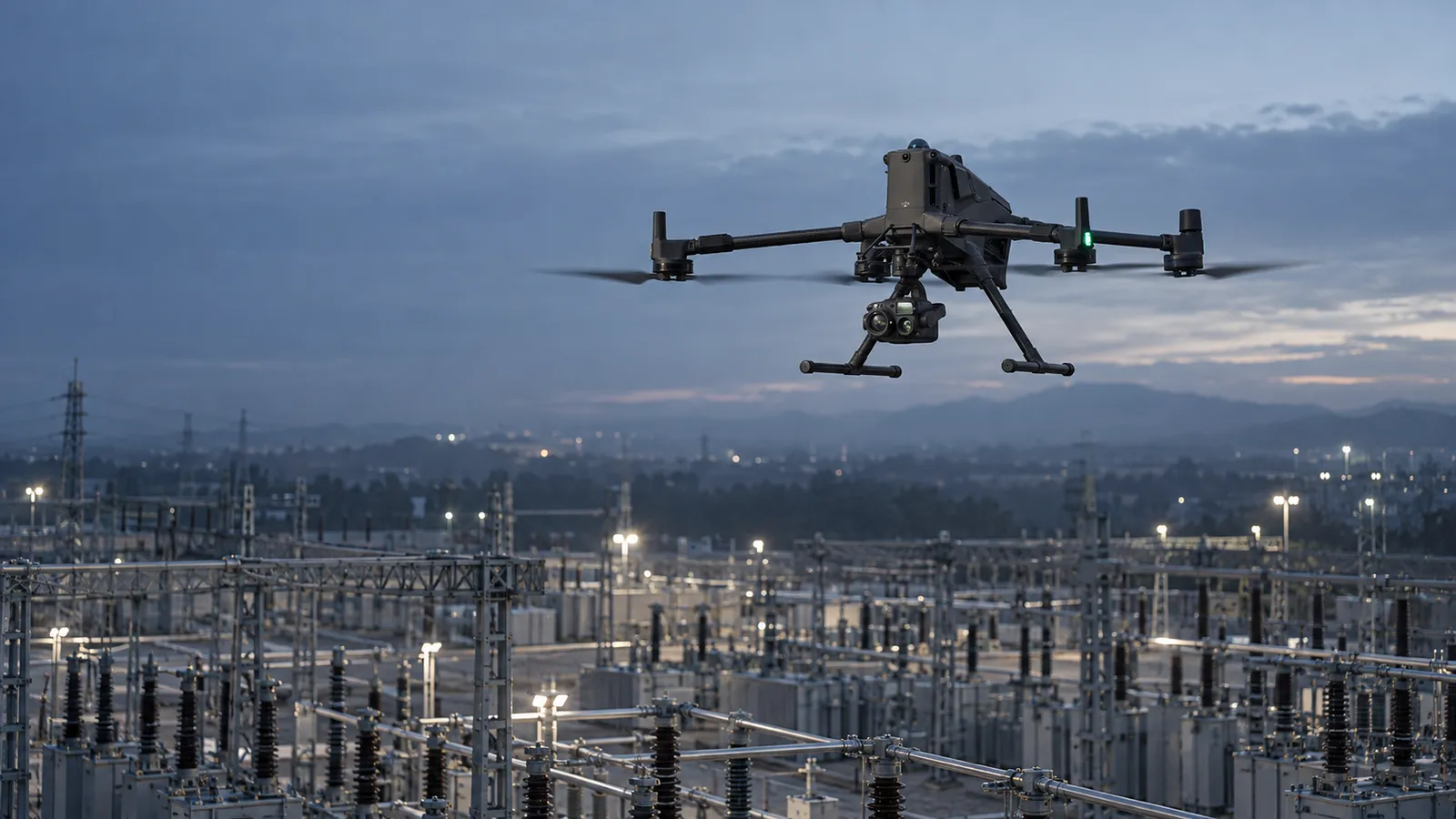
The DJI Matrice 400 is DJI's long-endurance heavy enterprise platform: 15.8 kg at takeoff, up to 6 kg of payload, 59 minutes with an H30T, and a sensing stack DJI describes as "power-line-level obstacle sensing". For remote operations the more important line is in its FAQ: through DJI FlightHub 2 it supports remote control of flights, gimbal cameras, PSDK accessories and route functions. It also supports dual control, two 4G modules and airborne relay through a second Matrice 400. That combination makes it the DJI aircraft best suited to a remote pilot flying long linear work, a power line, a pipeline or a rail corridor, while a crew on the ground handles launch, batteries and recovery.
Why the sensing stack matters for corridor work
Wires are what make corridor inspection dangerous. They are thin, hard to see on compressed video, and exactly where the aircraft needs to be. The Matrice 400 specs list a horizontal rotating LiDAR rated to about 35 m for 21.6 mm steel-core aluminum conductor, six-direction mmWave radar rated to 36 m for 12 mm wire and 50 m for 21.6 mm wire, an upper 3D ToF LiDAR, a downward 3D infrared sensor and fisheye binocular vision. The FAQ adds that power-line sensing works at up to 25 m/s facing a main line and up to 17 m/s with both main and distribution lines present.
What it gives a remote pilot
What it does not do
What the crew maintains
Regional caveat
How a Matrice 400 is flown remotely
There is no DJI dock for the Matrice 400 on its spec sheet, so remote flight runs through the controller. DJI's Cloud API architecture connects an aircraft to the cloud through a gateway, here the RC Plus 2 Enterprise Enhanced running DJI Pilot 2, and from there to FlightHub 2 or your own platform. In practice that gives three ways to split the job:
Remote pilot, local crew
Dual control
Supervised routes
Decide who holds authority at every phase. With FlightHub 2 control, dual control and a local controller all possible on the same aircraft, the procedure has to name one pilot in command and say exactly how and when control moves. Ambiguity about who is flying is the failure mode, not the hardware.
Links: radio, 4G and relay
O4 Enterprise Enhanced
Dual 4G
Airborne relay
Delay on a browser-flown aircraft is the sum of the radio hop, the cellular uplink, the cloud and the pilot's own connection. That is acceptable for wayline supervision and slow manual inspection at standoff distance, and not for close work around hardware. Our latency guide covers budgets by task.
Payloads and data
DJI lists the Zenmuse L3, H30, H30T, L2 and P1 as compatible gimbal cameras, plus the AP100 parachute, Zenmuse S1 and V1 accessories, Manifold 3 and the Cellular Dongle 2. Four E-Port V2 ports provide 120 W each, and with the E-Port HUB the aircraft supports up to seven payloads in total. Manifold 3 adds onboard compute for custom processing, and FlightHub 2 supports third-party algorithms on the Matrice 400.
Corridor LiDAR
Thermal and zoom
Photogrammetry
Delivery
Other features that change the remote job
DJI's product page also lists Smart Detection paired with visible and thermal imaging, AR projection, and ship-based takeoff and landing, which matters for offshore and coastal work where the launch point moves. There is no DJI dock for the M400, but the FAQ mentions a TB100C tethered battery used with an ecosystem partner's drone dock, so docked or tethered setups exist outside DJI's own line. Each of these changes the checklist and the takeover plan, and each should be trained on the customer's own aircraft before it is used on a live mission.
Running a Matrice 400 program from a remote operations center
One-to-many supervision
Mission planning
Takeover
Airspace and visual observers
Data delivery
What a good Matrice 400 pilot does differently
Matrice 400 vs Matrice 350 RTK
Against the Matrice 350 RTK (9.2 kg takeoff, 55 minutes without payload, O3 Enterprise to 20 km FCC), the M400 carries far more, flies longer with a payload, and adds LiDAR and radar sensing, ADS-B In, dual 4G and relay. The two do not share accessories, and the M400's RC Plus 2 Enterprise Enhanced does not support the M350. The M350 remains a capable on-site aircraft; the M400 is the one built for a remote pilot.
US regulatory notes, as of October 2026
FCC
Proposed sales cut-off
Tariffs
BVLOS
This summarizes public sources and regulation text, not legal advice.
How RoboPilots runs Matrice 400 programs
Your aircraft and FlightHub 2 workspace stay yours. We train a dedicated group of Part 107 remote pilots on your Matrice 400 configuration, corridors and procedures, including the handover routine with your ground crews, before they fly a live mission, and they work inside your approvals.
One-week trial
Coverage
Data
Interfaces, specs and sources
- DJI FlightHub 2 remote control
- DJI Pilot 2 on RC Plus 2 Enterprise Enhanced
- DJI Cloud API
- Payload SDK and E-Port V2
- Mobile SDK
- Manifold 3 onboard computer
- Dual 4G via DJI Cellular Dongle 2
Availability: As of October 2026 the Matrice 400 is still sold in the US: it was authorized by the FCC before the 22 December 2025 Covered List action and DJI showed it at Commercial UAV Expo 2026. Configurations with LiDAR or thermal payloads fall in categories the FCC's proposed DA 26-758 would cut off after a 180-day wind-down; the proposal was not final and would not ground owned aircraft.
Specs are the maker's published figures, checked on . RoboPilots is not affiliated with DJI; product names are trademarks of their owners.
- DJI Matrice 400 product page
- DJI Matrice 400 specifications
- DJI Matrice 400 FAQ
- DJI FlightHub 2 FAQ
- DJI Cloud API: product architecture (GitHub docs)
- DJI Matrice 350 RTK specifications
- 14 CFR §107.205, regulations subject to waiver (Cornell LII)
- DroneXL: DJI at Commercial UAV Expo, Covered List and tariffs (Sep 2026)
- DroneDJ: FCC extends DJI and Autel firmware waiver to 2029 (May 2026)
- PickDrones: Part 108 BVLOS rule at OIRA (Sep 2026)
Frequently asked questions
- Can the Matrice 400 be flown remotely through FlightHub 2?
- Yes. DJI's FAQ says it supports remote control of flights, gimbal cameras, PSDK accessories and route-related functions through FlightHub 2. The aircraft connects through its RC Plus 2 Enterprise Enhanced, which needs an internet link.
- What is the Matrice 400's maximum payload and flight time?
- DJI lists a 6 kg maximum payload on the screw-locked third gimbal connector at sea level, and up to 59 minutes of flight with an H30T. With the AP100 parachute fitted, flight time is about 53 minutes.
- Does the Matrice 400 support dual control?
- Yes, DJI's FAQ confirms dual control. It also supports two enhanced 4G modules and onboard relay of one additional Matrice 400.
- Can the Matrice 400 hot-swap batteries?
- Yes. It uses a single TB100 battery, and a built-in capacitor keeps essential components powered during a swap. If the swap finishes within 45 seconds, the aircraft resumes operation quickly.
- Is the Matrice 400 compatible with Matrice 350 accessories?
- No. DJI says Matrice 400 and Matrice 350 accessories are not compatible with each other, and the M400's RC Plus 2 Enterprise Enhanced does not support the M350 RTK.
- Is the Matrice 400 available in the US?
- As of October 2026, yes. It was authorized before the FCC's December 2025 Covered List action. A proposed FCC notice could end sales of foreign LiDAR and thermal configurations after a wind-down, but it was not final.