Robots · Drones
DJI Matrice 350 RTK remote operations: running LiDAR and survey crews with a remote operations desk
The M350 RTK is a heavy LiDAR and inspection airframe flown by a crew on site. The remote side is mission planning, live supervision and data. Here is how to split the work.
- Max takeoff weight
- 9.2 kg
- Max flight time
- 55 min (no payload, DJI test)
- Payloads
- Up to 3 at once: Zenmuse H30/H30T, L2, P1, L1, H20 series, PSDK third-party
- Protection and temperature
- IP55; -20 to 50 °C
- Wind resistance
- 12 m/s
- Video link
- DJI O3 Enterprise, 20 km max (FCC); 1080p/30fps night-vision FPV camera
- RTK (fix)
- 1 cm + 1 ppm horizontal; 1.5 cm + 1 ppm vertical
- Battery
- TB65, 263.2 Wh, 400 cycles; TB60 compatible
Updated
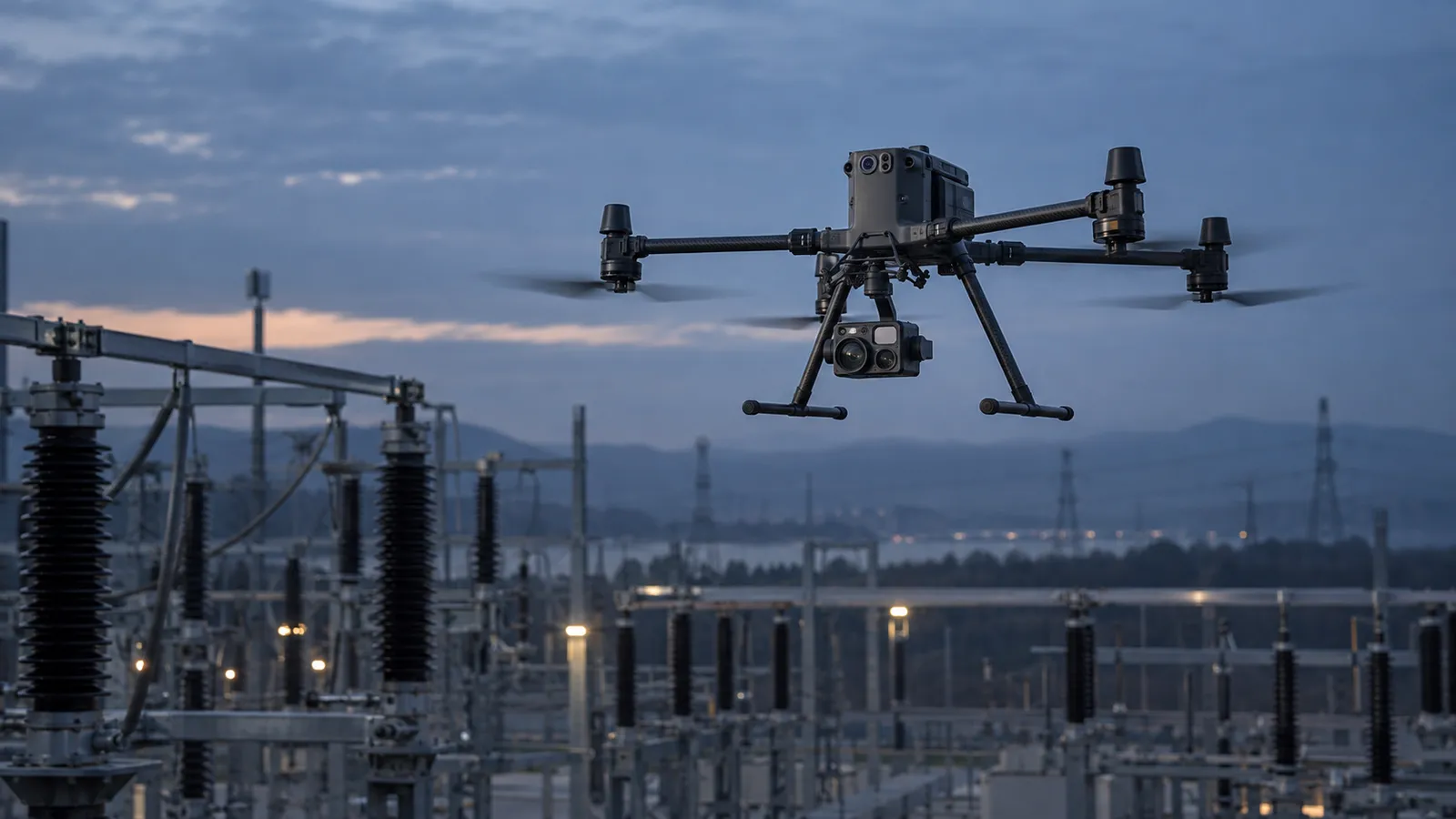
The DJI Matrice 350 RTK is DJI's heavy multi-payload airframe for LiDAR, photogrammetry and thermal inspection: 9.2 kg at takeoff, up to 55 minutes in the air without payload, IP55, and room for up to three payloads at once. It is not a docked aircraft. Somebody has to drive it to site, set up RTK, swap batteries and stand next to it. That is exactly why programs that run many M350s struggle to scale: every project needs a qualified crew, and the expertise that makes the data good (flight planning, payload settings, QA) is spread thin across them.
A remote operations desk does not replace the field crew on an M350. It takes the parts of the job that do not need to be on site and does them once, consistently, for every crew.
What can actually be done remotely on an M350
The aircraft is flown through DJI Pilot 2 on the DJI RC Plus. In DJI's Cloud API, the M350 RTK is a supported aircraft when connected through the RC Plus and Pilot 2, with H20-series and H30-series payloads listed. The controller is the gateway: it logs into FlightHub 2 or your own platform and reports the aircraft and payload. The Pilot 2 function set in the Cloud API includes map elements, situational awareness, live streaming, a media library, a route library and device management.
Mission planning
Live supervision
Situational awareness
Data intake
What we could not confirm: DJI's public documentation does not state that FlightHub 2 live flight control (a remote pilot flying the aircraft from a browser) works on the M350 RTK. DJI does confirm it on the Matrice 400. Plan M350 programs with the pilot in command on site, and treat the remote desk as planning, supervision and data.
Multi-payload missions and their failure modes
The M350 FAQ lists the Zenmuse H30, H30T, L2, H20N, L1, P1, H20 and H20T, plus third-party payloads certified on the Payload SDK, and supports up to three at once: one upward gimbal and two downward. Max payload is 960 g in the single-gimbal damper configuration. Combinations such as LiDAR plus a thermal camera let one flight collect what used to take two, but they also multiply what can go wrong:
Endurance
Settings drift
Third-party payloads
RTK, batteries and the logistics a crew lives with
RTK
Batteries
Cold
Controllers
Rain
Running an M350 program with a remote operations desk
One-to-many supervision
Mission planning
Takeover
Airspace and visual observers
Data delivery
Latency matters less here, and that is the point
Because the M350's pilot in command is on site with the O3 Enterprise link, the remote desk is never in the control loop. Its video arrives over the controller's Wi-Fi or cellular uplink, then the cloud, then the specialist's own connection, and a second or so of delay is fine for what it is doing: checking framing, reading a thermal signature, confirming coverage. That makes the M350 one of the easiest aircraft to add remote support to, even from another time zone and over a modest site connection. The trade-off is that decisions travel by voice, so the call protocol has to be short and unambiguous. Our latency guide explains where delay starts to matter for direct control.
What a good M350 crew and remote specialist do differently
Matrice 350 RTK vs Matrice 400
The Matrice 400 is DJI's other heavy platform, and the bigger change for remote work. DJI's M400 specs list 59 minutes with an H30T, a 6 kg max payload, O4 Enterprise Enhanced transmission to 40 km (FCC), rotating LiDAR and mmWave radar for power-line sensing, and an ADS-B In receiver. Its FAQ confirms FlightHub 2 remote control of flight, gimbal and PSDK accessories, plus dual control, hot-swap batteries and two 4G modules. The two platforms do not share accessories, and the M400's RC Plus 2 Enterprise Enhanced does not support the M350. If your program wants remote pilots flying rather than supervising, the M400 is the aircraft that supports it; if your M350 fleet is paid for and doing the job, a remote desk gets more out of it now.
US regulatory notes, as of October 2026
FCC
Proposed sales cut-off
Tariffs
BVLOS
This summarizes public sources, not legal advice.
How RoboPilots supports M350 programs
Your aircraft, payloads and crews stay yours. We train a dedicated group of certified pilots on your M350 configuration, payloads, sites and data standards, and they work from a remote operations desk on planning, live supervision and data QA, inside the approvals your program holds.
One-week trial
Coverage
Data
For background on how remote operations services are structured, see our guide to robot teleoperation as a service.
Interfaces, specs and sources
- DJI Pilot 2 on DJI RC Plus
- DJI Cloud API (via RC Plus)
- DJI FlightHub 2
- Payload SDK V3+ (E-Port)
- Mobile SDK
- D-RTK 2 or NTRIP network RTK
Availability: The FCC's Covered List action of 22 December 2025 blocks new authorizations for foreign-made drones but does not ground owned aircraft, and previously authorized models can still be imported and sold; check current M350 stock with a dealer. DJI devices keep receiving firmware updates until at least 1 January 2029 under FCC notice DA 26-454.
Specs are the maker's published figures, checked on . RoboPilots is not affiliated with DJI; product names are trademarks of their owners.
- DJI Matrice 350 RTK product page
- DJI Matrice 350 RTK FAQ
- DJI Matrice 350 RTK specifications
- DJI Cloud API: supported models (GitHub docs)
- DJI Cloud API: product architecture (GitHub docs)
- DJI Matrice 400 specifications
- DJI Matrice 400 FAQ
- DroneXL: DJI at Commercial UAV Expo, Covered List and tariffs (Sep 2026)
- DroneDJ: FCC extends DJI and Autel firmware waiver to 2029 (May 2026)
- PickDrones: Part 108 BVLOS rule at OIRA (Sep 2026)
Frequently asked questions
- Which payloads are compatible with the Matrice 350 RTK, and how many at once?
- DJI lists the Zenmuse H30, H30T, L2, H20N, L1, P1, H20 and H20T, plus third-party Payload SDK payloads. Up to three can be mounted at once: one upward gimbal and two downward.
- Is the Matrice 350 RTK compatible with the M300 RTK controller?
- No. The M350 uses the DJI RC Plus. An RC Plus updated to v01.02.04.40 or later can also link to the M300 RTK and M30 Series.
- Does the Matrice 350 RTK support TB60 batteries?
- Yes, but only two can be used at once, and TB60 and TB65 batteries must not be mixed.
- How does the M350 get RTK corrections?
- From a D-RTK 2 mobile station connected through DJI Pilot 2, or from network RTK (NTRIP) over the controller's Wi-Fi hotspot. One D-RTK 2 can serve multiple M350 aircraft.
- Can the Matrice 350 RTK be flown remotely from FlightHub 2?
- DJI's public documentation we reviewed does not confirm live flight control for the M350. It connects to the cloud through the RC Plus for live streaming, routes and media. DJI does confirm FlightHub 2 remote control on the Matrice 400.
- Which SDKs does the Matrice 350 RTK support?
- DJI lists the Payload SDK, Mobile SDK and Cloud API. Its E-Port requires Payload SDK V3 or later and is not compatible with the Onboard SDK.