Robots · Drones
DJI Dock 3 remote operations: multi-dock and vehicle-mounted DFR from one operations center
Dock 3 puts a Matrice 4D or 4TD on a rooftop or a truck and the pilot somewhere else. This is how the remote side actually works, what the link allows, and what changes for US owners in 2026.
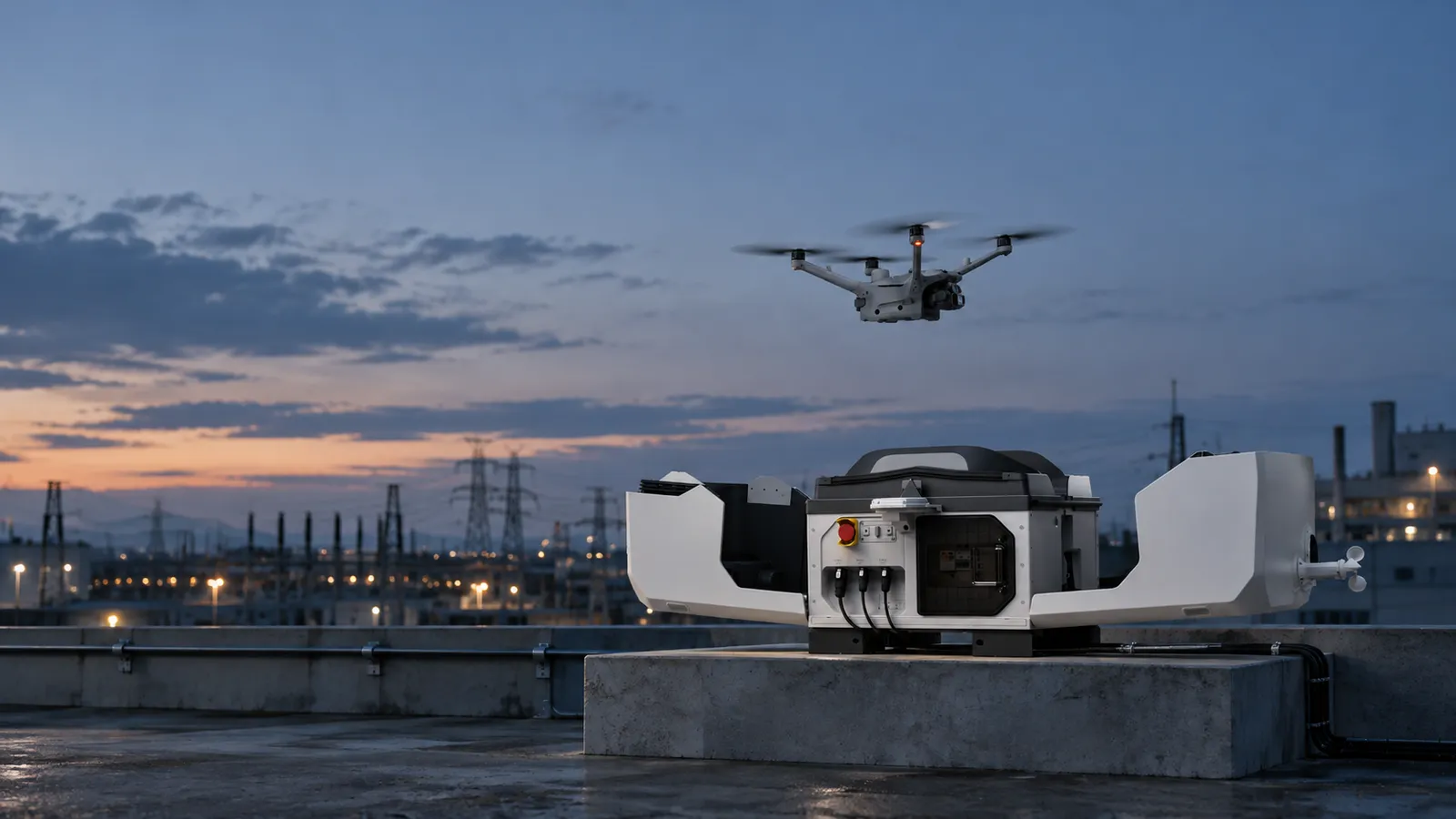
- Aircraft
- Matrice 4D or Matrice 4TD (thermal), one per dock
- Aircraft flight time
- Up to 54 min (DJI lab test)
- Max operating radius
- 10 km (DJI test conditions, 15% reserve)
- Charging
- About 27 min, 15% to 95%
- Weather limits
- Wind 12 m/s; rain 2 mm/h; dock -30 to 50 °C
- Protection
- Dock IP56; aircraft IP55
- Video link
- DJI O4+ Enterprise; about 100 ms aircraft to dock; 1080p/30fps live view in FlightHub 2
- Dock weight and power
- 55 kg; 100 to 240 V AC, max 800 W; backup battery over 4 h
Updated
DJI Dock 3 is the dock behind most of the large US drone-as-first-responder (DFR) and security programs built in 2025 and 2026. It houses a Matrice 4D or 4TD, charges it between flights, and launches it on a schedule, on an alarm or on a dispatcher's click. Nobody on site touches the aircraft. That is the point, and it is also the staffing problem: every flight still needs a certified remote pilot who plans the mission, watches the airspace, decides when to take over and gets the data to the right person. The aircraft is automated. The operation is not.
Dock 3 adds two things that change how the remote side is organized: it can be mounted on a vehicle, and one aircraft can fly between several docks. Both multiply what a single operations center covers, and both add procedures a pilot has to get right.
How a Dock 3 is flown remotely
The dock connects to a cloud platform over wired internet, with a 4G dongle as backup, and the pilot works in a browser. DJI's Dock 3 FAQ lists support for FlightHub 2, the Cloud API, the Payload SDK and the Mobile SDK. In practice, programs run one of three control paths:
DJI FlightHub 2
A third-party platform on the Cloud API
Your own software
Takeover is the part to rehearse. In the Cloud API's live flight controls model, a pilot can interrupt an idle aircraft or a mission in progress, but the platform must first claim flight control authority and payload control authority; DJI recommends seizing both before sending manual commands. Commands include direct stick-style flight control, Fly To a point, one-key takeoff to a point, and camera and gimbal actions. Whatever platform you run, the pilot should know exactly which button takes authority, what the aircraft does when the link drops, and where its alternate landing point is.
On-site fallback: a Matrice 4D can be paired with a DJI RC Plus 2 Enterprise for manual flight, but it cannot be controlled by two remote controllers at once. If you keep a field pilot as backup, decide in the procedure who holds control at each phase and how it is handed over.
Multi-dock and vehicle-mounted operations
Each Dock 3 holds one aircraft, but a Matrice 4D can take off from one dock and land in another (a Multi-Dock Task). For a city network that means an aircraft can work outward from one station, land at the next to recharge, and keep coverage continuous. Multi-Dock Tasks are not available when the dock is connected to the D-RTK 3 Relay, the accessory that extends siting options and video range for fixed installs.
Vehicle mounting is new with Dock 3, and DJI's FAQ is specific about it. The vehicle has to park on a slope under 3°, the dock needs a cloud-based remote calibration before operating, the cover stays closed while driving, and neither the vehicle nor the dock may move while the aircraft is out; if they do, the aircraft falls back to its recorded alternate landing position instead of following the truck. Two docks on one vehicle go in the same project. For the remote pilot, a mobile dock means a new launch point every deployment, so airspace checks, obstacle review and the emergency landing plan have to be redone each time rather than set once.
Scale is real here. DroneXL's DFR playbook coverage describes El Paso, Texas, running 22 DJI docks across roughly 40 miles on Dock 3 and FlightHub 2 On-Premises, with about 40 licensed pilots shared by police, fire and airport operations. DJI's own whitepaper, as reported there, says one pilot could supervise up to four dock operations where rules allow, and notes that in the US that ratio requires a waiver.
The link: what the remote pilot sees and how fast
There are two hops. Aircraft to dock runs on DJI O4+ Enterprise, which DJI specifies at about 100 ms latency, with live view up to 1080p at 30 fps in FlightHub 2 and a maximum range of 25 km under FCC rules. Dock to pilot runs over the site's internet connection, then the cloud, then the pilot's own connection. Dealers ask for a reliable wired line of at least 10 Mbps up and down, with a 4G or 5G dongle as backup; Dock 3 supports enhanced transmission over 4G through the DJI Cellular Dongle 2, sold separately and not offered in every region.
What works well at that latency
What does not
What the pilot should watch
Our latency guide covers how round-trip delay changes what an operator can safely do by hand.
Running Dock 3 from a remote operations center
One-to-many supervision
Mission planning
Takeover
Airspace and visual observers
Data delivery
What a good Dock 3 pilot does differently
Dock 3 vs Dock 2, and vs Dock 4
DJI calls Dock 3 an iterative upgrade of Dock 2: IP56 protection, a -30 to 50 °C operating range, O4+ video with lower live-view latency, vehicle mounting, flexible siting with the D-RTK 3 Relay, and quicker departures because the aircraft is ready once the cover opens. The aircraft change too: Dock 2 flies the Matrice 3D or 3TD, while Dock 3 flies the Matrice 4D (a 20 MP 4/3 wide camera plus 48 MP medium-tele and tele cameras) or the 4TD with its thermal camera. If you also fly handheld aircraft, the Matrice 4 Series page covers the non-docked 4T and 4E.
Dock 4 and the Matrice 5TD launched on 14 October 2026 with a battery swap: 25 seconds once the lid closes and about 45 seconds from landing to takeoff, where Dock 3 charges the aircraft in place. The Matrice 5TD cannot be flown with a remote controller, and Dock 4 works only with it. For US programs the deciding fact is simpler. As reported by DroneXL, Dock 4's spec sheet lists no FCC transmit power and there is no listed path to US sale. Dock 3 is the dock a US program can still buy.
US regulatory notes, as of October 2026
BVLOS
DJI's waiver baseline
FCC and tariffs
This is a summary of public reporting, not legal advice. Check your own approvals with the FAA and your counsel.
How RoboPilots runs Dock 3 programs
The docks stay yours, on your FlightHub 2 workspace, On-Premises server or third-party platform. We train a dedicated group of Part 107 remote pilots on your docks, your sites and your procedures before they fly a live mission, and they work inside the waivers and approvals your program holds.
One-week trial
Coverage
Data
Interfaces, specs and sources
- DJI FlightHub 2 (cloud or On-Premises)
- DJI Cloud API
- Payload SDK
- Mobile SDK / DJI Pilot 2
- DJI RC Plus 2 Enterprise (on-site)
- 4G via DJI Cellular Dongle 2
- Third-party: DroneSense, VOTIX
Availability: As of October 2026, Dock 3 is still sold in the US because it was authorized before the FCC added foreign-made drones to the Covered List on 22 December 2025. The FCC's proposed DA 26-758 would end import and sale of previously authorized foreign docking stations and thermal drones after a 180-day wind-down if adopted; it was not final as of October 2026, and docks already owned would not be grounded. Docking stations imported since 3 September 2026 carry a 100% Section 232 tariff.
Specs are the maker's published figures, checked on . RoboPilots is not affiliated with DJI; product names are trademarks of their owners.
- DJI Dock 3 product page
- DJI Dock 3 FAQ
- DJI Dock 3 specifications
- DJI Cloud API: live flight controls (GitHub docs)
- DJI Enterprise: The Ultimate BVLOS Resource Library (Dec 2024)
- Advexure: DFR with DJI Dock 3, a 4-step guide
- DroneXL: DJI's DFR dock playbook and the FCC proposal (Aug 2026)
- DroneXL: DJI at Commercial UAV Expo, Covered List and tariffs (Sep 2026)
- DroneXL: Dock 4 and Matrice 5TD launch without FCC listing (Oct 2026)
- PickDrones: Part 108 BVLOS rule at OIRA (Sep 2026)
Frequently asked questions
- How is DJI Dock 3 different from Dock 2?
- DJI describes Dock 3 as an iterative upgrade: IP56 protection, a -30 to 50 °C operating range, O4+ Enterprise video with lower live-view latency, vehicle mounting and D-RTK 3 Relay siting. It flies the Matrice 4D or 4TD, while Dock 2 flies the Matrice 3D or 3TD.
- Can one drone use multiple Dock 3 units?
- Yes. A Matrice 4D can take off from one Dock 3 and land in another as a Multi-Dock Task, though each dock holds only one aircraft. Multi-Dock Tasks are not available when the dock is connected to the D-RTK 3 Relay.
- Can the Matrice 4D be flown manually?
- Yes, remotely through the platform's live flight control, or on site by pairing it with a DJI RC Plus 2 Enterprise. It cannot be controlled by two remote controllers at the same time.
- What weather can DJI Dock 3 operate in?
- DJI lists a maximum wind speed of 12 m/s and rainfall up to 2 mm/h, with the dock rated from -30 to 50 °C. The aircraft battery is rated from -20 to 45 °C and flies shorter in the cold.
- Can you still buy a DJI Dock 3 in the US?
- As of October 2026, yes, because it was authorized before the December 2025 Covered List action. An FCC proposal could end new sales of foreign docks after a wind-down, but it was not final and would not ground docks already owned.
- Does DJI Dock 3 need a BVLOS waiver?
- Flying beyond visual line of sight in the US currently requires FAA approval, usually a waiver, because the Part 108 rule was still under review in October 2026. DJI's published waiver baseline covers the original Dock and Dock 2, so Dock 3 programs prepare their own safety case.