Robots · Drones
Skydio X10 remote operations: browser flight, Blue UAS fleets and clean mission data
The X10 was built to be flown from somewhere other than the launch site. Here is how that works in practice, what the remote pilot controls and what the aircraft decides, and what a program needs to staff it every shift.
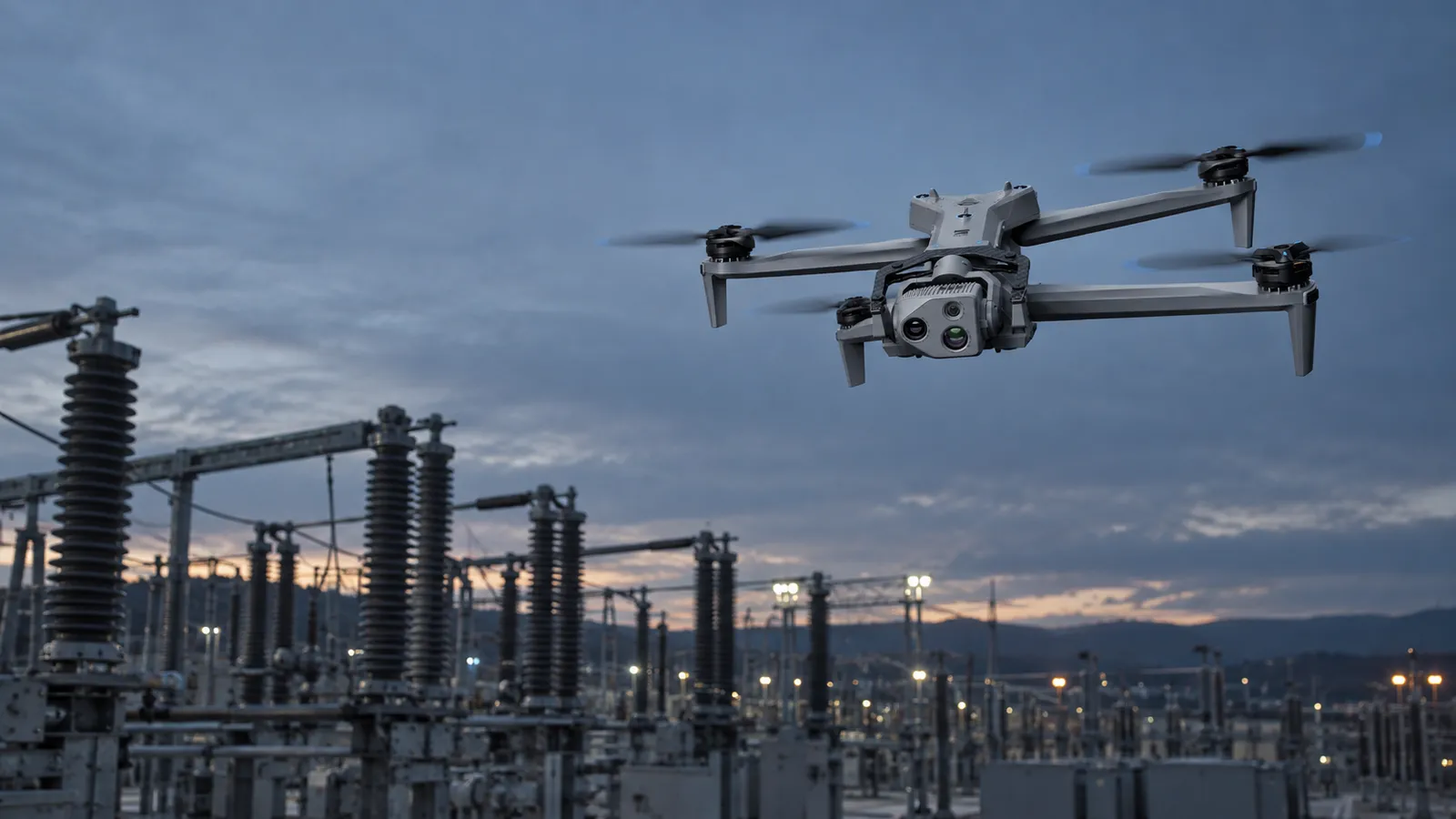
- Max flight time
- 40 min
- Max speed
- 45 mph
- Weight
- Under 4.7 lb
- Max gust handling
- 28.6 mph (43 km/h)
- Operating temperature
- -4°F to 113°F (-20°C to 45°C)
- Ingress protection
- IP55
- Sensor packages
- VT300-Z, VT300-L, V100-L (640 x 512 radiometric thermal on VT300 packages)
- Attachments
- Four bays, up to 385 g (parachute, spotlight, speaker, dropper, RTK/PPK and others)
Updated
The Skydio X10 is the aircraft most US agencies and utilities look at first when they need a drone they are allowed to fly: designed and assembled in the US, NDAA compliant, and on the Blue UAS Cleared List. It is also a drone designed around remote operation. Skydio's own page describes flying it from a browser and handing control to "an operator anywhere". That makes the X10 less about stick skills and more about who sits in the remote seat, how many aircraft they watch, and what they do in the seconds after something goes off plan.
X10 or X10D: two aircraft, two operating models
The two share an airframe and most specs: 45 mph top speed, IP55, a 15,000 ft service ceiling and the same VT300 sensor packages. They differ in how they connect, and that decides how you run them remotely.
X10 (enterprise and public safety)
X10D (defense and government)
For a remote operations center serving a city or a utility, the X10 is the usual choice. For an agency that needs its own ground control software or cannot route video through a commercial cloud, the X10D and its MAVLink interface are the starting point. Skydio's R10, added to the Blue UAS list at the same time as the X10, is a separate aircraft and not covered here.
How an X10 is flown remotely
There are four layers, and a remote program usually uses three of them. Knowing which one a pilot is working in at any moment is most of the training.
Controller 2 and Flight Deck (on site)
Ops Center and Remote Flight Deck (browser)
Command products (DFR, Security, Asset)
Skydio Cloud API (your own systems)
The X10 decides more than most enterprise drones. Six navigation lenses and an onboard NVIDIA Jetson Orin handle obstacle avoidance, Pathfinder plans routes around terrain and airspace rules, and NightSense supports autonomous flight in the dark with visible or IR illumination. A remote pilot's job is to command intent (go here, look at that, hold, come home) and to judge when the autonomy's choice is wrong for the mission.
The link: what the remote pilot can and cannot do over it
Video from an X10 reaches a remote pilot either over a point-to-point radio and then the internet, or straight over cellular. Either way it is compressed, buffered and subject to coverage. That delay is the reason a remote X10 pilot does not fly close-quarters manual maneuvers by the video alone: the onboard obstacle avoidance closes that loop locally, at the aircraft. What works well over the link is supervised flight: waypoint and map missions, point-and-fly moves, camera and zoom control, holding a position on a subject, and deciding when to return.
Plan for the coverage you have
Know the lost-link behavior
Keep a local fallback
Our latency guide explains why supervised control holds up over delayed links when direct manual control does not.
One pilot, many aircraft
Skydio's Ops Center page says "a single operator flies multiple missions, across different locations at the same time", and DFR Command adds the qualifier that matters: "with the required FAA approval". The ratio of pilots to aircraft is set by your FAA approvals, not by the software. In practice a remote operations center runs it in tiers:
Mission planning and takeover
Most X10 flights in a remote program start as a template: a Waypoint or Map Capture mission built in the browser, with geofences and operating rules set once and applied to every flight. A good planning standard for each site covers launch and landing points, altitude bands, no-fly geofences, which sensor package and camera settings to use, and what counts as a successful capture. Takeover is the other half. The pilot should be able to answer three questions at any point in a flight: who is in control right now, what the aircraft will do if I let go, and where it will land if the link drops.
Data from an X10: what comes back and how it is tagged
Imagery and video
Thermal
3D and maps
Logs and records
The step teams skip is the tagging. Every flight should land in your system with the site, asset or incident number, the mission template it ran, the pilot of record and the outcome. That is easy to set at planning time and painful to reconstruct from timestamps later.
What a good X10 remote pilot watches for
The allowed-fleet question
Much of the X10's demand comes from rules about which aircraft an agency may buy. As of October 2026, here is what the sources we checked say:
Blue UAS
FCC Covered List
Proposed cut-off for foreign drones
Agencies planning a switch
None of this is legal advice, and procurement rules vary by grant and agency. The practical point for an operations team: a fleet moving from DJI to Skydio changes software, link, data path and autonomy at once, so pilots need retraining on the X10 even if they have years on a Matrice.
BVLOS and airspace procedures
In the US, routine BVLOS flight still runs on case-by-case approvals. The FAA's Part 108 BVLOS final rule has been at OIRA since July 10, 2026 and, per PickDrones, had no firm publication date. Until it lands, programs fly under Part 107 waivers, public-agency COAs or Part 135. Skydio sells regulatory services for this and lists waivers it has helped with, including no-visual-observer DFR approvals with ADS-B at 200 ft. Each waiver carries its own conditions: altitude, shielding, whether a visual observer is required, and what the pilot must do when traffic appears. The remote pilot's procedures have to match those conditions exactly, flight after flight.
How RoboPilots runs X10 programs
Your aircraft, docks and Skydio accounts stay yours. We train a dedicated group of Part 107 certified remote pilots on your X10s, your sites and your waiver conditions before they fly a live mission, and the same group stays on your program.
One-week trial
Coverage
Procedures
Data
If your X10s will live in docks, read the Skydio Dock for X10 page next. If you are hiring rather than outsourcing, our remote drone pilot careers page describes the role.
Interfaces, specs and sources
- Skydio Controller 2 + Flight Deck
- Ops Center / Remote Flight Deck (browser)
- DFR Command
- Skydio Cloud API
- Webhooks, live telemetry, RTSP
- MAVLink / RAS-A (X10D)
Availability: Available in the US. As of October 2026 the X10, X10D, R10 and Dock for X10 are on the Blue UAS Cleared List, per Skydio. Skydio says the X10 is designed, assembled and supported in the US.
Specs are the maker's published figures, checked on . RoboPilots is not affiliated with Skydio; product names are trademarks of their owners.
- Skydio X10 product page and specifications
- Skydio X10D product page
- Skydio Ops Center
- Skydio DFR Command
- Skydio Cloud API documentation
- Skydio: X10, Dock and R10 join the Blue UAS Cleared List (July 2026)
- DroneXL: Skydio lineup on the Blue UAS Cleared List; FCC Covered List (July 2026)
- Skydio Regulatory Services
- DroneXL: DFR programs and FCC DA 26-758 (August 2026)
- PickDrones: Part 108 BVLOS final rule at OIRA (September 2026)
Frequently asked questions
- Can a Skydio X10 be flown remotely from a browser?
- Yes. Skydio says dock-launched X10 missions can be flown through Remote Flight Deck in Ops Center, and its Command products give browser-based flight controls alongside live video and maps. The pilot can take direct control during the mission.
- What is the difference between the X10 and X10D?
- The X10 is the enterprise and public-safety version, built around Skydio Connect links, 5G/LTE and Skydio's cloud software. The X10D is the defense and government version, with a multiband radio, a fully offline mode, and RAS-A and MAVLink support for third-party ground software.
- Is the Skydio X10 Blue UAS approved?
- Yes. Skydio announced in July 2026 that the X10, Dock for X10 and R10 had joined the X10D, cleared in 2024, on the Blue UAS Cleared List.
- How long does the X10 fly?
- Skydio lists a maximum flight time of 40 minutes. Real endurance is lower in cold weather, strong wind and with attachments.
- Can one pilot fly several X10s at once?
- Skydio's software supports one operator running several missions at the same time, but Skydio itself notes that this needs the required FAA approval. Without it, plan on one pilot per aircraft in flight.