Robots · Drones
Percepto Air Max remote operations: the nationwide waiver, one pilot to many drones, and the inspection data
Percepto built its drone-in-a-box around one idea: nobody on site. Here is what that means for the person in the remote seat, what the FAA approvals behind it say, and how inspection data should come back.
- RGB camera
- 61 MP full-frame
- Thermal
- Boson radiometric thermal camera
- Gas detection variant
- Air Max OGI (Sierra Olympia Ventus OGI plus RGB)
- Safety
- Integral FAA-compliant parachute
- Dock
- Percepto Base: integrated weather station, LTE, patented docking and charging, base hopping
- BVLOS approval
- FAA nationwide waiver for drone-in-a-box at qualifying sites (Nov 2022)
- Fleet approval
- Up to 30 drones simultaneously with one pilot (FAA, Nov 2023)
- Software
- Percepto AIM
Updated
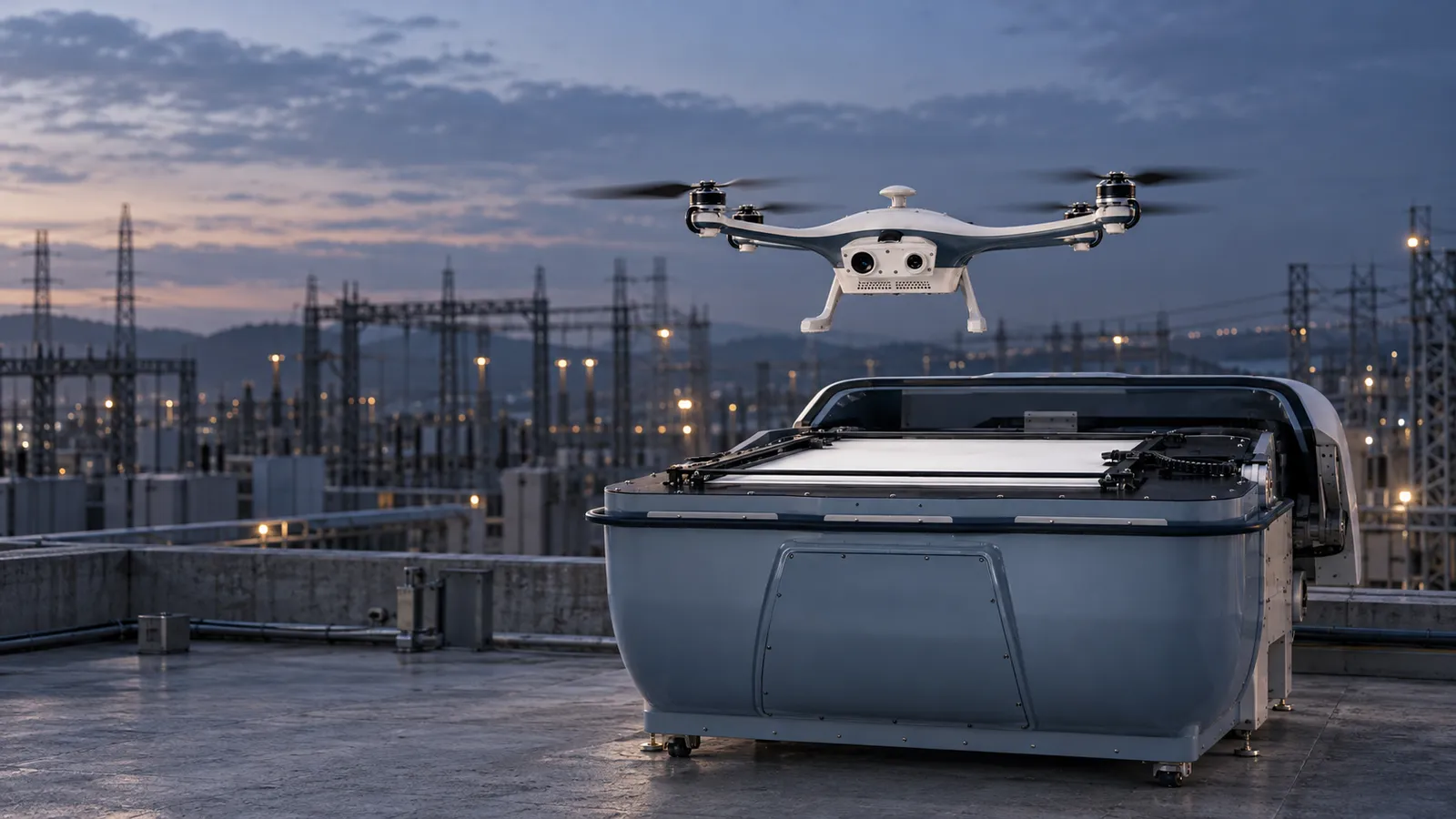
Percepto sells a complete drone-in-a-box: the Air Max aircraft, the Percepto Base that stores and charges it, and the AIM software that plans flights, analyzes the imagery and reports what changed. It targets sites where the same assets need checking again and again: substations, solar farms, refineries, mines, ports and heavy industrial plants. What sets Percepto apart is its regulatory paperwork. It holds an FAA nationwide BVLOS waiver for drone-in-a-box at qualifying sites, and an FAA approval for one pilot to fly up to 30 drones at once. That makes the remote pilot's job less about flying and more about supervision, judgment and data.
What the Air Max system is
Air Max
Air Max OGI
Percepto Base
Percepto AIM
How a Percepto drone is flown remotely
Percepto Air drones are fully controlled by AIM. Most flights are automated: the drone launches from the Base on a schedule or on demand, flies a planned route, captures the asset and returns. Per Percepto's remote operations page, an AIM user can intervene in real time, manually navigating the drone or aborting the mission, and bring it to a safe landing at the Base. The onboard system makes its own flight decisions on low battery, GPS issues and similar faults.
So there are three levels of control for the remote pilot, and a site's procedures should say when each applies:
Supervise
Intervene
Abort and recover
The link runs over LTE from the Base and through the cloud. That delay is fine for supervision and repositioning, but not for close-quarters manual flying by video. Our latency guide covers where that line sits.
The approvals behind "nobody on site"
Percepto's operating model rests on two FAA approvals. Read the conditions before planning staffing around them.
Nationwide BVLOS waiver (November 2022)
One pilot, up to 30 drones (November 2023)
Percepto also says its drone is certified by the FAA under Part 21, and lists approvals from regulators including CASA, Transport Canada, the UK CAA and EASA member states. Outside these approvals, US BVLOS still runs on case-by-case waivers: the FAA's Part 108 BVLOS rule has been at OIRA since July 10, 2026 with no firm publication date, per PickDrones. This is a summary of public statements as of October 2026, not legal advice.
Who sits in the pilot seat? Percepto's regulation page says "Percepto handles drone operations remotely", and its remote operations page says Verizon pilots were permitted to fly Percepto missions from their homes. Whether your contract keeps operations with Percepto or leaves the remote-pilot role to your team, or to a staffing partner, is a commercial question to settle with Percepto first.
One-to-many supervision in practice
An approval for 30 drones per pilot is a ceiling, not a staffing plan. The usable ratio depends on how many missions overlap, how often a flight needs a human decision, and how much of the pilot's time goes to reviewing anomalies rather than watching aircraft. A sensible operations center splits the work:
Base hopping, where one drone uses several Bases, adds a planning question the pilot has to own: which Base the drone will land at, and whether that Base is charged, clear and inside the same approval. On a large site it is the difference between a drone that finishes its round and one that diverts home early.
A takeover, step by step
Takeovers on a Percepto site are rare, which is exactly why they need a rehearsed sequence. A pilot who has not intervened in weeks should not be improvising the first time a contractor walks into a route.
1. Announce
2. Stabilize
3. Decide
4. Return control
Mission planning and site procedures
An inspection round is only as good as its repeatability. Plan every route so the drone captures each asset from the same position, angle and range on every flight, because AIM's change detection compares flights against each other. Then add the site-specific parts: weather go/no-go limits read from the Base's weather station, no-go areas around cranes, flare stacks and work zones, the site's emergency contacts, and what the pilot does if a person or vehicle appears on the route. If the site is outside the nationwide waiver's shielded envelope, the extra conditions of its own approval, including any visual-observer requirement, go into the same plan.
Data: what comes back from a Percepto flight
Visual
Thermal
Gas
Analytics
The pilot's contribution to the data is discipline: flag every capture that was degraded by weather or glare, note interventions so analysts know when a route was not flown as planned, and tag each flight by site, asset and mission so the record matches the work order.
Percepto or a Skydio Dock?
Both are docked drones flown from a browser, but they are built for different jobs. Percepto is an industrial inspection system first: repeat rounds, thermal and gas analytics, and a waiver shaped around shielded flight near structures. The Skydio Dock for X10 leans toward public safety and security, with dispatch integrations and dock hives for response, and it is on the Blue UAS Cleared List. Percepto is not on that list as of UAV Coach's August 2026 check, which matters for buyers bound by federal procurement rules. For an industrial site that needs gas detection and one-to-many inspection, Percepto's approvals are the reason to choose it.
What a good Percepto pilot watches for
How RoboPilots works with Percepto programs
Where your Percepto agreement leaves the remote-pilot role with you, we can staff it. We train a dedicated group of Part 107 certified remote pilots on your Percepto systems, your sites and the conditions of the approvals you fly under, and the same group stays on your program.
One-week trial
Coverage
Procedures
Data
For more on the industries these systems serve, see agriculture and infrastructure robots.
Interfaces, specs and sources
- Percepto AIM (cloud)
- Remote manual navigation and abort
- Percepto Base (dock, LTE)
- Base hopping
- AIM analytics and GIS reporting
Availability: Sold to industrial customers through Percepto. Not on the Blue UAS Cleared List as of UAV Coach's August 2026 check. Percepto does not publish flight time, weight or environmental ratings on its product pages.
Specs are the maker's published figures, checked on . RoboPilots is not affiliated with Percepto; product names are trademarks of their owners.
- Percepto Air Max product page
- Percepto drone-in-a-box overview (Air Max, Air Max OGI)
- UAV Coach: Blue UAS Cleared List (checked August 2026)
- Percepto Base
- Percepto AIM software
- Percepto remote operations
- Percepto: FAA nationwide BVLOS waiver for drone-in-a-box (Nov 2022)
- Percepto: FAA approval for one operator to fly up to 30 drones (Nov 2023)
- Percepto drone regulation page
- PickDrones: Part 108 BVLOS final rule at OIRA (September 2026)
Frequently asked questions
- Does a Percepto site need its own BVLOS waiver?
- Not if it meets the criteria of Percepto's FAA nationwide waiver from November 2022, which Percepto describes as shielded airspace within 50 feet of structures. Sites or routes outside those criteria need their own approval.
- Who flies a Percepto drone, the customer or Percepto?
- Percepto says it handles drone operations remotely, and AIM users can also intervene and take manual control. Who holds the remote-pilot role for your sites depends on your agreement with Percepto.
- Can operators take manual control of a Percepto drone?
- Yes. Percepto says AIM lets users intervene in real time, navigating the drone manually or aborting the mission, and bring it to a safe landing at the Base.
- How many Percepto drones can one pilot fly?
- Percepto announced in November 2023 that the FAA approved one pilot operating up to 30 of its drones simultaneously. In practice the ratio depends on how many flights overlap and how often they need a human decision.
- What does the Air Max OGI detect?
- It carries a Sierra Olympia Ventus optical gas imaging camera, an RGB camera and an onboard AI emission detector for autonomous gas surveys. Percepto does not name specific gases on the pages we checked.