Robots · Drones
BRINC Responder remote operations: LiveOps teleoperation, station dispatch and DFR shifts
A drone-as-first-responder program is a 911 shift with an aircraft attached. Here is how the BRINC Responder is flown from a browser, how control passes to an officer on scene, and what it takes to keep the seat filled around the clock.
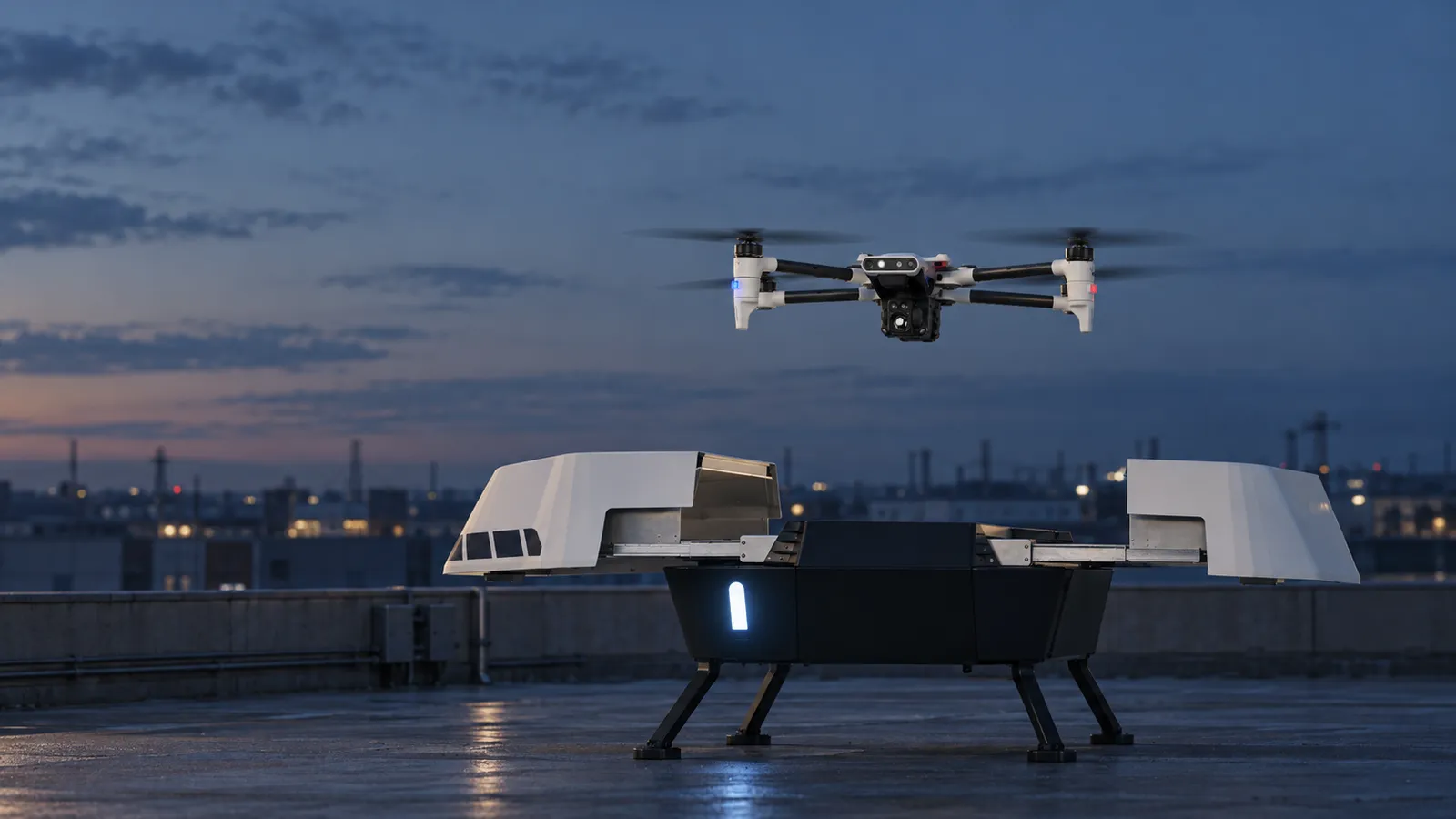
- Flight time
- 42 min
- Recharge in Responder Station
- 10% to 90% in 20 min
- Visual cameras
- Dual Full HD, 40x total zoom, 3-axis gimbal
- Thermal
- 640 px LWIR (8–14 µm), 4x digital zoom
- Audio
- 95 dBA loudspeaker, microphone audible beyond 100 ft
- Connectivity
- Integrated 4G LTE, mesh networking
- Water resistance
- IPX4
- Payload
- Dropper for AEDs, Narcan, EpiPens, PFDs
Updated
The BRINC Responder is a mid-sized outdoor drone built for one job: get to a 911 call before the patrol car does and show the dispatcher and responding officers what is there. It lives in a Responder Station, launches on a teleoperator's command, flies to the call location, streams video and two-way audio, and returns to the nearest free station to recharge. BRINC says its systems are deployed by more than 900 public safety agencies. In a DFR program the aircraft is the easy part. The hard part is the person in the remote seat: trained on the system, sitting next to the call stream, and making flight decisions at the pace of a police radio.
How a Responder flight runs, start to finish
BRINC's Responder Station page lays out the sequence, and it is a good template for a written procedure:
1. Call intake
2. Checks
3. Launch
4. On scene
5. Handoff or return
The procedure the program writes around this should add what BRINC leaves to the agency: who can request a launch, which call types qualify, the minimum information the teleoperator needs before takeoff, and who decides when the drone leaves the scene.
LiveOps: the remote pilot's seat
LiveOps is BRINC's browser platform. From it, an operator can pilot drones, control attachments and stations, dispatch drones to incident locations, and watch every BRINC aircraft in the fleet on one page. The Responder page describes teleoperation from a browser over 4G LTE. LiveOps also shows ADS-B, ground-based radar and weather data, and BRINC says it can automatically reroute drones using integrated ADS-B.
Over the link
Not over the link
Our latency guide covers why supervised control works over a cellular link when direct manual control near obstacles does not.
BRINC Connect: takeover on scene
BRINC Connect is what makes the Responder different from a dock drone flown only from the operations center. BRINC says an on-scene pilot can take over control from the teleoperator. That is useful when an officer needs to put the drone exactly where they want it, or when the cellular link is weak and the local mesh is not. It is also where programs most often get confused about who is flying. Write the handoff down:
Mission planning for a call-driven program
DFR flights are not planned one at a time; the program is planned once and each call reuses it. BRINC's homepage describes the Responder as covering 28 square miles. Within that area, the planning work is a map: station locations, the approved operating area and altitude from the waiver or COA, standing no-go zones such as hospital helipads and stadiums, preferred transit corridors that keep the drone over roads rather than backyards, and fallback landing points if a station is occupied or the link drops. Add standing patrol or scheduled missions where the agency uses them. The teleoperator should be able to launch on a call knowing the route will stay inside those lines without redrawing anything under pressure.
One teleoperator, several drones
LiveOps puts the whole fleet on one screen, which makes it tempting to plan for one teleoperator per several drones. US rules set the limit: 14 CFR 107.35 bars one person from acting as remote pilot for more than one aircraft at a time unless a waiver allows it. For staffing, that means the number of seats on shift is set by how many calls overlap at the busiest hour, not by how many stations are installed. A common pattern is one teleoperator per active flight, plus a supervisor who watches the fleet view and the call queue and decides which call gets the next aircraft.
Responder, Guardian or Lemur 2?
Responder
Guardian
Lemur 2
For a remote operations center, the main difference between Responder and Guardian is continuity. A Responder covers a call and goes back to charge. A Guardian station swaps batteries robotically, so one site can keep an aircraft up for a long incident. Both run in LiveOps, so an agency that adds Guardians to a Responder fleet trains its pilots on a new aircraft, not a new console.
Data and evidence
Video and thermal
Maps
Flight logs
Evidence
The pilot's part is tagging. Every flight should carry the incident or CAD number, the requesting unit and the outcome. Without them, an evidence clerk cannot find the right footage, and a program manager cannot show the council what the drones did.
Regulation and the allowed-fleet question
As of October 2026, the facts we could verify:
Made in the US, not Blue UAS listed
Agencies moving off DJI
BVLOS
Each waiver or COA sets its own conditions: altitude, where a visual observer must stand, what detect-and-avoid equipment is required, and what the pilot does when traffic appears. The teleoperator's checklist must match those conditions exactly. None of this is legal advice.
What a good Responder teleoperator does
How RoboPilots staffs BRINC programs
Your stations, drones and LiveOps accounts stay with your agency, and your command structure stays in charge. We train a dedicated group of Part 107 certified remote pilots on your Responders, your jurisdiction, your call types and your waiver or COA conditions before they fly a live call, and the same group stays on your program.
One-week trial
Coverage
Procedures
Data
For the role itself, see remote drone pilot careers. For a dock-based alternative that is on the Blue UAS list, see the Skydio Dock for X10.
Interfaces, specs and sources
- BRINC LiveOps (browser teleoperation)
- BRINC Connect (on-scene takeover, mesh)
- Responder Station
- 4G LTE
- LiveOps Public API
- CAD, RTCC, ALPR and DEMS integrations
Availability: Sold to US public safety agencies. BRINC says its drones are designed, supported and made in the USA and are NDAA, CJIS and SOC 2 compliant. The Responder is not on the Blue UAS Cleared List as of UAV Coach's August 2026 check.
Specs are the maker's published figures, checked on . RoboPilots is not affiliated with BRINC; product names are trademarks of their owners.
- BRINC Responder product page
- BRINC Responder Station
- BRINC LiveOps
- BRINC Guardian
- BRINC Lemur 2
- BRINC homepage (agency count, compliance)
- UAV Coach: Blue UAS Cleared List (checked August 2026)
- DroneXL: DFR programs and FCC DA 26-758 (August 2026)
- 14 CFR 107.35, operation of multiple small UAS (LII)
- PickDrones: Part 108 BVLOS final rule at OIRA (September 2026)
Frequently asked questions
- Can the BRINC Responder be flown from a browser?
- Yes. BRINC says the Responder is teleoperated from a browser over 4G LTE through LiveOps, which also controls attachments and stations and shows the whole fleet's video on one page.
- How long does the BRINC Responder fly, and how fast does it recharge?
- BRINC lists 42 minutes of flight time. In the Responder Station it recharges from 10% to 90% in about 20 minutes.
- What can the Responder carry?
- It has a payload dropper that BRINC lists for AEDs, Narcan, EpiPens, personal flotation devices and other lifesaving items, plus a parachute, spotlight, loudspeaker and microphone.
- How does handoff to an on-scene pilot work?
- Through BRINC Connect, an on-scene pilot can take over control from the remote teleoperator. Programs should script the handoff so both sides confirm who is in control and the change is logged.
- Is the BRINC Responder Blue UAS approved?
- No. BRINC was not on the Blue UAS Cleared List as of UAV Coach's August 2026 check, although BRINC says its drones are made in the USA and are NDAA, CJIS and SOC 2 compliant.