Robots · Humanoids
Tesla Optimus teleoperation: what is human-driven and how Tesla trains it
Optimus is the most searched humanoid in the world and you cannot order one. Here is what Tesla and the press have actually documented about how it is driven and trained.
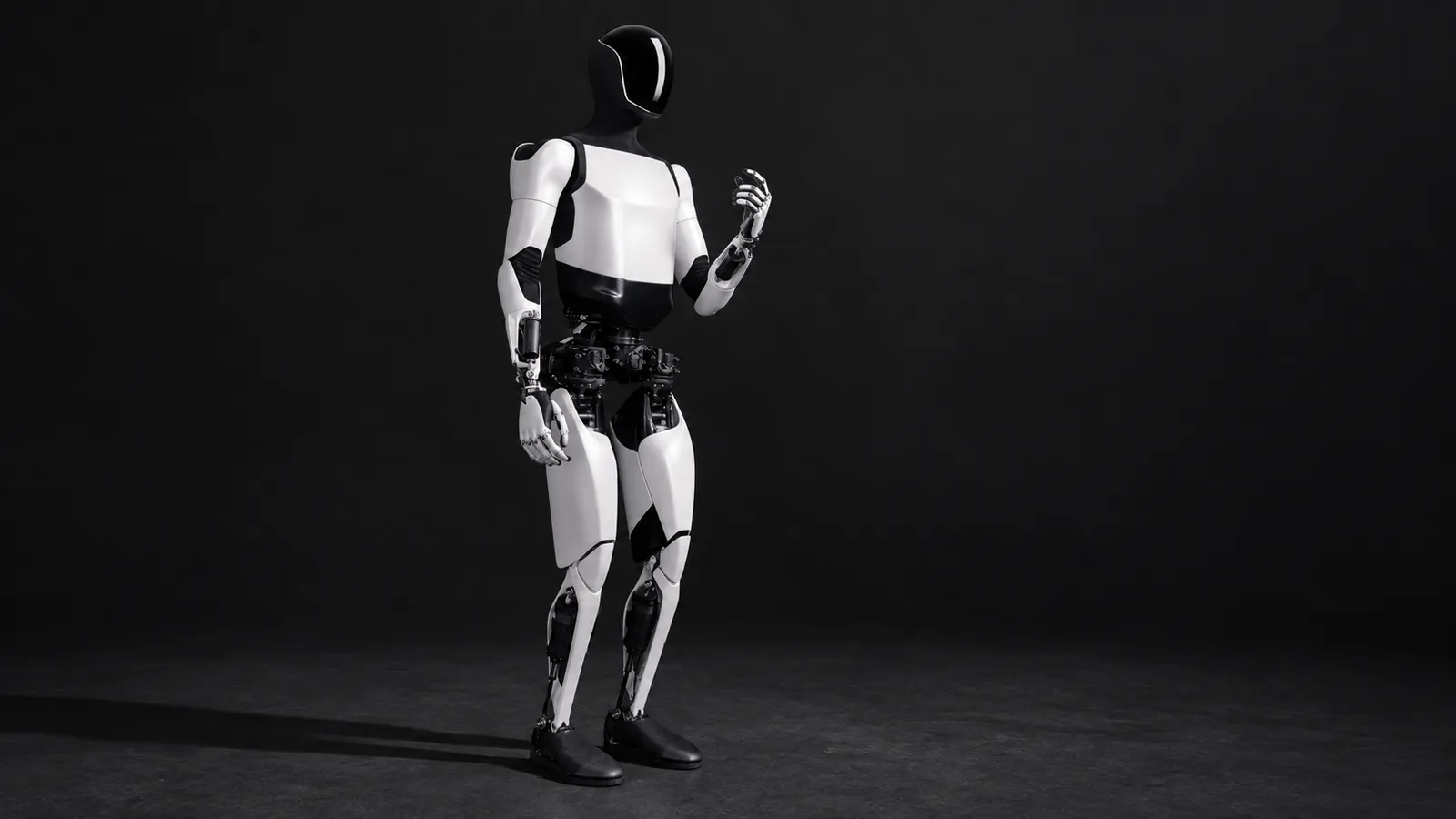
- Status
- Not for sale; internal use at Tesla
- Hand (2024 redesign)
- 22 DoF in the hand, plus 3 in the wrist and forearm (per Tesla, via Electrek)
- Planned size (AI Day 2021)
- 173 cm, 57 kg, 20 kg carrying capacity
- Price
- None listed; Musk has floated targets, see below
- Production
- Fremont lines being installed (Q1 2026 call)
- Data collection (2024)
- Motion-capture suit plus VR headset operators
- Data collection (from June 2025)
- Video from five-camera helmet and backpack rigs (Business Insider)
Updated
People search "is Optimus teleoperated" more than almost any other question about humanoid robots, and the honest answer is: often, yes, in public demos, and Tesla has confirmed it at least once. That is not a scandal. Every humanoid that does useful work learned it from people, and remote operation is how those people get their movements into the robot. What makes Optimus interesting for anyone building a humanoid program is how openly the public record shows Tesla wrestling with the same question every team faces: how do you get enough good human data, and what kind?
Can you buy a Tesla Optimus?
No. Tesla does not sell Optimus, takes no orders and lists no price. Elon Musk has floated targets: about $20,000 at AI Day in September 2022, as reported by Shacknews, and around $30,000 at the We, Robot event in October 2024. Neither is a list price. On the Q1 2026 earnings call (April 22, 2026) Tesla said first-generation production lines were being installed in Fremont "in anticipation of volume production", and as of September 2026 the Gen 3 robot had not been unveiled, according to the Optimus entry on Wikipedia, which tracks these statements with citations.
There is also no public SDK, developer kit or research program to join. If your goal is to teleoperate a humanoid, collect whole-body data on one or staff operators on one this year, Optimus is not an option, and every page claiming otherwise is selling something else. Skip to the section on buyable alternatives below.
Is Optimus teleoperated? The public record
Tesla rarely says how a given demo was run, so most of what is known comes from video, attendees and reporters. Here is the documented timeline, in order:
December 2023
October 2024, We, Robot
November 2024, the new hand
October 2025
December 2025, Miami
Read together, the record supports a plain conclusion: some Optimus demos have been fully or partly driven by remote operators, Tesla has confirmed this for at least one of them, and Tesla says others were autonomous. Nothing public lets an outsider check which mode any given clip used, so treat every demo as unlabeled until Tesla labels it.
There is a practical reason the question is hard to settle from video. A well-tuned teleop stack hides the operator: the robot's own balance controller keeps it upright, the operator's hand motion is smoothed and retargeted, and the output looks like the robot moving on its own. The tells are the ones the Miami clip showed, a human reflex the robot copied because a person was inside the loop. Without those, a viewer has nothing to go on but the company's word.
Teleoperation in a demo and teleoperation as a training method are two different things. The first is a disclosure question. The second is how essentially every humanoid policy today gets its first thousand hours of examples, and it is the part that matters if you are building one.
How Tesla collects Optimus training data
The clearest view into Tesla's method comes from its own job postings. In August 2024 Tesla advertised a "data collection operator" role at its Palo Alto facility paying $25.25 to $48 an hour. Per Decrypt's summary of the listing, operators would "wear a motion capture suit and virtual reality headset while performing designated movements", walk a set test route daily while carrying the gear for more than seven hours a day, start and stop recording devices, do minor equipment and software debugging, and write daily reports. The listing asked for a height between 5'7" and 5'11" and described three eight-hour shifts for around-the-clock collection.
The height band is the detail worth noticing. A motion-capture pipeline maps a human skeleton onto a robot skeleton, and the closer the operator's proportions are to the robot's, the less retargeting distorts the motion. Tesla chose to hire people who fit the robot instead of correcting for every body in software. Three shifts a day says the other thing every data team learns: the robot is the expensive part, so it should not sit idle overnight.
In late June 2025 the approach changed. According to Business Insider reporting republished by AOL, Tesla told staff it would focus on a vision-only approach, recording workers doing tasks with five in-house cameras mounted on a helmet and backpack, rather than relying mainly on mocap suits and VR headsets to teleoperate the robot. Tesla did not comment for that story.
Video or teleoperation: what each gives a policy
Tesla's shift is a bet on scale. Camera rigs are cheaper per hour than a robot plus a suited operator, any worker can wear one, and there is no robot to break. The researchers quoted in the same Business Insider piece pointed at the cost of that bet.
Teleoperation records the robot's own experience
Video has to be translated first
The two can work together
That last view matches how most open humanoid work runs today: large volumes of cheaper human or simulated data for broad priors, then teleoperated episodes on the target robot to ground the policy in that body's hands, cameras and contact. Our guide to teleoperation data for robot learning covers how teams balance the two and what makes an on-robot episode worth training on.
Why teleop in a humanoid demo is not cheating
A remotely driven humanoid proves real things: the hardware can balance, reach and grip well enough to do the task, and a person can do it through the robot's body. That is the first step of any learning pipeline. It does not prove the robot can do the task alone, and the problem with the We, Robot event was disclosure, not method.
For deployed robots the human stays in the loop longer than most demos suggest. A policy that handles most of a task still needs someone to finish the rest when it stalls, and those takeovers are the most valuable training data a fleet produces, because they cover exactly the cases the policy gets wrong. Our human-in-the-loop guide for humanoids explains how that fallback layer is set up and how its sessions feed the next training run.
The data collection operator job, as Tesla defined it
Many people searching for Optimus are really looking for the job. Tesla's 2024 listing is a good description of what humanoid data work demands anywhere: physical stamina (hours of walking in gear), coordination and what the posting called "kinesthetic awareness", comfort with debugging hardware, and the discipline to record, upload and report every shift. Remote humanoid operators add two more skills on top: working through the robot's cameras with network delay, and keeping one consistent strategy across hundreds of episodes so the dataset teaches one way to do the task. Our humanoid robot teleoperator careers page covers what the role looks like when the robot is somewhere else.
If you need humanoid operators today
You cannot put operators on an Optimus, but you can on robots that ship now, with open SDKs and maintained teleop stacks. Two common starting points:
Unitree G1
Unitree H2
The data you collect on either follows the same logic Tesla's program shows: consistent operators, proportions and protocol held steady, collection running on shifts so the robot is not idle, and teleop episodes on the real body to ground whatever cheaper data you add.
How RoboPilots works with humanoid teams
Several humanoid makers have sent RoboPilots robots to test our operating protocols. For a customer program, the robot stays at your site and we train a dedicated group of operators on your own unit and your task protocol before they record anything.
One-week trial
Coverage
Data
Interfaces, specs and sources
- Motion-capture suit (data collection)
- VR headset teleop
- Helmet and backpack camera rigs
- No public SDK
Availability: Not for sale. Tesla has not opened orders or published a price. On its Q1 2026 call (April 22, 2026) Tesla said first-generation Optimus production lines were being installed in Fremont, and a Gen 3 reveal was still pending as of September 2026.
Specs are the maker's published figures, checked on . RoboPilots is not affiliated with Tesla; product names are trademarks of their owners.
- Optimus (robot): timeline, price statements and production status (Wikipedia)
- Tesla data collection operator listing, Aug 2024 (Decrypt)
- Tesla hiring Optimus data operators, Aug 2024 (Fortune)
- Tesla shifts Optimus training to video, Aug 2025 (Business Insider via AOL)
- We, Robot Optimus units operated by humans, Oct 2024 (Interesting Engineering)
- New Optimus hand demo confirmed teleoperated, Nov 2024 (Electrek)
- Optimus fall at Miami event, Dec 2025 (Electrek)
- Optimus price claim at AI Day 2022 (Shacknews)
- Unitree G1 product page and price
- Unitree xr_teleoperate: supported robots and headsets (GitHub)
Frequently asked questions
- Is Tesla Optimus teleoperated?
- Some public demos have been. Reporters documented remote operators at the October 2024 We, Robot event, and Tesla confirmed that its November 2024 hand demo was teleoperated. Tesla has said other demos were autonomous, and outsiders cannot verify which mode a given video used.
- Can you buy a Tesla Optimus?
- No. Tesla does not sell Optimus or take orders. As of April 2026 it said first production lines were being installed in Fremont, and it has not announced when or how outside customers could buy one.
- How much will Tesla Optimus cost?
- There is no list price. Elon Musk has floated targets of about $20,000 in 2022 and around $30,000 in October 2024, but Tesla has not published a price or opened orders.
- Does Tesla still use motion-capture suits to train Optimus?
- Business Insider reported that in late June 2025 Tesla told staff it would focus on video of workers recorded with helmet and backpack camera rigs, instead of relying mainly on motion-capture suits and VR teleoperation. Tesla did not comment on that report.
- How much did Tesla pay Optimus data collection operators?
- Tesla's August 2024 listing for a data collection operator at its Palo Alto facility advertised $25.25 to $48 an hour, for work in a motion-capture suit and VR headset.