Robots · Drones
DJI FlyCart 30 remote operations: two-pilot handovers, DeliveryHub monitoring and heavy-lift logistics
The FlyCart 30 carries up to 30 kg over 16 km and hands control from a launch pilot to a drop-site pilot mid-route. Here is what that workflow needs, what DeliveryHub does and does not do, and where remote operators fit.
- Max takeoff weight
- 95 kg (with cargo, sea level)
- Max payload
- 30 kg dual battery; 40 kg single battery
- Range
- 16 km at full payload, 28 km empty (dual battery)
- Flight time at full payload
- 18 min (30 kg, dual battery)
- Modes
- Cargo box (about 73 L) or winch (20 m cable, 5 to 30 kg)
- Protection and limits
- IP55; -20 to 45 °C; wind 12 m/s
- Link
- O3 to 20 km (FCC), converged with 4G enhanced transmission
- Safety
- Dual batteries, parachute, ADS-B receiver (15 km), phased-array radar and binocular vision
Updated
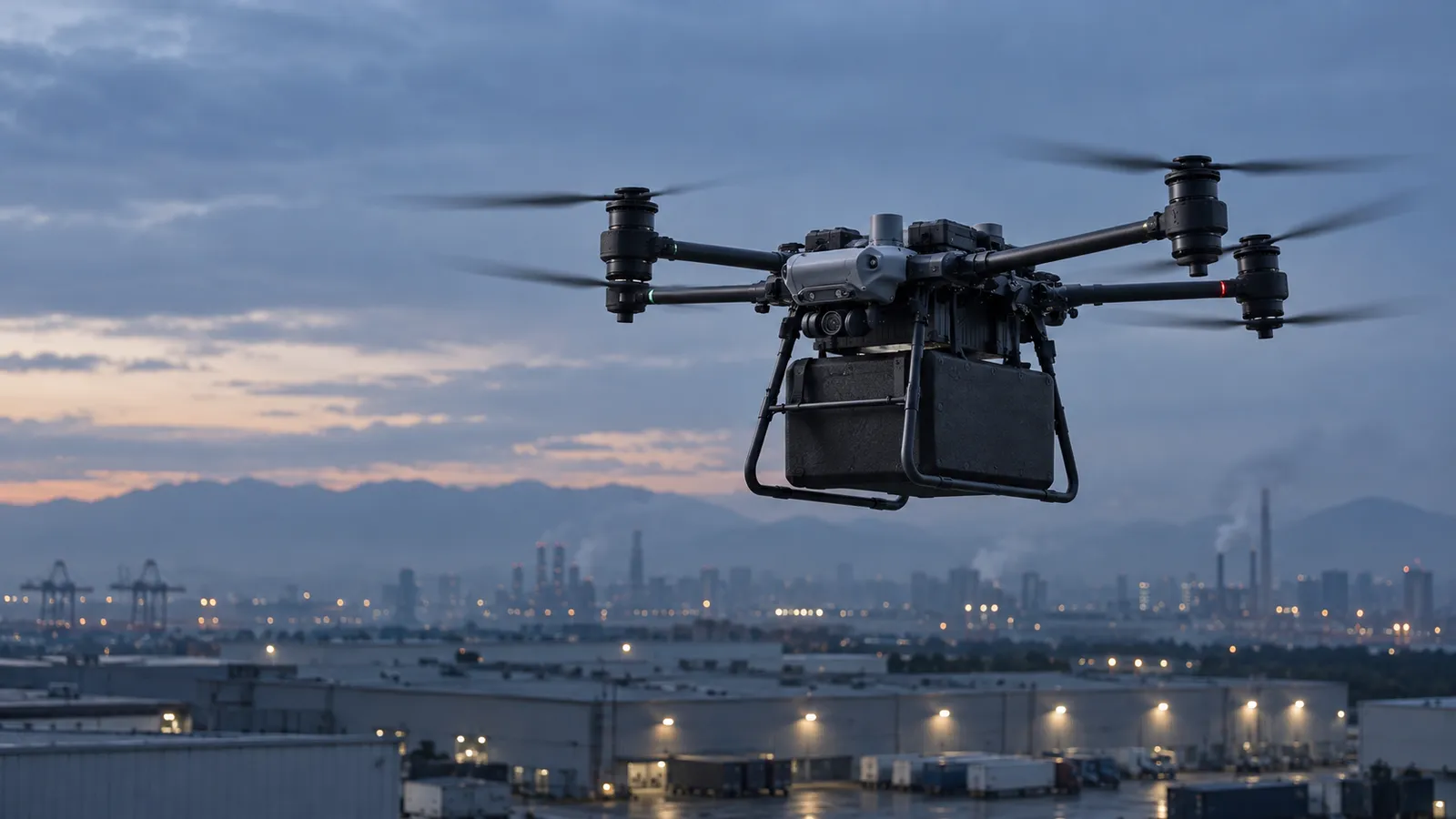
The DJI FlyCart 30 is a 95 kg-class cargo drone: up to 30 kg on dual batteries (40 kg on one battery, for shorter hops), 16 km of range at full load, and either a cargo box or a 20 m winch. That suits loads that have to cross ground a vehicle cannot: up a slope to a tower, across a river to a site, into an area without a road. Its operating model is different from the docked aircraft in this section. Two pilots share a flight, one at each end, and the aircraft is handed over between them.
Dual operator mode: the two-pilot handover
The FlyCart 30 FAQ confirms dual operator mode, with two remote controllers running DJI Pilot 2. In practice the launch-site pilot loads, takes off and starts the route; the drop-site pilot takes control for the approach, the release or winch descent, and either lands or sends the aircraft back. Each pilot sees the ground they are standing on, which is exactly what you want for loading and unloading heavy cargo around people.
Before the flight
Handover
At the drop
Return
What we could not confirm: DJI's FlyCart 30 materials describe dual operator mode and a converged 4G and O3 link, but they do not say a second controller can be operated from a remote operations center far from the route. Treat both pilots as on site unless DJI or your dealer confirms otherwise for your configuration.
The link: O3 plus 4G
The FlyCart 30 uses DJI O3 transmission, rated to 20 km under FCC rules in clean conditions, and 4G enhanced transmission, which DJI describes as a converged link: the aircraft switches between the two without interruption. That matters on mountain and valley routes, where line of sight to one controller is lost behind terrain. The controllers accept DJI's IoT 4G card or your own Nano-SIM. One detail for log handling: before exporting logs with dual control active, DJI says to disable 4G enhanced transmission on both controllers.
Latency on a heavy-lift aircraft is less about precision than about reaction time near the ground: the pilot at the drop has the aircraft in direct view and a local radio link, which is why that role stays on site. Our latency guide explains how delay limits what can be done remotely.
What DeliveryHub does, and what it does not
DJI DeliveryHub is the cloud platform around the FlyCart 30. It is useful for an operations team, and its limits are just as important to know before you design a workflow around it. From DJI's FAQ:
Does
Does not
So DeliveryHub is a dispatch and monitoring screen, not a remote cockpit. An operations center can watch every active flight at once, coordinate crews, and confirm deliveries, but flight logs come from the controllers and have to be collected separately.
Safety systems a pilot has to understand
Airspace
Obstacles
Redundancy
Parachute
Weather
Batteries and turnaround
The DB2000 battery is 1,984.4 Wh, so it cannot travel by air, and is rated for 12 months or 1,500 cycles. The C8000 charger takes one battery from 0% to 98% in about 26.5 minutes, or two in about 36.6 minutes, from a 220 V single-phase generator of 8 kW or more. Turnaround at the launch site is set by that charger, so a busy delivery day needs enough battery pairs to fly one set while another charges.
What a good FlyCart pilot does differently
Where a remote operations center fits
One-to-many supervision
Mission planning
Takeover
Airspace and visual observers
Data delivery
FlyCart 30 vs FlyCart 100
The FlyCart 100, per DroneXL, goes up to 149.9 kg at takeoff with an 85 kg payload and includes LiDAR among its sensors. It holds FCC grant SS3-T100A2411, shared with the Agras T100, but launched globally on 4 December 2025 without a US launch; DJI's US site offers a dealer contact form rather than a price. For US programs, the FlyCart 30 is the reference aircraft for now.
US regulatory notes, as of October 2026
Weight
Carrying cargo for others
FCC and tariffs
BVLOS
This summarizes regulation text and public reporting, not legal advice.
How RoboPilots supports FlyCart programs
We train a dedicated group of operators on your aircraft, routes and handover procedures. From a remote desk they run dispatch and DeliveryHub monitoring, route and airspace preparation, and log collection, working with the certified pilots at each end of the route and inside the approvals your operation holds.
One-week trial
Coverage
Data
Our delivery and logistics page covers the wider picture for cargo robots.
Interfaces, specs and sources
- DJI Pilot 2 (dual operator mode)
- DJI DeliveryHub (cloud monitoring)
- Converged 4G + O3 link
- Payload SDK
- D-RTK 2 or network RTK
Availability: US availability of new FlyCart 30 units was not confirmed in the sources for this page; check with a DJI dealer. The larger FlyCart 100 holds FCC grant SS3-T100A2411 but launched globally on 4 December 2025 without a US launch, per DroneXL. At 95 kg maximum takeoff weight, the FlyCart 30 falls in the "55 lb or more" category of the FCC's proposed DA 26-758, which was not final as of October 2026 and would not ground owned aircraft.
Specs are the maker's published figures, checked on . RoboPilots is not affiliated with DJI; product names are trademarks of their owners.
- DJI FlyCart 30 product page
- DJI FlyCart 30 FAQ
- DJI FlyCart 30 specifications
- 14 CFR §107.3, definitions (Cornell LII)
- 14 CFR §107.1, applicability (Cornell LII)
- 49 U.S.C. §44807 (Cornell LII)
- DroneXL: DJI at Commercial UAV Expo, FlyCart 100 and tariffs (Sep 2026)
- DroneDJ: FCC extends DJI and Autel firmware waiver to 2029 (May 2026)
- PickDrones: Part 108 BVLOS rule at OIRA (Sep 2026)
Frequently asked questions
- Does the FlyCart 30 support dual operating mode?
- Yes. DJI confirms dual operator mode, with two remote controllers on DJI Pilot 2, so a launch-site pilot and a drop-site pilot can hand the aircraft over mid-route.
- Can the FlyCart 30 switch between 4G and O3 without interruption?
- Yes. DJI describes 4G enhanced transmission and O3 as a converged link, and says the aircraft switches between them without interruption.
- Can I control the FlyCart 30 or its gimbal from DeliveryHub?
- No. DeliveryHub only shows the gimbal camera feed. Control stays with the pilots on DJI Pilot 2, and DeliveryHub supports immediate tasks only, not scheduled ones.
- Can DeliveryHub run on a private server?
- No. DJI says DeliveryHub is a public cloud platform only, hosted on AWS servers with ISO/IEC 27001 certification.
- What can the FlyCart 30 winch do?
- It has a 20 m cable, manual and automatic descent, Swing Control, weighing and Cut Cable Protection, and carries 5 to 30 kg on dual batteries or up to 40 kg on a single battery.
- Does the FlyCart 30 detect other aircraft?
- Yes. Its built-in ADS-B receiver detects equipped planes, helicopters and other aircraft within 15 km and warns the operator.