Robots · Drones
DJI Agras T100 remote operations: staffing spray seasons, and what can and cannot be done from afar
The T100 is a 175 kg spray drone flown by a crew at the field edge. Remote work on it is planning, records and support, not flying. Here is how to staff a season honestly.
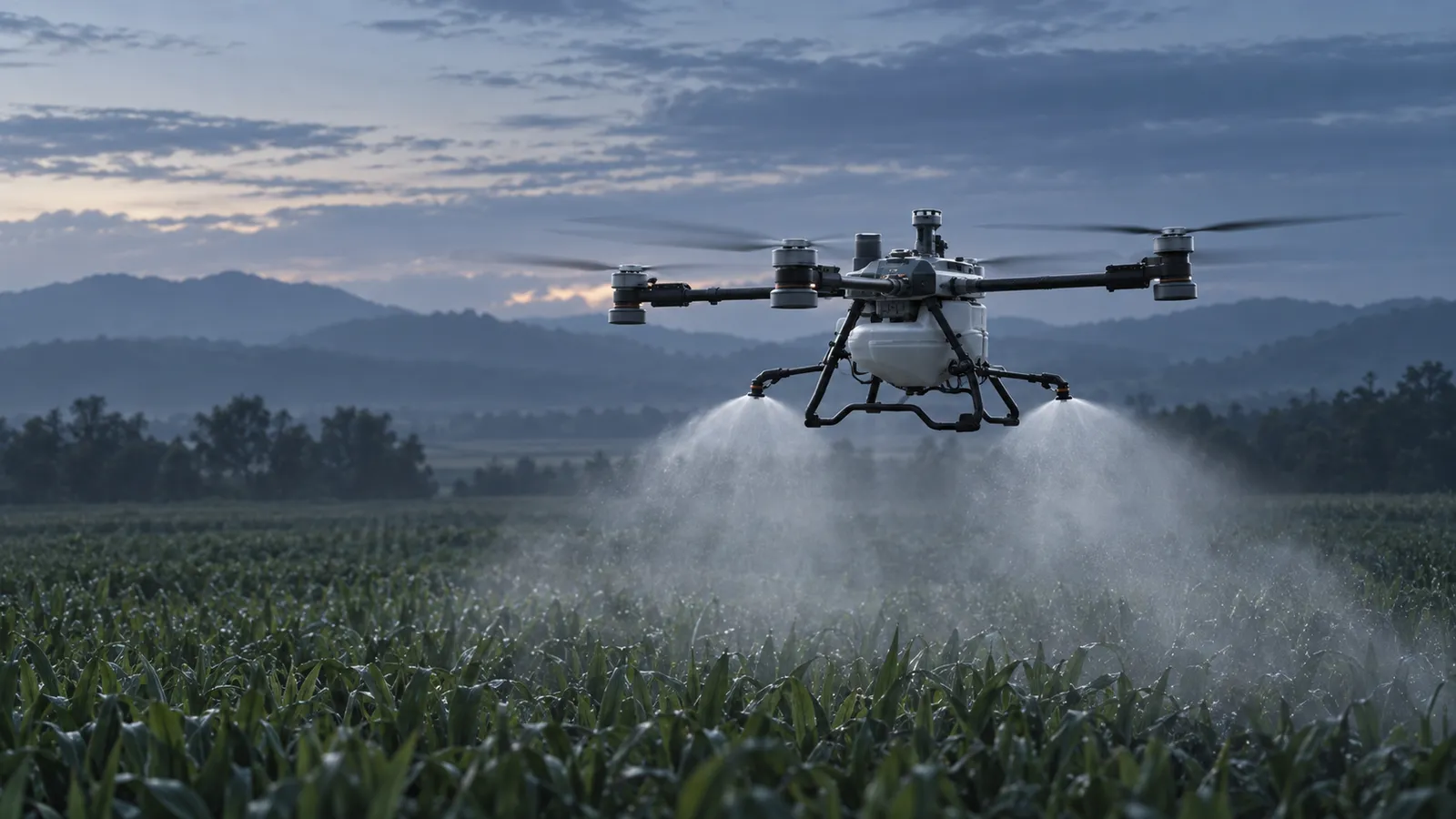
- Spray system
- 100 L tank; 30 L/min (2 nozzles) or 40 L/min (4 nozzles); 5 to 13 m effective width
- Spreading
- 150 L tank; 3 to 10 m effective width
- Lifting
- 100 kg (80 kg with dual-battery module); 10 m rope standard
- Max takeoff weight
- 175 kg spraying (2 nozzles); 165 kg lifting
- Obstacle sensing
- LiDAR, mmWave radar and quad vision; up to 60 m; avoidance up to 13.8 m/s
- Operating limits
- 0 to 40 °C; wind under 6 m/s
- Battery
- DB2160, 41,000 mAh; 8 to 9 min charge, 30% to 95%
- Relay range
- 8 km (FCC), interference-free, at 2.5 m height
Updated
The DJI Agras T100 is a heavy agricultural drone that sprays from a 100 L tank, spreads from a 150 L hopper, and lifts up to 100 kg on a rope. It weighs 75 kg empty in its two-nozzle spraying configuration and up to 175 kg at takeoff. Unlike the docked aircraft elsewhere in this section, it is flown by a crew standing at the field edge with a controller, and it should be. Remote operations matter here for a different reason: spray work is seasonal and time-critical, and the work around each flight (field mapping, scheduling, records, weather calls) is where a lot of time and compliance risk sits.
What remote support can and cannot do on an Agras
Cannot: fly it from an operations center
Can: plan the work
Can: run the season
Can: keep the records
We are explicit about this because the rest of our drone work is remote flying. On the T100, the pilot in command is at the field. A remote desk makes that pilot more productive; it does not replace them.
How the T100 works in the field
The crew flies with the DJI RC Plus 2, which the T100 FAQ says is also compatible with the T70P but not the T25P. DJI lists brighter screen, longer runtime with internal and external batteries, backlit buttons for night work and more customizable buttons as its upgrades over the T50's controller; the RTK module is not included as standard. The D-RTK 3 AG and the Agras Relay extend positioning and link range around the field.
Spraying
Spreading
Obstacle sensing
Charging
Lifting: a second job with its own rules
With the lifting system fitted, the T100 carries up to 100 kg (80 kg with the dual-battery module, which adds endurance and a fuse for faster emergency release). DJI recommends a rope of 10 to 15 m: too short and the load can swing into the propellers, too long and it can hit the ground or snag on trees and wires. DJI does not recommend lifting in strong wind, since the load keeps swinging, especially with a large windward surface. Lifting is a different skill from spraying, and a crew trained for one is not automatically ready for the other, so it gets its own procedure, its own checklist and its own training flights.
Running an Agras season from a remote operations desk
One-to-many supervision
Mission planning
Takeover
Airspace and visual observers
Data delivery
DJI lists the SmartFarm app and SmartFarm Web as its software around the Agras line. Whatever tools a program uses, the value of the desk is that the same people prepare and file every job, so the records look the same whichever crew flew it.
What a good T100 crew does differently
US regulatory notes, as of October 2026
Weight
Agricultural operations
FCC and tariffs
This summarizes regulation text and public reporting, not legal advice. Confirm your own exemption and certificate requirements with the FAA and counsel.
If DJI Agras sales stop
The FCC proposal would not ground T100s already in service, and firmware support runs to at least 2029, so a fleet bought now keeps working. What it would change is fleet growth and replacement: new foreign spray aircraft in the 55 lb-plus and spraying categories would stop being imported after a wind-down if the proposal is adopted. Programs planning several seasons ahead should keep their crew procedures, records and field data platform-neutral, so that a change of aircraft is a retraining exercise rather than a restart. Our agriculture and infrastructure page covers the wider picture.
T100 vs T50
DJI's own comparisons are on the controller and the spray system: the T100's RC Plus 2 is brighter, longer-running and better for night work than the T50's controller, and the T100's pump flow is 87.5% higher, with a spraying system that does not interchange with the T50's. The T100 also adds the lifting role. For crews moving up from a T50, the main adjustments are a heavier aircraft, new power logistics and the lifting procedures if they use them.
How RoboPilots supports Agras programs
We train a dedicated group of operators on your aircraft, fields and record-keeping, and they work from a remote desk on planning, scheduling, weather calls and records, alongside the certified crews who fly on site and inside the exemptions and certificates your operation holds.
One-week trial
Coverage
Data
For roles on the operations side, see remote drone pilot careers.
Interfaces, specs and sources
- DJI RC Plus 2 (Agras)
- DJI SmartFarm app and SmartFarm Web
- Agras Relay
- D-RTK 3 AG
- Lifting system (single or dual battery)
Availability: The Agras T100 shares FCC grant SS3-T100A2411 with the DJI FlyCart 100, according to DroneXL. US availability of new T100 units was not confirmed in the sources for this page; check with a DJI Agriculture dealer. The FCC's proposed DA 26-758, not final as of October 2026, names both aircraft of 55 lb or more and pesticide (economic-poison) spraying among the categories whose import and sale would end after a wind-down; aircraft already owned would not be grounded.
Specs are the maker's published figures, checked on . RoboPilots is not affiliated with DJI Agriculture; product names are trademarks of their owners.
- DJI Agras T100 product page
- DJI Agras T100 FAQ
- DJI Agras T100 specifications
- 14 CFR §107.3, definitions (Cornell LII)
- 14 CFR §107.1, applicability (Cornell LII)
- 14 CFR §137.1, applicability (Cornell LII)
- 14 CFR §137.3, definitions (Cornell LII)
- 49 U.S.C. §44807, special authority for certain unmanned aircraft (Cornell LII)
- DroneXL: DJI at Commercial UAV Expo, Covered List and tariffs (Sep 2026)
- DroneDJ: FCC extends DJI and Autel firmware waiver to 2029 (May 2026)
Frequently asked questions
- Is the RC Plus 2 compatible with the Agras T70P and T25P?
- DJI says the T100's RC Plus 2 is compatible with the T70P but not with other models, so the T25P is not supported.
- What upgrades does the T100 controller have over the T50's?
- DJI lists stronger performance, a brighter screen, longer runtime with internal and optional external batteries, backlit buttons for night use and more customizable buttons. The RTK module is not included as standard.
- What rope length should be used for lifting with the T100?
- DJI recommends 10 to 15 m. A shorter rope lets the load swing into the propellers; a longer one risks the load hitting the ground or snagging on trees or wires.
- Can the T100 lift in strong wind?
- DJI does not recommend it. Wind keeps the load swinging, which compromises flight safety, especially with cargo that has a large windward surface.
- What is the difference between the standard and dual-battery lifting modules?
- The standard module carries up to 100 kg. The dual-battery module carries 80 kg but holds two batteries for longer endurance and adds a fuse for a quicker, safer emergency release.
- Can an Agras T100 be flown remotely from an operations center?
- Not on the basis of DJI's published T100 material, which describes flight with the RC Plus 2 and a relay at the field. Remote teams can handle planning, scheduling and records, while a certified pilot flies on site.