Robots · Drones
PX4 and ArduPilot remote operations: flying custom MAVLink drones over 4G from an operations center
Custom and OEM drones built on PX4 or ArduPilot can be flown from anywhere with an IP link, but the open stack leaves the operating procedures, security and failsafe design to you. Here is how to get them right.
- Autopilots
- PX4 (BSD 3-Clause, Dronecode Foundation); ArduPilot Copter (GPLv3)
- Vehicle types
- Multicopters, fixed-wing, VTOL, helicopters, rovers (PX4); multicopters and helicopters (ArduPilot Copter)
- Ground stations
- QGroundControl (PX4 and ArduPilot; Windows, macOS, Linux, Android, iOS); Mission Planner (ArduPilot)
- Protocol
- MAVLink; PX4 also uXRCE-DDS to ROS 2
- Companion link (PX4)
- Ethernet recommended, or serial; MAVLink Router recommended for IP bridging
- External control (PX4 Offboard)
- Position, velocity, attitude and lower-level setpoints; 2 Hz minimum proof-of-life
- GCS link-loss failsafe (ArduPilot)
- FS_GCS_TIMEOUT, default 5 s; RTL, SmartRTL, Land or Brake
Updated
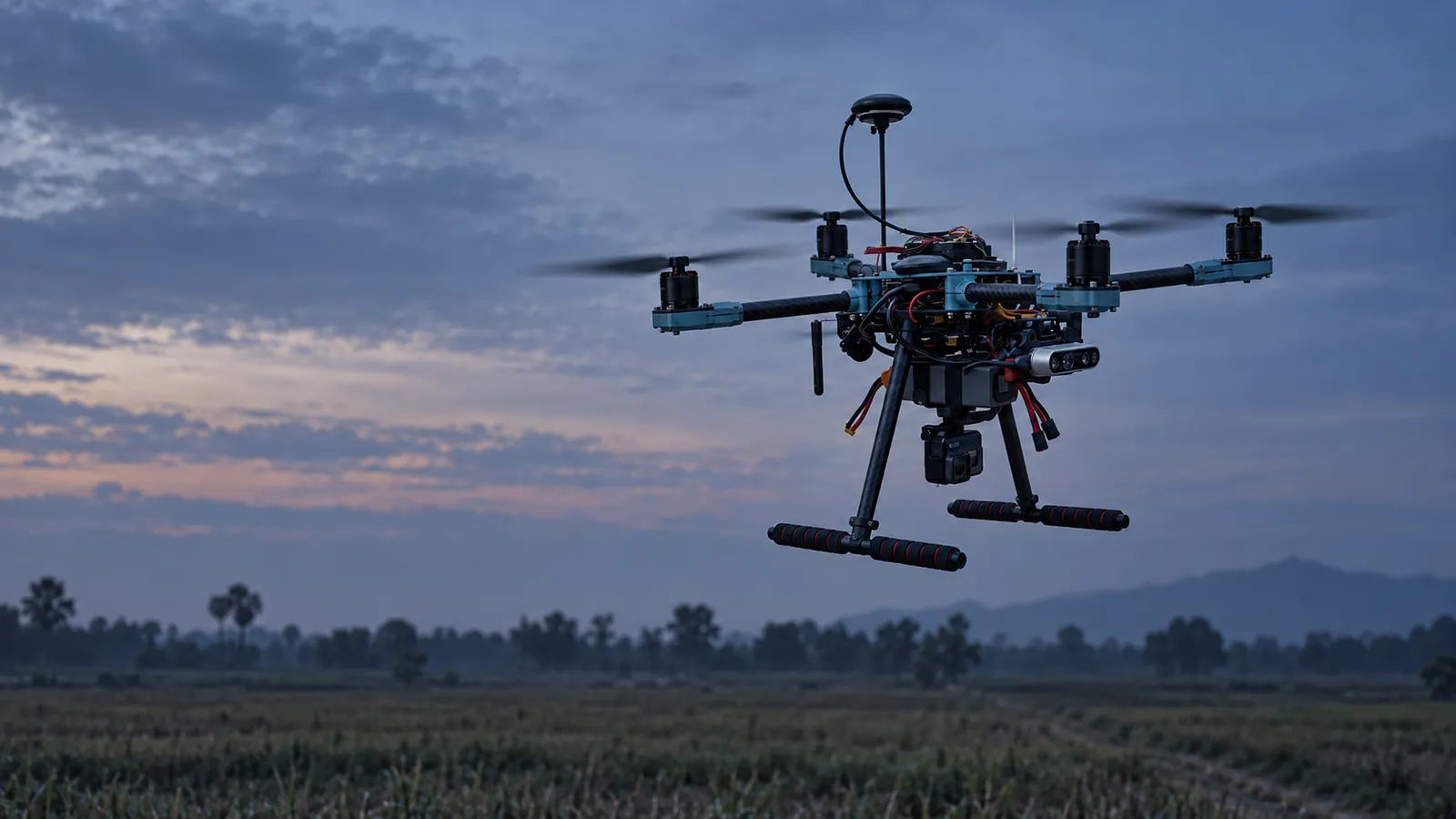
Not every drone program flies a DJI or a Skydio. Many run aircraft built on PX4 or ArduPilot, the two open-source autopilots: custom inspection rigs, OEM airframes, research platforms and in-house designs. They all talk MAVLink, they all work with QGroundControl, and they can all be flown from far away over any IP network. What they do not come with is the operating layer a closed platform ships: hardened links, cloud control with defined handover, logging conventions and procedures. Remote operations on an open stack are as good as the team that designs and runs them.
PX4 or ArduPilot: what changes for the operator
PX4
ArduPilot
What they share
For a remote pilot the day-to-day difference is mostly in parameter names, flight mode behavior and failsafe options. A good operator team writes the procedure against the autopilot actually on the aircraft, and does not assume a PX4 failsafe behaves like an ArduPilot one.
The remote link: telemetry over 4G/LTE
On site, these aircraft usually talk to the ground station over a telemetry radio. For remote operations the link becomes IP: a companion computer or a cellular telemetry device on the aircraft carries MAVLink over a 4G or 5G modem to a server or VPN, and the pilot's ground station connects to that. PX4's companion computer guide recommends Ethernet between flight controller and companion where supported, and recommends MAVLink Router for bridging MAVLink to ground stations or IP networks, with MAVProxy as an alternative. On the ArduPilot side, cellular telemetry devices such as UAVCast carry MAVLink over 3G/4G networks over what its documentation calls nearly unlimited distances.
Coverage at altitude
Video
Redundancy
Latency
Secure it before you put it on the internet. The PX4 docs state plainly that "PX4 ships with every control interface unauthenticated, unsigned, and unencrypted" and that securing a deployment is the integrator's job. A MAVLink port reachable from a public IP is a control interface reachable by anyone. Put the link inside a VPN, restrict who can connect, and enable message signing where your stack supports it.
Failsafes: design them for a remote pilot
On an open stack the failsafe is a set of parameters you choose. For remote operations these are the ones that matter most, and they should be set, tested in simulation or on the bench, and written into the procedure.
ArduPilot GCS failsafe
PX4 data link loss
PX4 manual control loss
Geofence
Companion computers and autonomy
Most remote setups put a Linux companion computer next to the flight controller: it runs the modem, the router, the camera pipeline and any onboard autonomy. PX4 lists Pixhawk Autopilot Bus carriers (ARK Jetson, Holybro Jetson and Raspberry Pi CM4 baseboards) and managed systems such as Auterion Skynode and ModalAI VOXL 2. Software options include MAVSDK, ROS 2, and ROS 1 with MAVROS.
When the companion flies the aircraft, PX4's Offboard mode is the interface: it follows position, velocity, acceleration, attitude or lower-level setpoints, and needs a proof-of-life signal at 2 Hz or more. If MAVLink setpoints stop for longer than COM_OF_LOSS_T, PX4 leaves Offboard and applies COM_OBL_RC_ACT. Over ROS 2, PX4 does not trigger that failsafe if setpoints stop arriving, so the controller must keep streaming them, and the docs warn that conflicting setpoint writes can cause catastrophic behavior. Takeoff, landing and return are better left to their dedicated modes.
Running MAVLink fleets from a remote operations center
One-to-many supervision
Mission planning
Takeover
Airspace and visual observers
Data delivery
A remote preflight for a MAVLink aircraft
1. Link
2. Configuration
3. Mission
4. People
5. Recording
What a good open-stack operator does differently
US regulatory notes, as of October 2026
Aircraft origin
BVLOS
This summarizes public sources, not legal advice.
How RoboPilots runs MAVLink aircraft
If it speaks MAVLink, a trained operator can fly or supervise it. Your aircraft, autopilot configuration and ground station stay yours. We train a dedicated group of Part 107 remote pilots on your airframe, your parameter baseline, your link and your procedures before they fly a live mission, and they work inside the approvals your program holds.
One-week trial
Coverage
Data
Interfaces, specs and sources
- MAVLink
- QGroundControl
- Mission Planner
- MAVSDK / ROS 2 (PX4 Offboard)
- Companion computer + MAVLink Router
- 4G/LTE telemetry
Specs are the maker's published figures, checked on . RoboPilots is not affiliated with PX4 (Dronecode Foundation) and ArduPilot; product names are trademarks of their owners.
- PX4 Guide (main): overview, license and security note
- PX4 Guide: Offboard mode
- PX4 Guide: safety and failsafe configuration
- PX4 Guide: companion computers
- QGroundControl user guide
- ArduPilot Copter documentation
- ArduPilot Copter: GCS failsafe
- ArduPilot: UAVCast 3G/4G cellular telemetry
- DroneXL: DJI's DFR dock playbook and the FCC proposal (Aug 2026)
- PickDrones: Part 108 BVLOS rule at OIRA (Sep 2026)
Frequently asked questions
- How do I fly a PX4 or ArduPilot drone over 4G or LTE?
- Put a cellular modem on the aircraft, usually through a companion computer running a MAVLink router or a dedicated cellular telemetry device, and connect your ground station to it over a VPN or server. Check coverage at flight altitude, since cellular coverage is often aimed at low altitudes.
- What happens if the ground station link drops?
- It depends on your failsafe parameters. ArduPilot's GCS failsafe triggers after FS_GCS_TIMEOUT, 5 seconds by default, and can RTL, SmartRTL, land or brake. PX4 uses NAV_DLL_ACT after COM_DL_LOSS_T, with options including hold, return and land.
- How do I control PX4 from a companion computer?
- Use Offboard mode over MAVLink (for example with MAVSDK) or ROS 2. PX4 needs a proof-of-life signal at 2 Hz or more, and leaves Offboard if MAVLink setpoints stop for longer than COM_OF_LOSS_T.
- Is it safe to expose MAVLink to the internet?
- Not without protection. PX4's documentation says it ships with every control interface unauthenticated, unsigned and unencrypted, and that securing a deployment is the integrator's responsibility. Use a VPN and restrict access.
- Which ground station should I use, QGroundControl or Mission Planner?
- QGroundControl supports both PX4 and ArduPilot on desktop and mobile, with mission planning, video, joystick control and multi-vehicle support. Mission Planner is the ArduPilot ground station its documentation names, with point-and-click setup and a full ground control interface.
- Can a custom PX4 or ArduPilot drone get a BVLOS waiver?
- US BVLOS currently needs case-by-case FAA approval while the Part 108 rule is under review. Custom aircraft can apply, but the operator has to build the safety case, including link design and failsafes, without a manufacturer baseline.